Pollinators and Climate

Happy Juneteenth**and Happy Pollinator Week! Both important in making the world a better place to live.
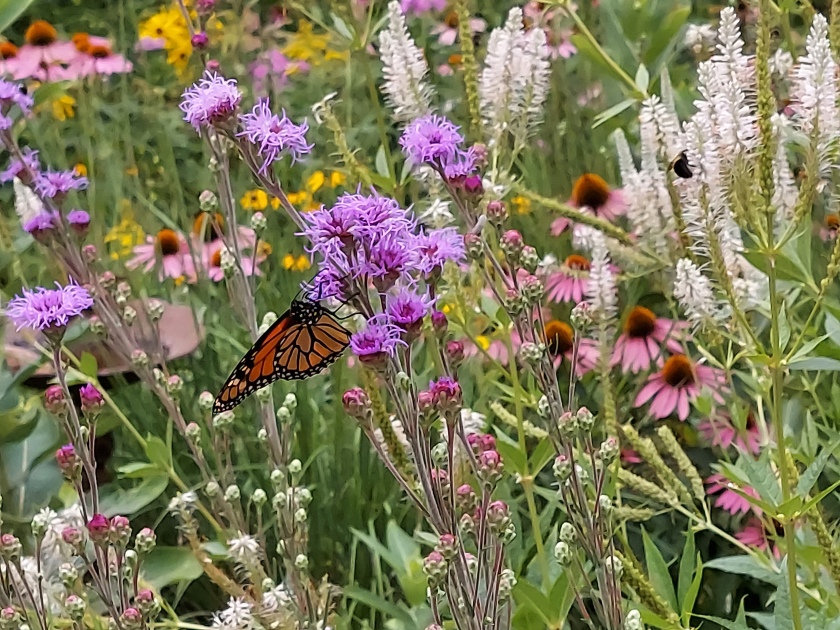
This mix of native plants attracts bees, butterflies, and singing birds.

Bee balm is one of the best plants for pollinators.

Pearly everlasting is a host plant for the painted lady butterfly. Picture of her catterpillar.

An unsung hero of the pollinator world.

June 19 to June 25, is pollinator week highlighting the importance of pollinators to our world and our survival. Drought, floods, storms, chemicals and loss of habitat are hard on our pollinators, and there are things we can do to ensure their survival.

Pollinators bring me joy and I can’t imagine a world without butterflies, dragonflies, hummingbirds and beautiful singing birds. Take time this week to think about what you can do to help the pollinators of our world. Maybe decide to stop putting chemicals on your yard, plant some native plants, or take out some grass lawn for more garden.

This Pollinator Week is emphasizing the connections between climate and pollinators. Pollinators are dying because their food and homes are disappearing, diseases have increased, and rising temperatures and natural disasters are affecting their ability to survive – all of which are related to climate change. At the same time, the conservation of pollinators and their habitats can help combat climate change by supporting healthy ecosystems, air, soil, water, and plants. Combined, these results make planet earth a safer place for us to live. These are big problems and the efforts that are made around North America and globally during Pollinator Week can help provide real solutions for the pollinators we all love. https://pollinator.org/pollinator-week

https://journeynorth.org/pollintorpatches/featured/06142023-2023-national-pollinator-week

4 steps to help bring back pollinators: https://www.xerces.org/bring-back-the-pollinators

https://www.audubon.org/native-plants

**Juneteenth is the “longest-running African-American holiday,” and it recognizes June 19, 1865, as the date that news of slavery’s end reached slaves in Texas and other states in the southwest—formalizing their emancipation after the end of the Civil War a month earlier. It also came two years after President Abraham Lincoln signed the Emancipation Proclamation.

A Lot to Celebrate!

A Juneteenth holiday weekend, pollinator week, the longest day/summer, and Father’s Day, a lot to celebrate! Enjoy this historic weekend by planting a native tree or plant in honor of the slaves that helped build our country, the beginning of summer, and your dad. Happy Pollinator Week! Happy Juneteenth!

Plant native plants and trees.

This is National Pollinator Week.

What are pollinators? Pollination occurs when pollen is moved within flowers or carried from flower to flower by pollinating animals such as birds, bees, bats, butterflies, moths, beetles, or other animals, or by the wind.

Pollinators are essential to our environment.  They are necessary for most of the world’s flowering plants and crops. Habitat loss, pesticide use, and introduced diseases are taking an enormous toll on our pollinators.

Agriculture, land development, mowing and chemicals to reduce weed and insects have resulted in loss of habitat loss for our pollinators. These essential pollinators are necessary for most of the world’s flowering plants and crops.

Urban areas are food desserts for pollinators. Turf lawns and hostas contribute to these urban food desserts. My yard is full of plants for bees, birds and butterflies, but I’m surrounded by too much treated turf grass.  I encourage everyone to help pollinators by creating and maintaining native habitat to help bees, birds and butterflies. Native plants and native trees are excellent choices for pollinators. Their deep roots keep them surviving during droughts and heavy rains. Dig out some hostas or grass and plant something helpful to our earth. See suggestion in reading list.

This is an exciting new holiday weekend, in recognition of the day 156 years ago when the enslaved people of Texas were finally met with the far overdue promise of freedom. Juneteenth | History, Meaning, Flag, Importance, & Facts | Britannica

Our new United States holiday!

Reading List:

https://www.ecowatch.com/lawns-must-die-2653462778.html

Pollinator Supportive Trees – Michigan Pollinator Initiative (msu.edu)  

TreesShrubsPoster.indd (msu.edu) 

Trees for Bees and Other Pollinatorss – The Arbor Day Foundation

Pollinator Conservation Resource Center | Xerces Society

The Xerces Society for Invertebrate Conservation 

Some Minnesota dragonflies are peaking – StarTribune.com 

Attract Birds: A Dozen Native Trees and Shrubs that Birds Love (abcbirds.org) “Every single person who owns a piece of property of any size can make a difference. They can begin by removing non-native plant species on their land and replacing them with natives. Why native plants? Native plants are important for many reasons, but they are essential as virtually the only hosts for many native insects. Insects are essential food for many birds, particularly nesting songbirds. … A small yard, even in the heart of a city, can provide these crucial sites.”

Twelve spotted skimmer