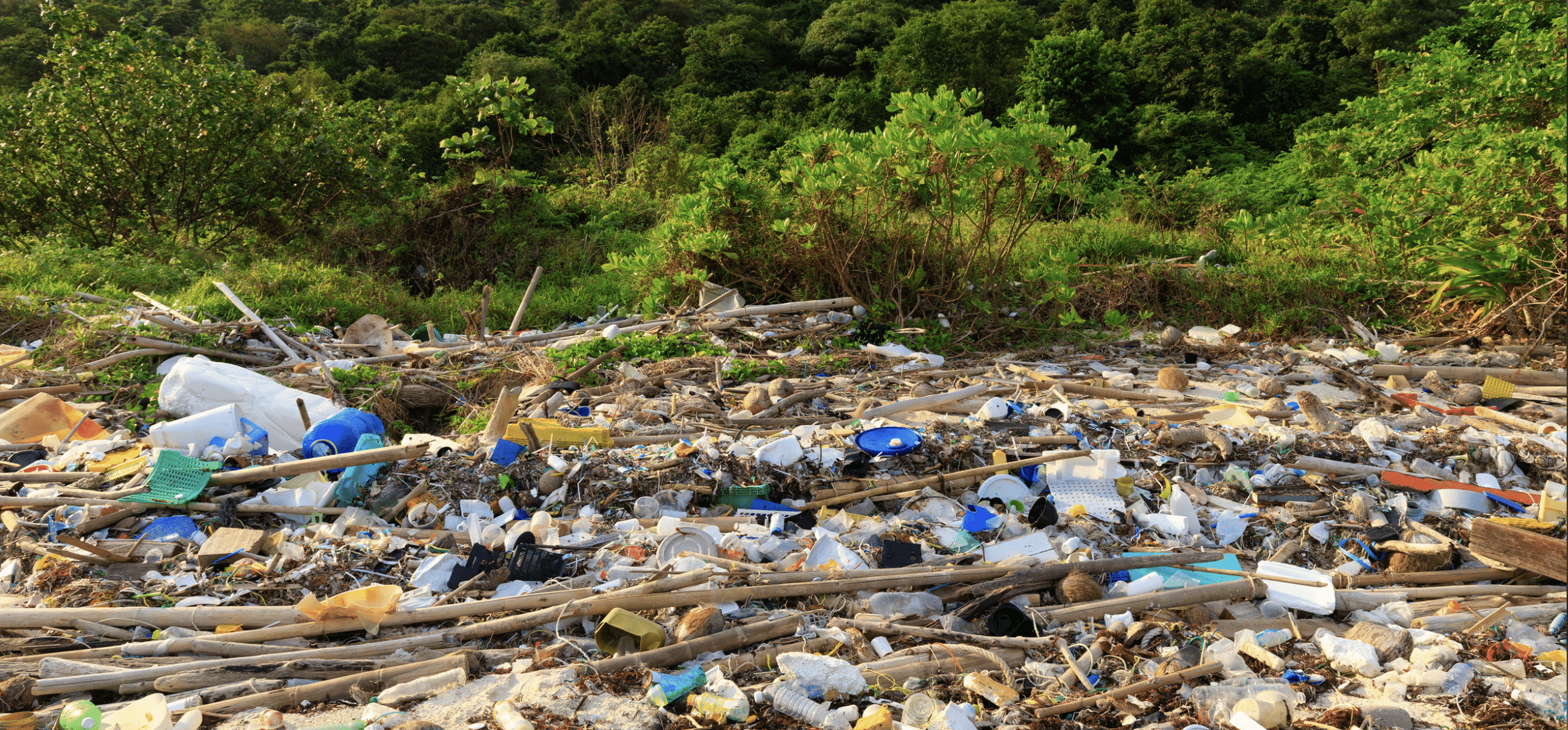
From busy city streets to remote coastlines, waste is piling up faster than we can manage. Each year, the world produces more than two billion tons of household waste, a number expected to nearly double by 2050. The impacts of waste are not shared equally: marginalized communities are often located near landfills, incinerators, and toxic dumping sites, while high-income countries export waste to nations with fewer resources, deepening global environmental injustice.
❝
There is no such thing as ‘away’. When we throw anything away, it must go somewhere.“
– Annie Leonard, Environmental Activist and Strategist
Plastics are among the most harmful forms of waste. Despite decades of recycling efforts, only about nine percent of all plastic ever produced has been recycled. The rest is buried, burned, or broken down into microplastics that infiltrate food, water, air, and even human bloodstreams. These particles persist for centuries, releasing toxins, disrupting ecosystems, and threatening human health.
I challenge you to reduce your trash. The easiest way is to eliminate single use plastic–No plastic bags, No plastic cups, utensils, straws or pouches. Good Luck!
Contrast President Lyndon Johnson with the current administration. Wow! This Heather Cox Richardson essay documents a speech given by Johnson to graduates of the University of Michigan.
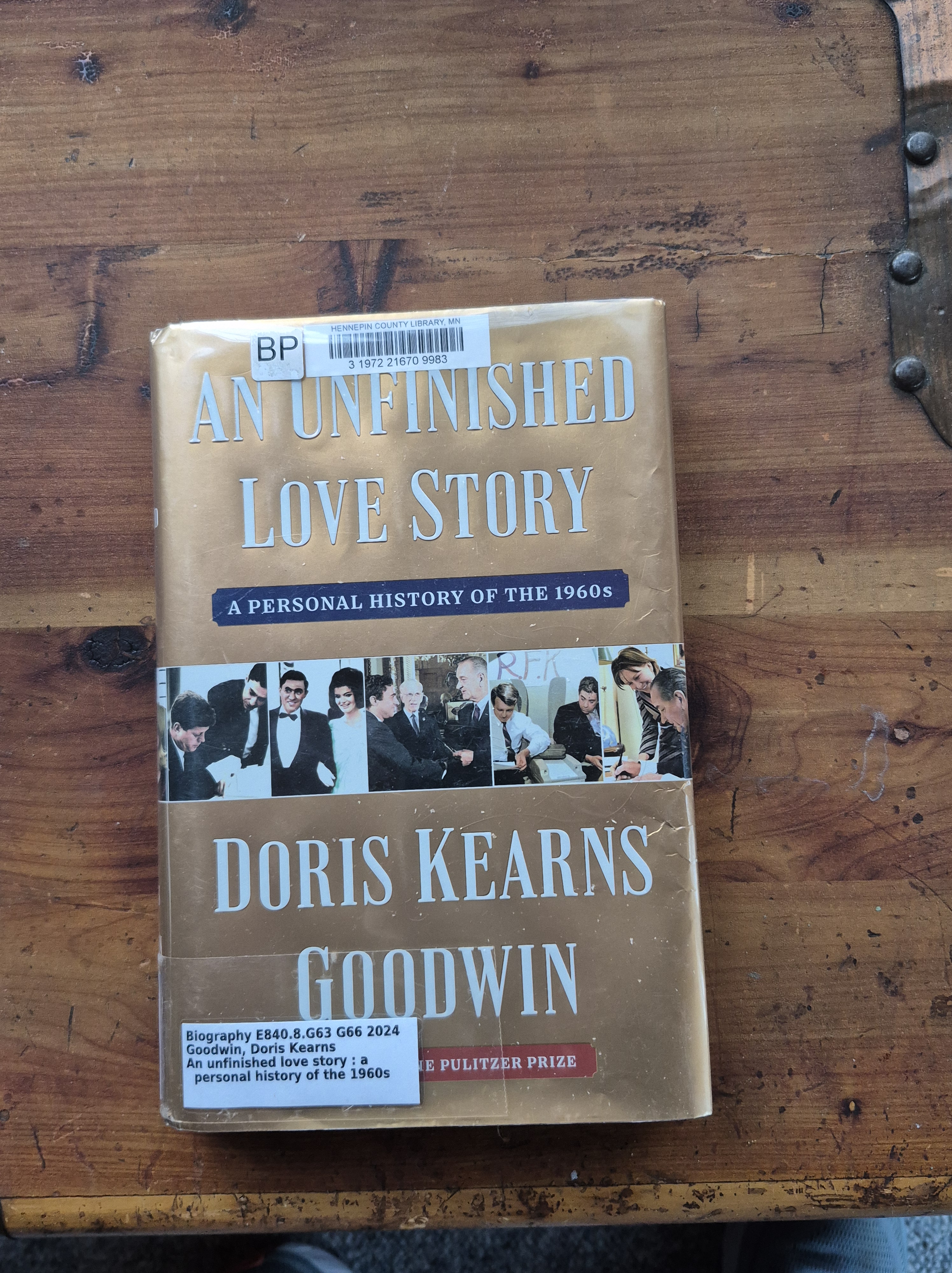
I have just finished reading, An Unfinished Love Story by Doris Kernes Goodwin. Like Richardson, Goodwin is documenting working for President Johnson, and the 1960’s, using the notes and artifacts from her deceased husband’s boxes. You will love this read.
From Heather Cox Richardson
“On May 22, 1964, in a graduation speech at the University of Michigan, President Lyndon Johnson put a name to a new vision for the United States. He called it “the Great Society” and laid out the vision of a country that did not confine itself to making money, but rather used its post–World War II prosperity to “enrich and elevate our national life.” That Great Society would demand an end to poverty and racial injustice.
But it would do more than that, he promised: it would enable every child to learn and grow, and it would create a society where people would use their leisure time to build and reflect, where cities would not just answer physical needs and the demands of commerce, but would also serve “the desire for beauty and the hunger for community.” It would protect the natural world and would be “a place where men are more concerned with the quality of their goals than the quantity of their goods.”
“But most of all,” he said, it would look forward. “[T]he Great Society is not a safe harbor, a resting place, a final objective, a finished work. It is a challenge constantly renewed, beckoning us toward a destiny where the meaning of our lives matches the marvelous products of our labor.”
Johnson proposed rebuilding the cities, protecting the countryside, and investing in education to set “every young mind…free to scan the farthest reaches of thought and imagination.” He admitted that the government did not have the answers to addressing all of the problems in the country. “But I do promise this,” he said. “We are going to assemble the best thought and the broadest knowledge from all over the world to find those answers for America. I intend to establish working groups to prepare a series of White House conferences and meetings—on the cities, on natural beauty, on the quality of education, and on other emerging challenges. And from these meetings and from this inspiration and from these studies we will begin to set our course toward the Great Society.”
Johnson’s vision of a Great Society came from a very different place than the reworking of society launched by his predecessor Franklin D. Roosevelt in the 1930s. Roosevelt’s New Deal had used the federal government to address the greatest economic crisis in U.S. history, leveling the playing field between workers and employers to enable workingmen to support their families. Johnson, in contrast, was operating in a country that was enjoying record growth. Far from simply saving the country, he could afford to direct it toward greater things.
Immediately, the administration turned to addressing issues of civil rights and poverty. Under Johnson’s pressure, Congress passed the Civil Rights Act of 1964, prohibiting voting, employment, or educational discrimination based on race, religion, sex, or national origin. Johnson also won passage of the Economic Opportunity Act of 1964, which created an Office of Economic Opportunity that would oversee a whole series of antipoverty programs, and of the Food Stamp Act, which helped people who didn’t make a lot of money buy food.
When Republicans ran Arizona senator Barry Goldwater for president in 1964, calling for rolling back business regulation and civil rights to the years before the New Deal, voters who quite liked the new system gave Democrats such a strong majority in Congress that Johnson and the Democrats were able to pass 84 new laws to put the Great Society into place.
They cemented civil rights with the 1965 Voting Rights Act protecting minority voting, created jobs in Appalachia, and established job-training and community development programs. The Elementary and Secondary Education Act of 1965 gave federal aid to public schools and established the Head Start program to provide comprehensive early education for low-income children. The Higher Education Act of 1965 increased federal investment in universities and provided scholarships and low-interest loans to students.
The Social Security Act of 1965 created Medicare, which provided health insurance for Americans over 65, and Medicaid, which helped cover healthcare costs for folks with limited incomes. Congress advanced the war on poverty by increasing welfare payments and subsidizing rent for low-income families.
Congress took on the rights of consumers with new protective legislation that required cigarettes and other dangerous products to carry warning labels, required products to carry labels identifying the manufacturer, and required lenders to disclose the full cost of finance charges in loans. Congress also passed legislation protecting the environment, including the Water Quality Act of 1965 that established federal standards for water quality.
But the government did not simply address poverty. Congress also spoke to Johnson’s aspirations for beauty and purpose when it created the National Foundation on the Arts and Humanities. This law created both the National Endowment for the Arts and the National Endowment for the Humanities to make sure the era’s emphasis on science didn’t endanger the humanities. In 1967 it would also establish the Corporation for Public Broadcasting, followed in 1969 by National Public Radio.
“For better or worse,” Johnson told the University of Michigan graduates in 1964, “your generation has been appointed by history to deal with those problems and to lead America toward a new age. You have the chance never before afforded to any people in any age. You can help build a society where the demands of morality, and the needs of the spirit, can be realized in the life of the Nation.
“So, will you join in the battle to give every citizen the full equality which God enjoins and the law requires, whatever his belief, or race, or the color of his skin?” he asked.
“Will you join in the battle to give every citizen an escape from the crushing weight of poverty?…”
“There are those timid souls who say this battle cannot be won; that we are condemned to a soulless wealth. I do not agree. We have the power to shape the civilization that we want. But we need your will, your labor, your hearts, if we are to build that kind of society.”
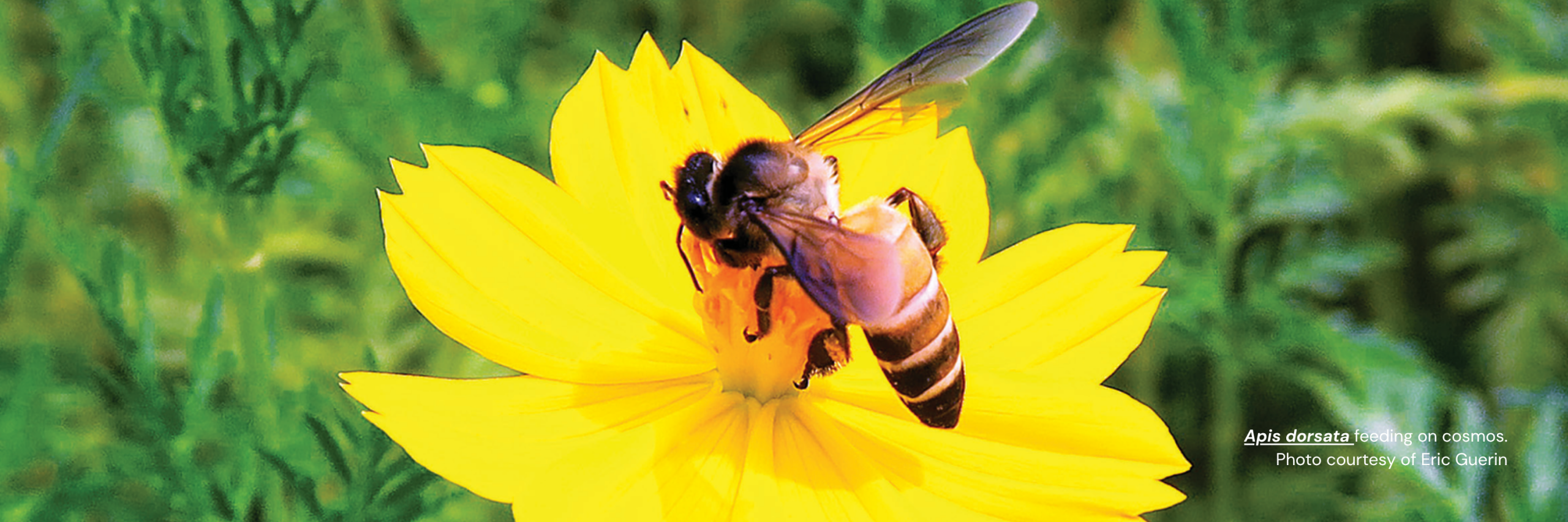
Bees are important to our food production. Protect them!
I hate chemicals. Corporations have gotten away with poisoning our Earth and our food. I suspect many cereal companies are the same. We need to purchase organic cereal in bulk at your local food coop. I think you will save money and also avoid the harmful chemicals, and best of all, you don’t expose your family to plastic.
Pesticides kill our bees, birds, butterflies and us too!
Below is from Organic Consumers Association:
General Mills’ Broken Pesticide Promises
General Mills is a bastion of ultra-processed, genetically modified foods, but it’s always found ways to make it look like it’s part of the regenerative organic movement.
Its worst greenwashing was when it used its Honey Nut Cheerios brand for a Bring Back the Bees campaign – never mentioning that glyphosate and chlormequat, pesticides used to harvest the cereal’s oats, were implicated in Colony Collapse Disorder.
In 2016, General Mills announced a partnership with Organic Valley to expand its organic yogurt offerings by transitioning dairy farmers to organic. In 2025, it sold its yogurt division. Its organic lines were dropped—along with its organic farmers.
In 2019, General Mills announced it had put “strategies in place to reduce synthetic pesticide use,” but that didn’t stop the company from selling pesticide-soaked breakfast cereals. Worryingly, one of its organic cereals was contaminated with chlormequat, suggesting that General Mills may be buying fraudulent organic oats from overseas.
The latest news is that General Mills has abandoned its commitment to reduce pesticides.
We can’t let this slide. It isn’t okay for a company to lure its customers with false promises it’s never going to deliver on.
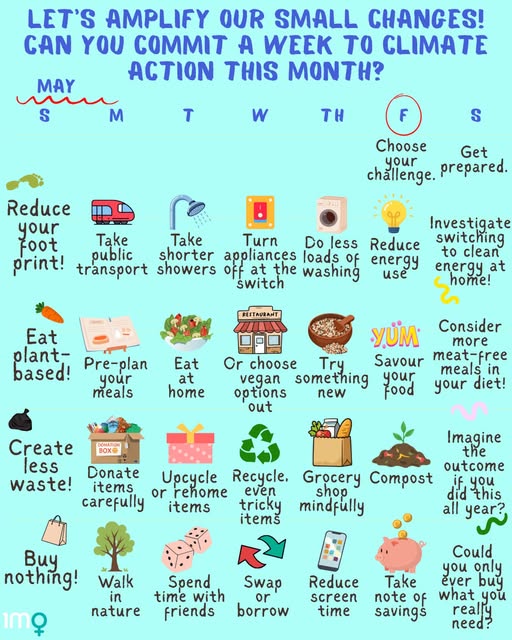
Choose your climate challenge for the month of May. They left out plastic reduction which is also important. Plastic reduction should fit into every week
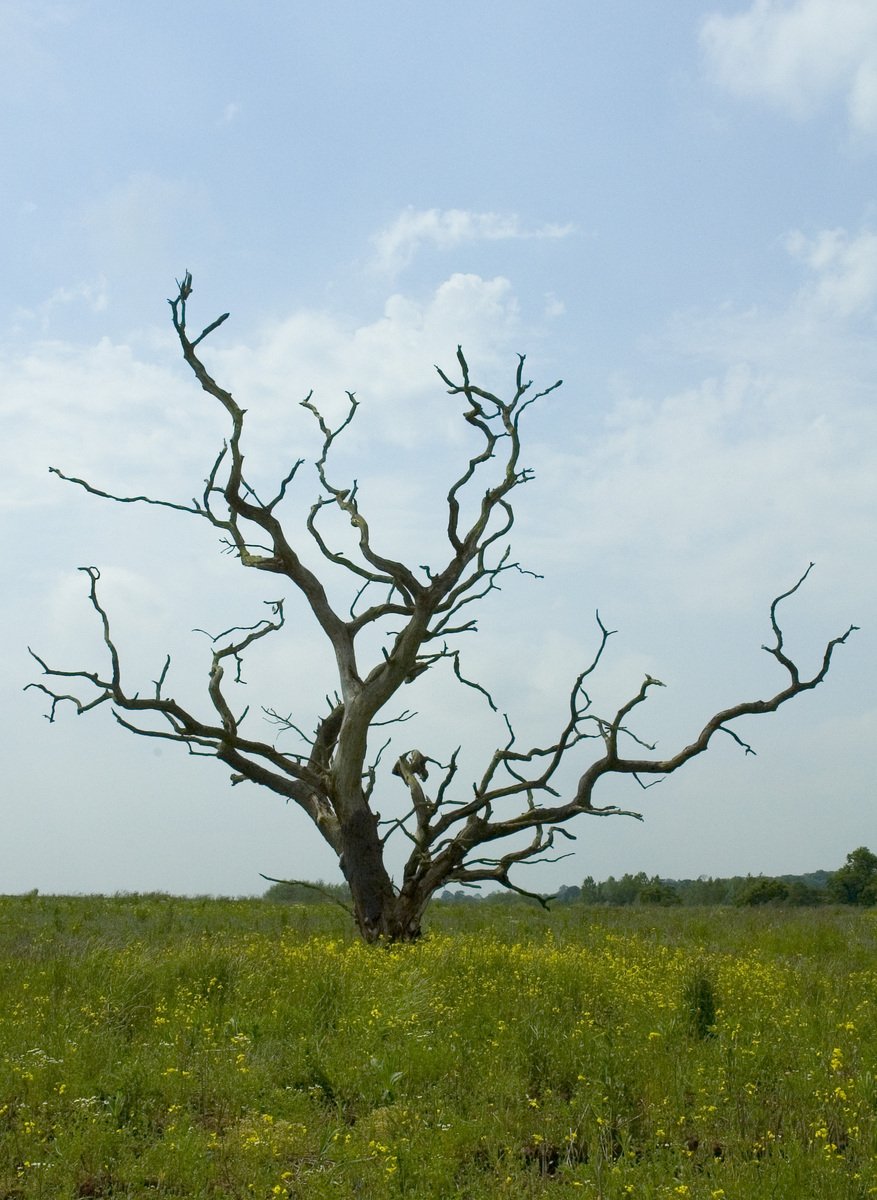
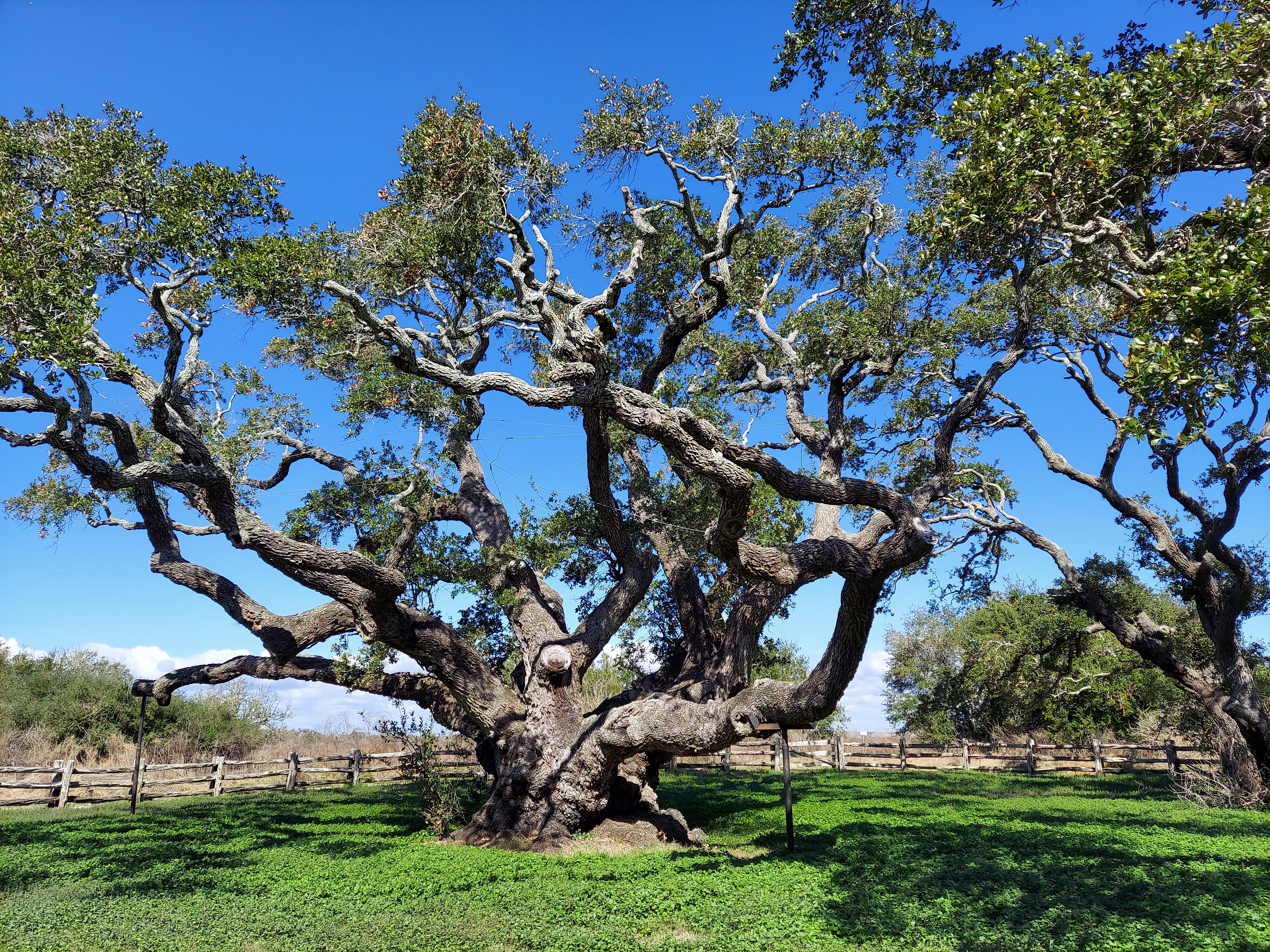
Below is a beautiful story about loving trees. How is your favorite tree? Go say hello to it today.
By Kate Morgan
“We take care of things when we have a relationship with them, If you get to know the nature around you, then you value it, and you nurture it, and you protect it.”
RJ Laverne’s childhood home in Detroit had a big elm out front. In fact, the whole neighborhood was lined with them: great, graceful trees whose branches spread across the street to create a shady canopy. Elms were so widely planted in cities and suburbs in the 19th and 20th centuries that they became known as the “Main Street tree.” Then, in the 1930s, Dutch elm disease began to ravage them, and by 1989, most of America’s 77 million mature elms were dead.
Laverne’s elm and its demise remain seared into his memory decades later. “I was maybe 8,” he says, “and I remember standing at the front door next to my sister when the trucks came down the street and cut down the elm trees one by one. When they cut ours, it felt similar to losing a pet. I imagine I was not the only person that grieved to see our neighborhood transformed from this beautiful cathedral of trees to clear cut.”
It was the first tree he loved, but certainly not the last for Laverne, who is a master arborist, an adjunct associate professor of forestry at Michigan Tech, and manager of education and training for Davey Tree Expert Company.
Many of us have loved a tree. Maybe it’s the big sycamore that held a tree house behind your childhood home. Maybe it’s the spruce that waves outside the window of your office, or the maple on the corner near your town’s post office.
I adored a huge fir in the corner of my cousins’ yard in New Jersey, with lower boughs that bent all the way to the ground and formed a sticky, fragrant fort at the trunk. Every day, my daughter greets a trio of towering oaks in our front yard that she lovingly calls “the mama trees.”
It’s not all that unusual to feel a particular bond with a specific tree. In fact, researchers in Finland found that the majority of respondents to a survey did in fact have a favorite. It’s also not unusual, says Laverne, for that bond to feel a lot like friendship. We form interspecies relationships, he points out, with our pets. So why not plants?
In most cases, when we think about a friendship, it’s a symbiotic relationship and both parties are actively involved,” he says. Trees might not respond to us the way a dog or cat would, but “we can form a symbiotic relationship with them nevertheless,” Laverne says, “if we understand all of what they provide for us. Not just the wood, but the shade, the wind-shielding. They take pollutants from the air, reduce stormwater runoff. There’s a huge list.”
While those are all good reasons to appreciate trees, Laverne adds, “you’re not going to fall in love with a tree because it’s sequestering carbon.” But there are other, perhaps slightly more intangible, reasons you might.
In the Finnish study, University of Turku researcher Kaisa Vainio and her colleagues identified three main types of human-tree relationships. The first was centered on nostalgia: People recalled trees from their childhood memories, or felt a familial connection. “It’s a custom here, and in many places in the world, that you plant a tree when somebody has been born,” Vainio says. “You see it grow, and it’s mirroring your own growth, which creates a bond. That relationship is not just between yourself and the tree, but maybe with your grandmother who planted the tree, and her grandmother who planted one before her.”
Others in Vainio’s study chose their favorite tree based on what she calls a nurturing relationship. People felt close to trees that they had planted or were directly responsible caring for.
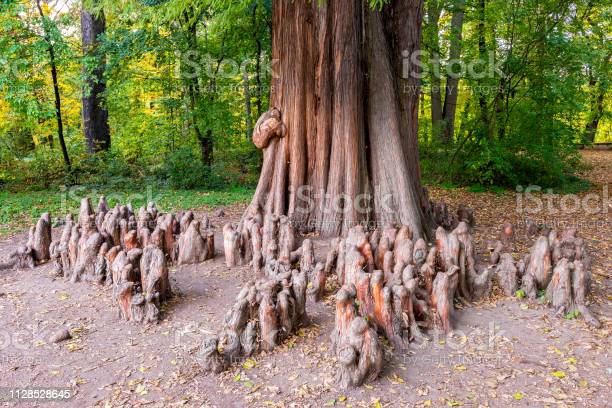
The third category, which she calls admiring relationships, involves “charismatic trees,” she says. “You probably know one. They are somehow impressive — maybe weird-shaped, really old, very big. They can be monuments or have some special status, or be a rare species.”
But a tree needn’t be so singular to become beloved. In many cases, Vainio says, a “favorite” is just a “really ordinary looking tree that is important to somebody, because it’s the tree they share their everyday life with.”
How to befriend a tree There can be a lot of benefit to getting to know the trees in your yard or along your commute, says Holly Worton, a naturalist and author of the book “If Trees Could Talk,” but first you have to realize they’re there.
A lot of people think of them as inanimate objects,” she says, “even though obviously they’re alive. But they’re just standing there, so I think they’re so unlike other living creatures that it’s easy to think of them as, basically, outdoor furniture.”
Worton believes trees can communicate with her — and with anyone else open-minded enough to converse with them — telepathically. In addition to factual information about a number of tree species, her book also includes their advice for life, delivered, she says, in their own words. A Norway maple suggests she should stretch her comfort zone by spending time in the woods relaxing with her eyes closed. An ancient yew suggests that she might benefit from spontaneity, and stepping off the path.
Other trees tell her stories. An English oak, one of the last old-growth trees in a stand of young pines, describes seeing his neighbors cut down with chainsaws. “For some reason they let me stay,” Worton writes that the oak said. “They cut down the trees all around me — my network, my family — and planted these evergreens, the ancestors of those which you see today. The diversity of our community was gone.”
Laverne talks to trees, too (though he doesn’t expect them to respond), and he encourages his students at Michigan Tech to do the same. In his forestry courses, one assignment asks students to “interview” a tree, and Laverne provides a guide for how to do so.
“You go out, find a tree and introduce yourself out loud,” he says. “It might feel funny, but it’s really more an acknowledgment to yourself that you’re approaching another living organism. That opens the door to your imagination. Now, they’re not going to talk back, but a tree can still tell you things.”
He instructs his students to examine the details of the tree, feeling the bark and examining the foliage. “The most important part is to give yourself 10 minutes of silence with your tree,” he says. “Sit down, close your eyes and get as many thoughts out of your brain as you can. Listen to what’s happening in and around the tree. You’re going to hear birds. You’re going to hear wind going through the leaves. You may even hear some of the branches clattering around.” Laverne says he wants the students to become familiar with the tree and the environment in ways they weren’t before.
A connection to one particular tree can become a long-term relationship, Vainio says. In her study, more than 40 percent of respondents said their attachment to a favorite tree had lasted several years, and close to a quarter said they’d loved their tree for decades or even for their entire life. But like any lifelong relationship, there’s always a chance that things end in tragedy. When our favorite trees die, either of natural causes or by chainsaw, it’s typical to feel a real kind of grief.
In 2023, when the centuries-old Sycamore Gap tree in Northumberland, England was cut down by vandals, there was an international outpouring of anger and grief. And people will go to great lengths to try to save trees. “Any time one has to be removed in Central Park, they put notices up months in advance to try to ease the pressure,” Laverne says. “But people will still chain themselves to the trees to try to stop it.”
Worton, who has written about tree grief on her blog, often hears from readers mourning the loss of a tree, “whether it’s one they’ve had to cut down because of some kind of illness, or one the city has come and cut down,” she says. “That seems to be the worst kind of scenario, where people have this beloved tree and they show up one day and it’s a stump. That’s really difficult for people to deal with.”
Don’t miss the trees for the forest Feeling a particular kinship with a tree, Vainio says, isn’t whimsical or eccentric. It’s actually a lot more normal than you’d think.
“It’s not only weird people who have a tree friend,” she says. “In our survey, we saw that people of all ages, genders and professions can have an emotional connection with a special tree. We have this culture that sometimes says if you talk about trees this way, you’re a ‘tree hugger,’ which is somehow bad. But you can be a normal person and have a good relationship with your tree, and that’s not a fairy tale, and it doesn’t require you to believe anything weird to have this connection.”
Laverne’s goal in asking his students — and anyone else who’s willing — to “introduce themselves and start a conversation” with a tree is simply to encourage them to look closer, and to see each tree as an individual living creature.
“That familiar phrase, ‘You can’t see the forest for the trees,’ we can flip that around,” he says. “When they’re clustered together, sometimes you don’t see them as individuals.” But getting to know one tree at a time can help you see each as its own organism, rather than just scenery. And developing an emotional connection can be a shortcut to better environmental stewardship.
“We take care of things when we have a relationship with them,” Vainio says. “If you get to know the nature around you, then you value it, and you nurture it, and you protect it.”
Kate Morgan is a freelance writer in Richland, Pennsylvania.
Preserve and cherish the pale blue dot, the only home we have ever known! Carl Sagan
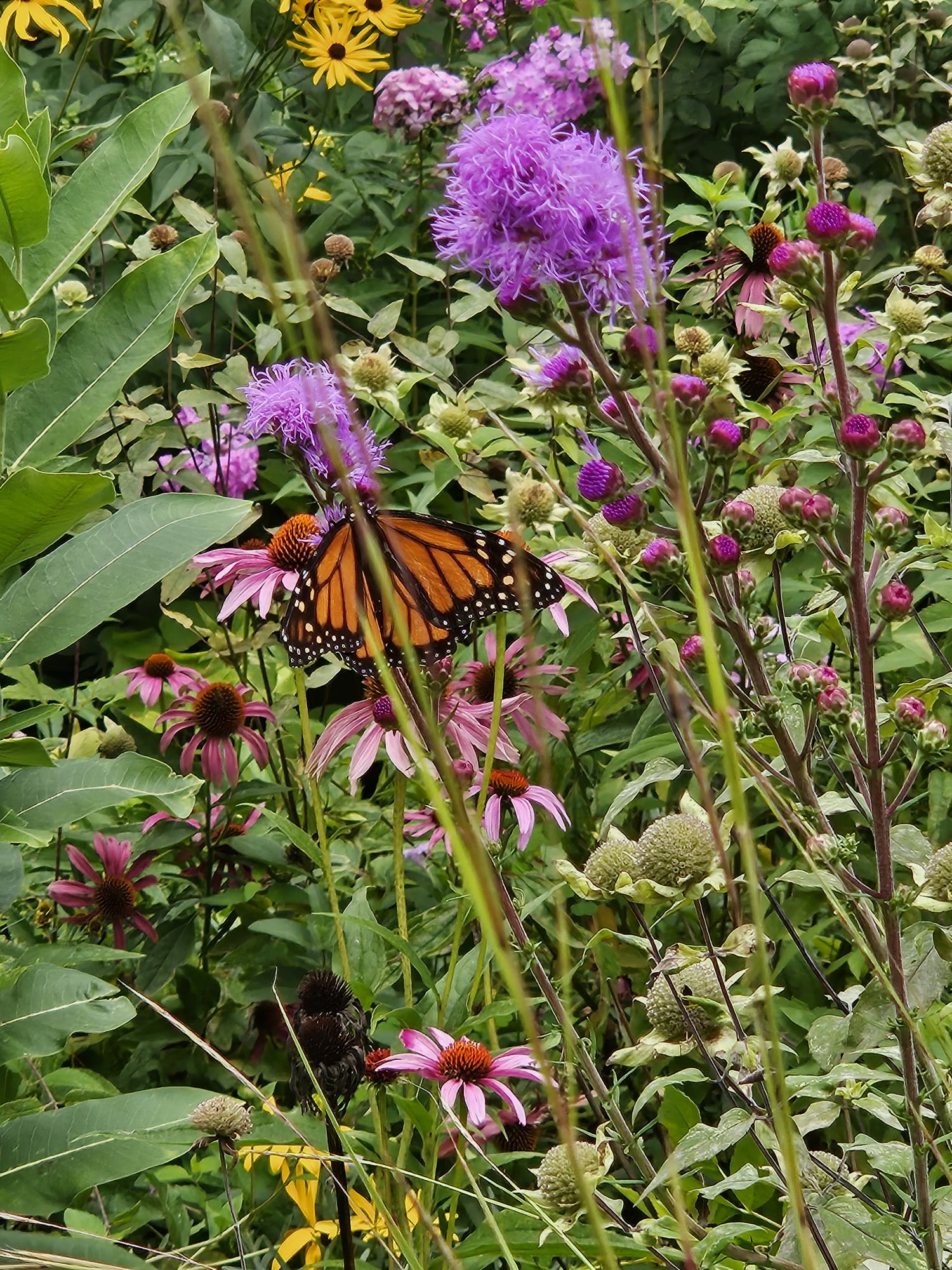
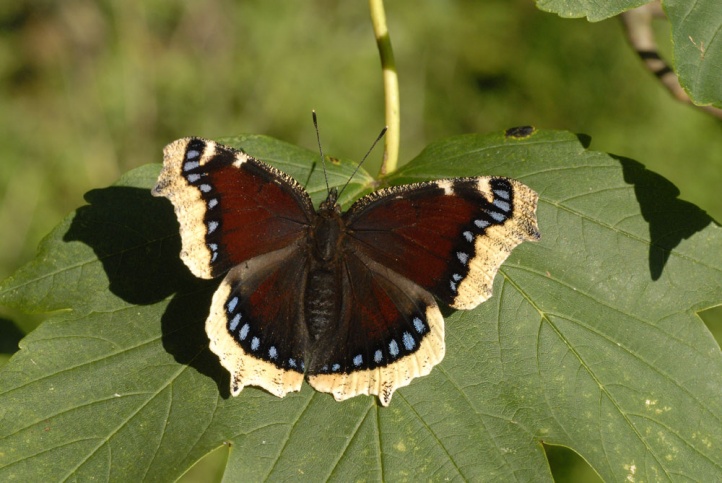
Can’t wait to see the first butterfly. This is the mourning cloak, usually the earliest butterfly
Be kind to our Earth and to all people and all life!
Yay, April, the best month of the year. It is a month of Hope and Joy. It is Earth Month, calling us to action to protect our Earth. It is native plant month and Arbor Day and Earth Day. It is a month to watch for migrating birds, clean up our yard and finally ride our bikes. April is a month to spend outside!
The theme for this year’s Earth Day is ‘Our Power, Our Planet’. This theme is a reminder that we all have the power to make a difference where we live and work.
Unfortunately, my country is at war. We need to be concerned and speak out against killing people, wasting money, and harming our earth, but we can’t allow a few silly men to destroy our joy.
More than ever we all need to make a difference. ‘Our Power, Our Planet’ is Earth Days’s theme, get put there and make a difference.
Every day I spend time outside; I look for new spring happenings, I look for new buds, new birds, new sounds, and new life. I focus on what is joyful and good and spend time with good people. I work daily on reducing the plastic we use in our home, we drive minimally, clean storm drains, and strive for creating zero waste.
What is good today? The New York Times has a new, “Look for the Good newsletter sign up to get next week’s sent to your inbox.
Important: The Earth is not merely a resource to be exploited; it is sacred ground, our shared home. What we do to the Earth, we do to ourselves and to all of those who come after us. What exactly do religions teach us about Earth Stewardship? Read more: https://www.plasticpollutioncoalition.org/…/sacred…
Be kind, be safe and enjoy your time outside. And remember, what is good? PEACE on EARTH
If you’re coming to Minnesota, wears some flowers in your hair!
An English family, the Marsh Family, wrote a song for Minnesota. See them sing below. Thank you for the support. People living in Minnesota are being attacked by their own government. The number one job of government is to keep people safe. What is going on?
A terrible situation in my city. Speak out for our democracy!
Lyrics to ‘Streets of Minneapolis’
Through the winter’s ice and cold Down Nicollet Avenue A city aflame fought fire and ice ‘Neath an occupier’s boots King Trump’s private army from the DHS Guns belted to their coats Came to Minneapolis to enforce the law Or so their story goes Against smoke and rubber bullets By the dawn’s early light Citizens stood for justice Their voices ringing through the night And there were bloody footprints Where mercy should have stood And two dead left to die on snow-filled streets Alex Pretti and Renee Good
Oh our Minneapolis, I hear your voice Singing through the bloody mist We’ll take our stand for this land And the stranger in our midst Here in our home they killed and roamed In the winter of ’26 We’ll remember the names of those who died On the streets of Minneapolis
Trump’s federal thugs beat up on His face and his chest Then we heard the gunshots And Alex Pretti lay in the snow, dead Their claim was self defense, sir Just don’t believe your eyes It’s our blood and bones And these whistles and phones Against Miller and Noem’s dirty lies
Oh our Minneapolis, I hear your voice Crying through the bloody mist We’ll remember the names of those who died On the streets of Minneapolis
Now they say they’re here to uphold the law But they trample on our rights If your skin is black or brown my friend You can be questioned or deported on sight
In chants of ICE out now Our city’s heart and soul persists Through broken glass and bloody tears On the streets of Minneapolis
Oh our Minneapolis, I hear your voice Singing through the bloody mist Here in our home they killed and roamed In the winter of ’26 We’ll take our stand for this land And the stranger in our midst We’ll remember the names of those who died On the streets of Minneapolis We’ll remember the names of those who died On the streets of Minneapolis
Lyrics to ‘Streets of Minneapolis’
Through the winter’s ice and cold Down Nicollet Avenue A city aflame fought fire and ice ‘Neath an occupier’s boots King Trump’s private army from the DHS Guns belted to their coats Came to Minneapolis to enforce the law Or so their story goes Against smoke and rubber bullets By the dawn’s early light Citizens stood for justice Their voices ringing through the night And there were bloody footprints Where mercy should have stood And two dead left to die on snow-filled streets Alex Pretti and Renee Good
Oh our Minneapolis, I hear your voice Singing through the bloody mist We’ll take our stand for this land And the stranger in our midst Here in our home they killed and roamed In the winter of ’26 We’ll remember the names of those who died On the streets of Minneapolis
Trump’s federal thugs beat up on His face and his chest Then we heard the gunshots And Alex Pretti lay in the snow, dead Their claim was self defense, sir Just don’t believe your eyes It’s our blood and bones And these whistles and phones Against Miller and Noem’s dirty lies
Oh our Minneapolis, I hear your voice Crying through the bloody mist We’ll remember the names of those who died On the streets of Minneapolis
Now they say they’re here to uphold the law But they trample on our rights If your skin is black or brown my friend You can be questioned or deported on sight
In chants of ICE out now Our city’s heart and soul persists Through broken glass and bloody tears On the streets of Minneapolis
Oh our Minneapolis, I hear your voice Singing through the bloody mist Here in our home they killed and roamed In the winter of ’26 We’ll take our stand for this land And the stranger in our midst We’ll remember the names of those who died On the streets of Minneapolis We’ll remember the names of those who died On the streets of Minneapolis
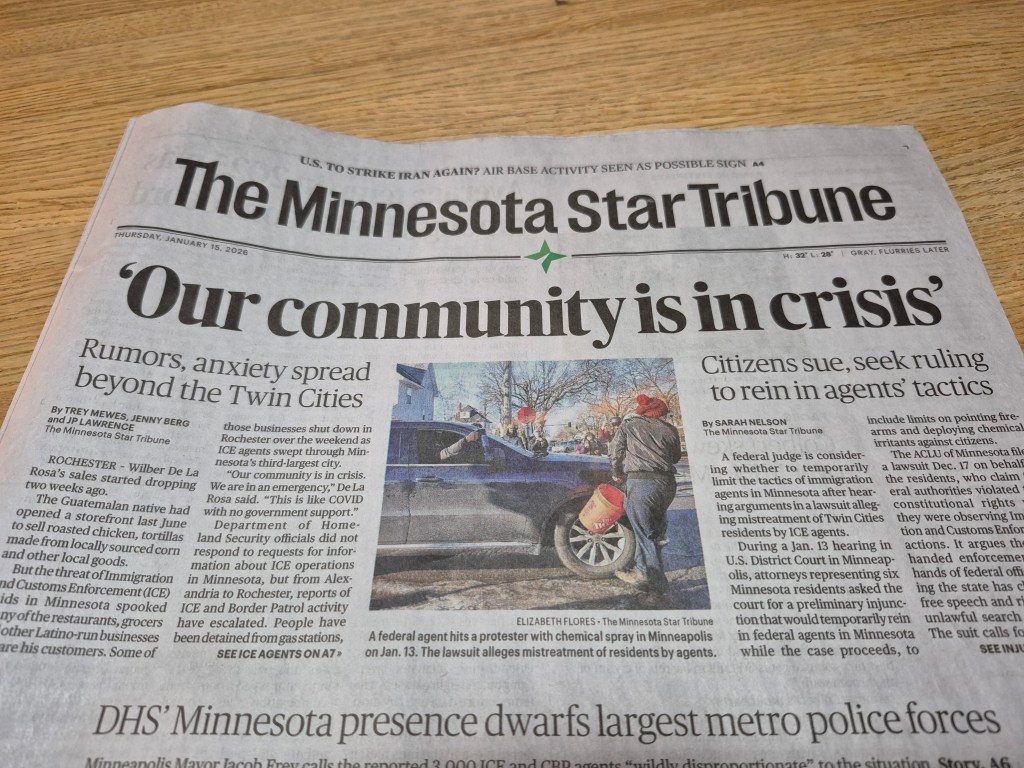
Our American government has created chaos and fear in Minneapolis and some parts of greater Minnesota. People living in the United States of America are disappearing.
My city is under seige from our own federal government. Our immigrants and people and children that aren’t white have gone into hiding. Last week students at one Minneapolis high school were pepper sprayed. Safety mandated our children not attend school, walk on the street or go to playgrounds. Many helpers are delivering food to families confined to their homes. Many helpers are also monitoring minority business and neighborhoods. doing what they can to keep everyone safe.
A city’s limit (From the New York Times) Minneapolis is on a knife’s edge. One week after a federal agent shot and killed Renee Good, aggressive arrests have enraged residents. The Trump administration has redoubled its effort to deport illegal immigrants, sending officers into residential neighborhoods and the parking lots of big-box stores in search of people to grab. They’ve also detained — and roughed up — several U.S. citizens, and social media is awash in viral videos of the confrontations.
Meanwhile, activists have sought to observe, document or impede the agents, Julie Bosman reports. On WhatsApp, neighbors watch out for immigration officers and run from their homes to shout at them. “It feels like our community is under siege by our own federal government,” State Representative Michael Howard, a Democrat, told The Times.
The encounters can be terrifying. My colleagues verified images circulating this week that show agents tackling a man at a gas station and shoving Elliott Payne, the president of the City Council. Payne told my colleagues that there were federal agents equipped with assault rifles and combat gear patrolling the streets, repeatedly unholstering their handguns. “It feels like a military occupation,” he said. Some of the stops go beyond ordinary law enforcement. In a few of the run-ins, you can feel the animosity building between federal officers and citizens they serve. One man The Times spoke to said he was glad that there were other people around to film his encounter with federal agents, which occurred after they rammed their car into his, forcing him to a stop.
He said he believed the presence of people with cameras had helped lead the agents to let him go. But as the crowd grew — the crowds always seem to grow now — and began to yell at the officers, he worried that the situation could tip over into something darker, something violent. “It makes them act different. NYT
Start the day with hope. Spring will come! Collective positive energy can make things better.
All people matter!
Embrace a new year and each new day with hope!
The road is before us! It is a new day, a new beginning, And it is filled with hope.” Walt Whitman
Start each day with hope!
2025 has been a hard year. Wars are raging, too many die from gun violence, democracy is threatened, ICE is threatening communities, climate change brings storms, fires, drought and flooding. But we must move forward toward a new world. Our mental health is so much better if we start each day with hope and positive energy to make things better.
Below is from the NYT today:
While optimism is the belief that the future will be better, hope is the belief “that we have the power to make it so,” said Chan Hellman, the director of The Hope Research Center at the University of Oklahoma. It is “one of the strongest predictors of well-being,” he said. It helps improve the immune system and aids recovery from illness. More hopeful people may actually grow taller than less hopeful people.
To cultivate hope, people need three things. They first need to be able to envision a better future, either personally or collectively. Second, they need the willpower or motivation to move toward that future. And third, they must be able to chart “a path from where they are to where they want to be,” he added.
How to be more hopeful There are a few ways, experts say.
People can set specific goals and then “begin brainstorming the pathways or road maps” to achieve them, ideally by writing them down, Hellman said. That can start small. “It is much better to set and focus on short-term goals rather than long-term, abstract goals,” he added.
That can often mean speaking more positively about other people. People gossip three times as much about the selfish things others do than about the generous things they do. To address that, an expert suggested “positive observation.” Share one story of something positive that you observed or did that day. The research finds that when you know you’re going to have to share something, you pay a lot more attention to it.
Lift every voice and sing Till earth and Heaven ring Ring with the harmonies of Liberty; Let our rejoicing rise, High as The list’ning skies, let it resound loud as the Rolling sea


 Read more: