I am at the Minnesota State Fair talking to individuals about rain gardens and native deep-rooted plants. Native plants help absorb pollutants, keep rain water in our yards, save on watering, and are loved by bees, butterflies and birds.
Plant deep-rooted plants for pollinators and clean water.
Love our lakes, rivers and streams. Take care of them!
My not so funny joke for Water Wednesday. A conversation I had this past week!
Friend: I hear Donald Trump has invested lots of money in bottle water.
Me: Why would he do that?
Friend: He wants to get rid of all regulation to protect our drinking water.
In contrast, Minnesota Governor Dayton has called for a Year of Water Action. He encourages all Minnesotans to take a role in protecting our state’s most precious resource for future generations. Read more about it here.
Deep rooted plants absorb run-off
What are you doing to protect our water resources? Reduce chemicals, sweep sidewalks and streets, install rain gardens, plant deep-rooted plants, stop building campfires, recycle and compost, clean off boats and equipment, What else?
“Today, Minnesota set the strongest rules in the nation to protect pollinators from pesticides,” said Lex Horan of Pesticide Action Network. “The plan will help ensure that bee-harming pesticides won’t be used unnecessarily, and it lays the groundwork for reducing the use of neonicotinoid seed coatings. This decision is rooted in the resounding scientific evidence that neonicotinoids are harmful to pollinators. It’s past time for state and federal decisionmakers to take action to restrict the use of bee-harming pesticides, and today Minnesota did just that.” Read the whole story here. Another story from Minnesota Public Radio.
Get in the habit of bringing your own bags shopping.
I do the majority of my grocery shopping at food coops, but when I visit regular grocery stores I am appalled by the number of plastic bags leaving with purchases. I know most them aren’t recycled. My city will put fees on some plastic bags in 2017, and I can’t wait!! It will be a fabulous education tool for many people!!
Below is from Earth911.com, and contains some information I didn’t know, how the below businesses have reduced plastic bags. Please shop retailers that protect our earth. I haven’t shopped at all these retailers so please let me know if this information is accurate???
From Earth911.com: “Did you know that studies have shown that about 12 million metric tons of plastic debris, including plastic bags, has accumulated in our oceans around the world? Due to this pollution, more than 100,000 marine animals die each year due to plastic entanglement! That is a startling number – and one that doesn’t show any signs of slowing its growth.” Read the entire article here.
These are the retailers to patronize!
Adidas
Ikea
COSCO, Sam’s Club, and BJ’s
Whole Foods
Local Coops Earth 911 gives a shout out to New Pioneer in Iowa City. I shopped there while traveling this summer and recommend shopping there if you are in Iowa City or traveling along Interstate 80 through Iowa.
Have you been caught in a record rain storm and flooding this summer? Chances are that most of us in the United States and Europe have experienced a heavier than normal rainfall. My travel this summer has brought me to see displaced people following storms (nothing like Louisiana or California). I have seen lakes created from heavy rain submerging homes, closed roads and bridges, yards with 20 uprooted trees, and experienced power outages.
What is going on with these storms? July 2016 was the hottest ever recorded since records started in 1880. As the earth warms, some places get dryer, but in other places the atmosphere is able to hold more moisture dumping larger amounts back to earth. Places in Louisiana received 31 inches of rain, unbelievable! I feel sad for everyone displaced from everything they own.
PBS had an interesting conversation about our weather extremes here. Is this all part of climate change?
There are consequences to our warming earth according to meteorologist Paul Douglas, “More moisture in the air, higher dew points and heat indexes, more thousand-year rains, wet basements with greater regularity, and more expensive insurance policies.”
Magnificent Lake Superior has over 300 rivers and streams that drain into it. Last week it was a brown lake because of mega rainfall in northern Minnesota, Wisconsin and Michigan where many rivers dumped sediment from the storms. I am on a road trip from Duluth, Minnesota along the south shore of Lake Superior to Sault Ste Marie and the St. Mary’s River. Canada is on the other side of the lake and across the St. Mary’s River.
An ore boat leaves Lake Superior on the St Mary’s. River headed toward Lake Huron
Even though 300 streams drain into the big lake only one, the St. Mary’s River, carries boats and water away from Lake Superior. The St. Mary’s River carries about 42 billion gallons of water from Lake Superior daily.
Lake Superior, looks browner than this picture below appears. I think the sun makes it look bluer than it is.
Is this how lakes should look? We all need to do better.
Minnesota, the land of “Sky Blue Waters” is adding more than 300 lakes, rivers and streams to its list of lakes and streams that are impaired. The story from MPR is here.
About two-thirds of Minnesota watersheds have been tested and 40 percent of Minnesota rivers and lakes have been found to be impaired by farm runoff, bacteria, mercury or other pollutants.
The below ideas for protecting our lakes is from the Superiorforum.org , Sigurd Olson Institute, Northland college, and the EPA, and Great Lakes Restoration Initiative:
1 .Be conservative with your water use.
2. Recycle as much as you can with the 4 Rs: reduce, reuse, recycle and repair. And….NEVER burn trash.
3. Curb Yard Pollution. Put your lawn on a chemical-free diet!!
4. Stop aquatic invasives by cleaning plants and animals off your boat.
5. Plant native plants, and reduce turf grass.
6. Plant native trees According to Audubon, oak trees are the best for attracting insects and birds.
7. Install a rain barrel
8. Create an energy-efficient home.
9. Bring hazardous waste to waste collection sites.
10. Love our lakes!
I would add several more:
1. Rain gardens are excellent for capturing harmful water runoff.
2. Keep leaves and trash out of streets and storm drains-Adopt a storm drain!
Love our lakes, rivers and streams. Take care of them!
3. Never use cleaning products or hand sanitizer with triclosan.
4. Reduce all plastic use–If you must use plastic bags and bottles, be sure you recycle them. 5. Pick up all liter.
It’s raining this week where I live. How can we use all this water rushing into the storm drains and at the same time improve the quality of the water runs from our roofs, sidewalks, driveways and streets? This water picks up many pollutants as it races to our lakes and rivers. There are things we can do to lessen this pollution such as sweeping our driveways and sidewalks and not using chemicals on our lawns. A good way to clean this polluted run-off is to direct the water into a garden, a rain garden. Today as it rains I can see the water rush into my rain gardens where my deep-rooted plants help clean this water as it drains into the earth below. This past week I have been part of a team that installed two rain gardens. Both gardens captured water that would run into the Mississippi River. We had fun, and were thrilled we helped to “plant for clean water.”
What is a rain garden?
The water that runs off our houses sidewalks, driveways and streets contains pollutants that run directly into our streams and lakes. A rain garden captures this water and the plants in the garden actually purify the water filtering out the pollutants. Like a friend said, “It’s like magic!”
An aspect of climate change is we can go for months without any precipitation then watch out…. inundation, too much rain. Rain gardens are a valuable tool to use and manage the water that falls on our properties. The plants should not need to be watered so we conserve water
Advantages of rain gardens:
1. They conserve water by managing rainfall
This is a narrow ditch for collecting run-off
2. Rain gardens filter out pollutants
3. Blooming plants add beauty to your yard
4. Rain gardens often use native plants that bees, birds and butterflies love.
Simple steps to creating a rain garden:
1. Remove the sod and dig a hole. It must be at least 10 feet from your house and where you can direct a drain-spout, driveway or sidewalk to drain rain water. Most rain garden holes are about 12 inches deep with wide 3 feet slanted sides surrounding the garden. The bottom of the garden should be flat.
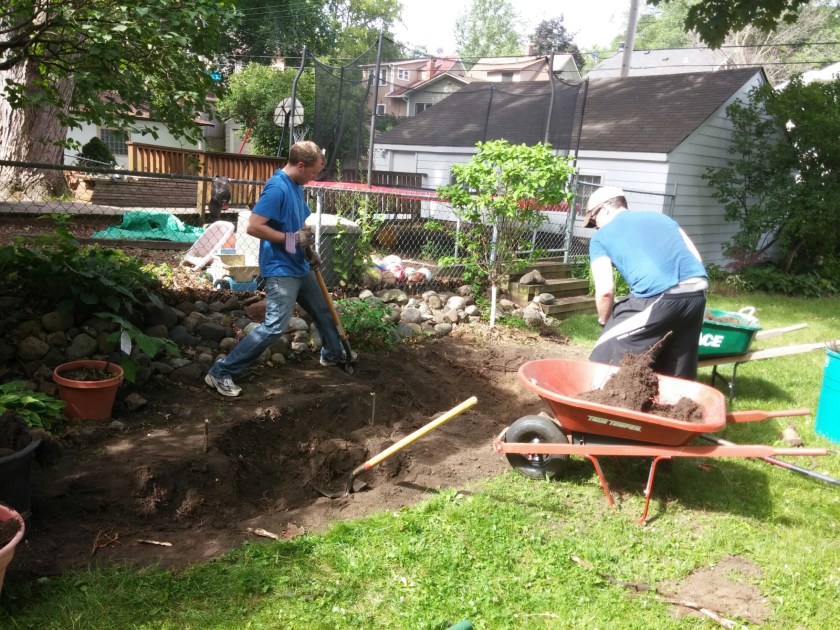
Digging the hole for the garden
2. Mix in about one inch of compost to the bottom and sides of your new garden
3. Cover the garden with a layer of several inches of double or triple shredded mulch.
Spreading the compost, next add the shredded mulch
4. Plant deep-rooted plants. Most of the plants you love will work matching the degree of sun and shade. Also, always work to have a variety of plants that bloom at different times for the bees and butterflies.The bottom plants need to be water tolerant. Some bottom plants I have used are: liatris, swamp milkweed, turtlehead, Culver’s root, blue flag iris, sensitive fern, cardinal-flower, blue lobelia and many kinds of sedges.
5.. Water–If it is dry, you need to water the new plants for the first couple of months.
Spring is slow to crawl out of winter next to the big lake, but early June brings hope that warmer weather and summer is coming.
Female American red start
The trees are filled with singing warblers, many are building nests, and a female red start has worked for days pulling threads from last years swamp milkweed stalks for her nest. It’s amazing how hard they work creating their nests!
Forget-me-nots and dandelions are the flowers the bees and butterflies depend on at this time, but the hummingbirds and bees attack each wild geranium flower that starts to bloom. Also, lupine is just beginning to bloom.
Carpets of bunch berries cover the forest floor
An American lady on a dandelion
Butterfly watching is at some of it’s best with the American Lady, Monarchs, tiger swallow-tail, spring azure, and dusty wings. What are your outside joys for June?
Wild geranium, easy to grow, is loved by bees and butterflies.
The below ideas for protecting our lakes is from the Superiorforum.org , Sigurd Olson Institute, Northland college, and the EPA, and Great Lakes Restoration Initiative:
1 .Be conservative with your water use.
2. Recycle as much as you can with the 4 Rs: reduce, reuse, recycle and repair. And….NEVER burn trash.
3. Curb Yard Pollution. Put your lawn on a chemical-free diet!!
4. Stop aquatic invasives by cleaning plants and animals off your boat.
5. Plant native plants, and reduce turf grass.
6. Plant native trees According to Audubon, oak trees are the best for attracting insects and birds.
7. Install a rain barrel
8. Create an energy-efficient home.
9. Bring hazardous waste to waste collection sites.
10. Love our lakes!
I would add several more:
1. Rain gardens are excellent for capturing harmful water runoff.
2. Keep leaves and trash out of streets and storm drains-Adopt a storm drain!
Love our lakes, rivers and streams. Take care of them!
3. Never use cleaning products or hand sanitizer with triclosan.
4. Reduce all plastic use–If you must use plastic bags and bottles, be sure you recycle them. 5. Pick up all liter.










 Health4earth