Is Air Pollution Bad for your Health?

970832_10153091136195497_1060532036_nToday I am commenting on two items that surprised me this week.

First, for a long time it has been said that bad air causes asthma and cancer. This week strokes have been added to this list! http://well.blogs.nytimes.com/2015/03/24/air-pollution-raises-stroke-risk/?_r=0

Two things that are terrible for air pollution in urban settings are idling your engines and outdoor fires!

Second, Dana Milbank in the http://www.Washingtonpost.com says that climate deniers are denying that they denied that climate change is happening. See below:
http://www.washingtonpost.com/opinions/climate-change-deniers-are-in-retreat/2015/04/06/942eb980-dc9f-11e4-be40-566e2653afe5_story.html?postshare=8431428889546576

What surprised you this week?


The Arctic is Unraveling.

618482main_earth1600_800-600

Did this cause the record snowfall in Boston?

Today’s news on the Arctic from the World Wildlife Fund:
In response to today’s news from the National Snow and Ice Data Center about record low winter sea ice extent, World Wildlife Fund released the following statement from Margaret Williams, managing director of Arctic programs.
“Today’s news is not only about record low levels of winter Arctic sea ice, it’s about the unraveling of the Arctic and the impact of climate change on the wildlife and people that call the region home.
“This is yet another signal that bold leadership is needed to address the climate crisis. As the US assumes chairmanship of the Arctic Council next month, we need a vision that redefines business-as-usual in the rapidly changing Arctic — one that embraces renewable energy, sustainable development, and healthy communities.”
http://www.mprnews.org/story/2015/03/19/bcst-climate-cast

https://health4earth.com/easy-things-you-can-do-to-help-stop-climate-change/

Minnesota Climate Changes MPR Series

 This is a “must listen to.”   What can we all do to mitigate these changes and prepare for the future?

wpid-wp-1412011643040.jpegClimate Change in Minnesota: An MPR News special report

Minnesota is warmer than it used to be. Rain falls in bigger downpours. Hay fever sufferers have a longer sneezing season, and the ticks that deliver Lyme disease are expanding their range. Red maple trees are moving north. So are purple finches. Moose numbers have shrunk.

Without question, the state’s climate has changed in recent decades. And that’s had an impact on the lives of its wildlife, its plants, its people.

http://www.mprnews.org/story/2015/02/02/climate-change-primer

http://blogs.mprnews.org/updraft/?elq=3d34d8b90977498d87588724b16139ef&elqCampaignId=4993

970832_10153091136195497_1060532036_n

2014, The Hottest Year On Record!

970832_10153091136195497_1060532036_n“Yesterday NOAA and NASA reported that 2014 temperatures (land and ocean) were the warmest globally since records began in 1880. Fifteen of the last 17 years have been the warmest ever recorded. There will still be cold fronts, but temperatures will continue to rise.  Who cares? Anyone living near rising sea levels– and the rest of us who like to eat. A warmer wetter atmosphere is resulting in climate volatility, more wild weather swings between drought and flood, putting more pressure on agriculture and fresh water supplies.” Paul Douglas in the Startribune.com on January 17, 2015.

We can all make a difference in stopping this rapid increase:960133_616554661744515_1305522394_n

1. Carpool, walk and take public transportation to reduce automobile usage.

2. Turn of lights and electronics when they are not in use.

http://blogs.mprnews.org/updraft/2015/01/2014-probably-hottest-year-in-5000-years/?WT.mc_id=48bd9cd9cef95d92dd17603334fe748a

http://ecowatch.com/2015/01/16/2104-hottest-year-on-record/?utm_source=EcoWatch+List&utm_campaign=5e82c91d95-Top_News_1_17_2015&utm_medium=email&utm_term=0_49c7d43dc9-5e82c91d95-85912169

Views of a Warming World

999922_619252368141411_1083645899_n (1)Below are two excellent articles from Audubon

I too am worried about the future of our birds, butterflies bees, and all of us!  I have noticed a big decline in the hummingbirds and butterflies in the last 4 years.

http://climate.audubon.org/article/12-views-warming-world

http://climate.audubon.org/article/face-new-climate-movement

Hummingbird
Hummingbird

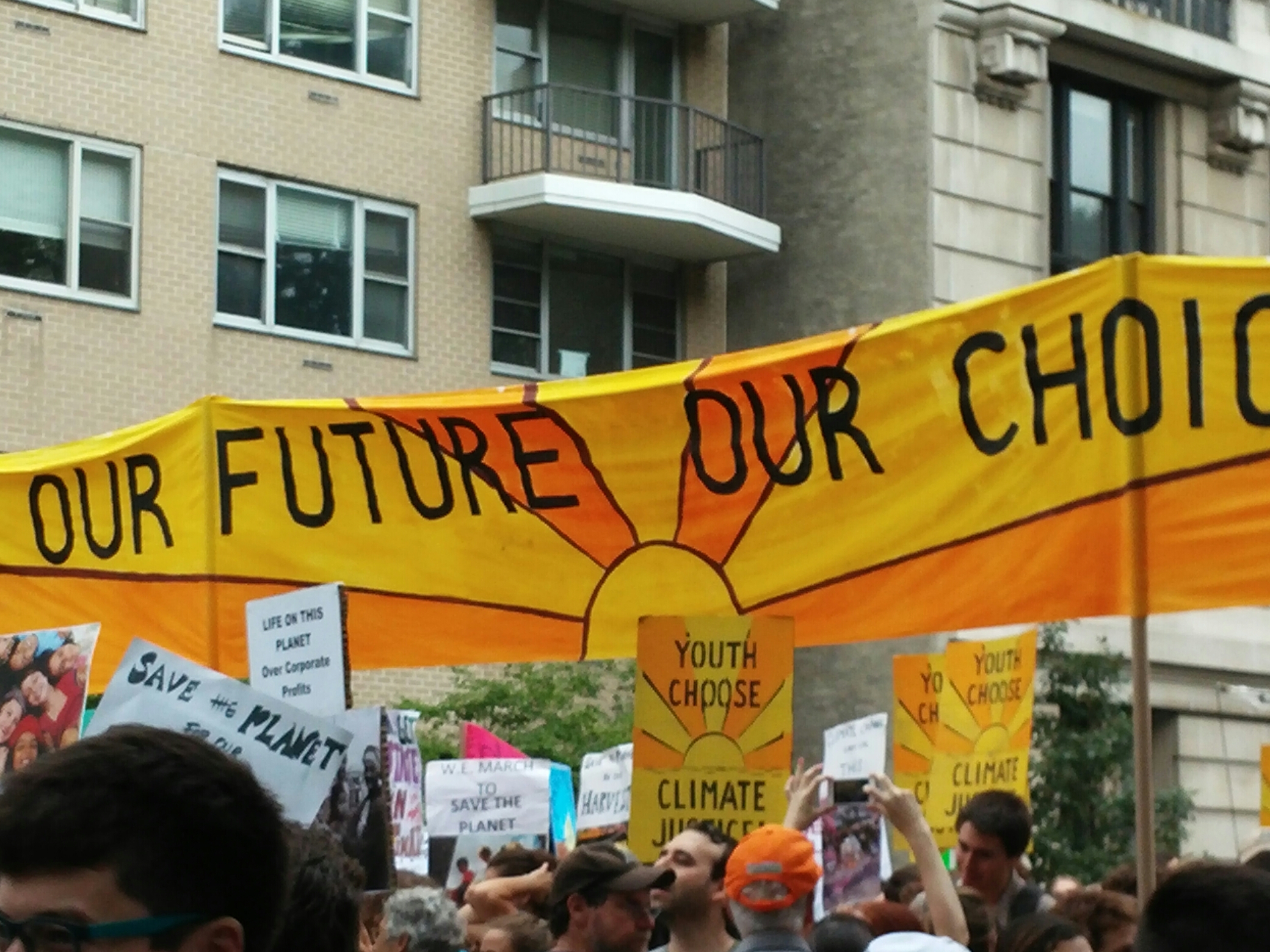
Climate March, September 21, New York City

970832_10153091136195497_1060532036_nOn September 21, WWF, Climate Reality, Sierra Club,
350.Org, Health4earth and many others are participating
in the People’s Climate March in New York City.
And we need you to be there with us!
Visit WWF's Website Action Update!
WWF march for climate change
Dear Friend,

We need your help—for the well-being of all species and especially for your family, friends and community. On September 21, WWF, in partnership with hundreds of other organizations, is participating in the People’s Climate March in New York City. And we need you to be there with us.

The march will kick off a week of climate action in New York and set the tone for world leaders as they head into a United Nations summit on the climate crisis two days later.

This is our moment to take a stand: be a part of a united call to protect our future.Let’s make sure our planet—including the people and species who share it—is rightfully represented at the Summit.

By joining us on September 21, you will help advocate for the health of our planet and make sure our voices are heard in the fight against climate change.

When we act together, we achieve amazing results. History’s great rallies and marches show us—you can make a difference.

Together, we can cultivate a world in which people and nature thrive together. A world with an economy that works for people and the planet. A world safe from the ravages of climate change. A world with clean air and water. A world with healthy communities.

To change everything, we need everyone. Join us by marching in New York City or taking action on that same day from your home town.

http://climaterealityproject.org/blog/were-marching-change-and-we-need-you

I'm going to the march
I'll participate in other ways

Record Cold and Record Heat

1711-msp2

Minneapolis will probably set a record cold for this week’s temperatures, and British Columbia and the Arctic might set record heat records.

When I travel, people often say, “Minnesota, it is really cold there!” This week’s cold spell during the All-Star Game is going to reinforce those beliefs.  Usually this is the hottest week of the year in Minnesota with average highs in the 80s F.

As someone who loves outdoor activity, I love cooler temperatures, but what is scary is the record heat in British Columbia and the Arctic.

From Minnesota Public Radio: As Minnesota shivers today in record July cold, western Canada is baking, and literally burning up in record heat.

This unprecedented “high amplitude” jet stream pattern is producing record cold and record heat at close range within North America.

Temperatures reached 105 degrees Sunday in parts of British Columbia. At least 20 weather stations across western Canada set high temperature records Sunday.

http://blogs.mprnews.org/updraft/    Get the entire story from Paul Huttner at MPR

And from Paul Douglas at the Minneapolis  www.Startribune.com

Climate Change for Dummies. Here’s an excerpt of an Op-Ed at the Concord Monitor: “…I distinctly remember my professor Richard Bopp, researcher at Goddard Institute for Space Studies, telling us that the only thing he knew was that you could not overload such a delicately balanced system like our atmosphere and not have something change. The idea that everything in the world would gradually and evenly rise in temperature was unlikely, but he and his colleagues could not offer an alternative at that time. Well, 25 years later, we have a better idea. Thanks to the Intergovernmental Panel on Climate Change, a voluntary 2,000-member group of scientists committed to understanding climate change, we can verify that we are experiencing more severe weather and increases of ocean levels, glacial melting and average temperature…”




Climate Data Slapping Us in the Face!

10003957_655105494556098_67013042_n

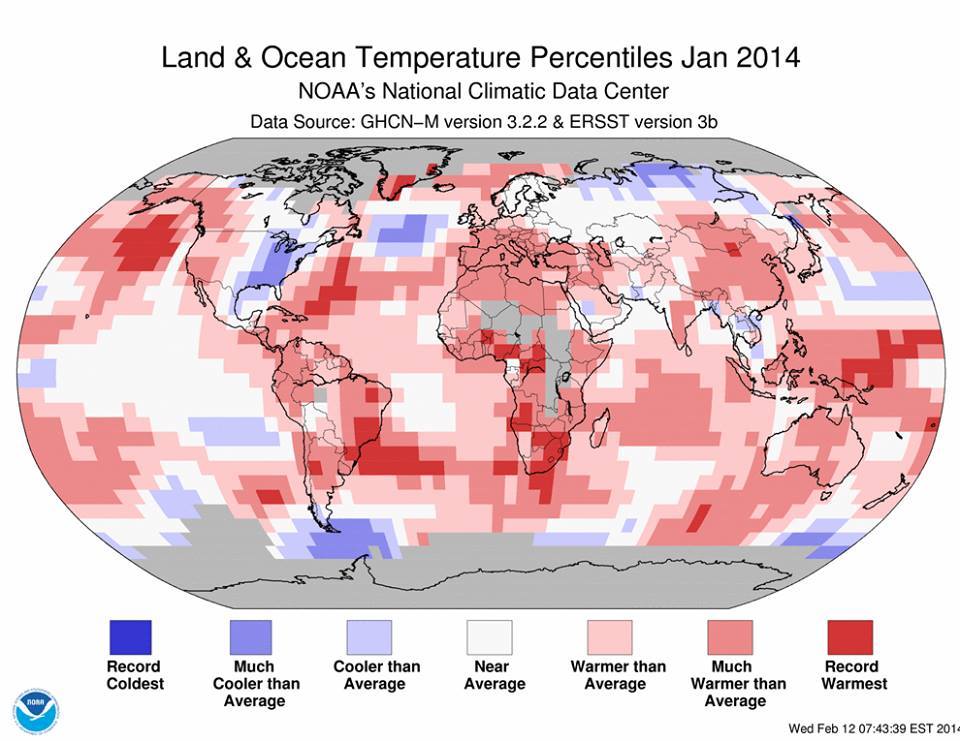
Yes, it has been a hard winter for most of us in North America. Drought, heavy snow, and the Polar Vortex all have contributed. Minnesota has experience the 6th coldest meteorological winter on record and Wisconsin the 5th coldest. Yet Alaska, and most of the earth are hotter than average. Globally it has been the 8th warmest winter! See map below. A few weeks ago I heard Mark Seeley from the University of Minnesota, http://www.climate.umn.edu/ speak on climate change. Seeley says that the climate data is, “slapping us in the face” telling us the climate is changing.
Several things he said were new and interesting. First, not all places are experiencing climate change to the same degree. The Southeastern part of the United States has not seen the changes we have experienced in the north. Second, there a latitude bias–The further from the equator the more evidence of change. Third, there is a winter bias, winters are showing more temperature warming.  Fourth, the minimum daily temperature is warming more than the high daily temperature. In other words, our night temperatures are warming! Finally, there is more moisture in the air which he says is the “ultimate greenhouse gas.” And more moisture in the air can cause more violent storms.
Unfortunately, the change is happening so fast we will have to adapt quickly. We need to limit the carbon we are pumping into the air, and make preparation to prepare for the future.

https://health4earth.com/easy-things-you-can-do-to-help-stop-climate-change/


1907960_664558816944099_1508189877_n


Minnesota Weather Disasters Cost Big Money

1507846_624777137588934_985916797_n

Minnesota prides itself in being number one, but who would think that land locked Minnesota would top the list in weather insurance claims?? We are all paying for climate change with our health and wallets. Minnesota has become the “New Florida” of the Midwest in paying for weather disasters. The new numbers from 2013 bring Minnesota into the top three states in the United States for catastrophic weather losses. AND…Insurance rates in Minnesota have increased 267% since 1997 according to Bob Johnson of the Insurance Federation of Minnesota.

The tornadoes in Illinois probably bumped Minnesota out of the number one spot for 2013, but the trend continues, and the frequency of extreme rains and hail is one of the triggers of insurance rate increases for Minnesota.

The changes in climate are happenings faster than we have ever seen, and it is clear we are changing the composition of the atmosphere according to Meteorologist Paul Huttner on Minnesota Public Radio.

Yes, we are already paying enormous costs because of the changes in our atmosphere and those that pollute should be paying their fair share. Polluters should be responsible for paying a fee for their contribution of carbon entering the atmosphere. This is a global problem.  Minnesota, and the United States together with the EU, need to take leadership to work with the entire world to do what we can to mitigate the climate effects we are seeing.  And we should all strive to reduce our individual pollution footprint.  Our health and the health of our earth depend on an enormous cooperative effort.

http://blogs.mprnews.org/updraft/2014/01/climate-cast-minnesota-near-1-in-extreme-weather-catastrophic-losses-in-2013/

Also, see below the number one catastrophic  disaster for the world.  It will surprise you:

http://abcnews.go.com/International/wireStory/global-disasters-killed-cost-2013-21444994

970832_10153091136195497_1060532036_n

The Ocean Reacts to A Warming Climate

1236896_563910837008898_870042492_n

Looking at this above chart, it is not surprising there are super storms on our oceans. Tens of Thousands are paying for the price of carbon with the loss of lives, homes, and destruction of their world.

I am grieving for the people of the Philippines.  What a horrific storm for this Pacific island to withstand. As Typhoon Haiyan was destroying the Philippines, individuals in Minnesota were meeting to plan how to adapt to our changed Minnesota climate. Is it possible for the Philippines, Hawaii, Florida or other ocean locations to adapt to super storms like this?  It seems impossible to adapt to a winds of 195 miles an hour or mountains of water washing over the land.  Without a doubt the warming and rising oceans played into this disaster.  Residents reported, “Surges of water as high as the trees.”  Can humans continue to inhabit land with the threat  of such devastation?  Yes, they are paying for the cost of carbon pollution with their health, their lives, and the loss of their world as they know it as they become climate refugees.

http://www.sfgate.com/news/science/article/Scientists-warn-of-hot-sour-breathless-oceans-4981452.php


I thought the extreme weather event I experienced in 2012 was frightening when thunderstorms kept rolling across Duluth and northern Wisconsin for 2 days and 3 nights.  The heavy rain, thunder and lightning just wouldn’t stop!  Today I am happy to be land-locked.

Please contact the Philippine Red Cross, Team Rubicon, or UNICEF to donate and find out about other ways to help.

http://www.huffingtonpost.com/jamie-henn/super-typhoon-haiyan-is-a_b_4239206.html?utm_content=buffer02f50&utm_source=buffer&utm_medium=twitter&utm_campaign=Buffer

While this storm was pounding and destroying life on the islands of the Pacific, Minnesota leaders were meeting to discuss how to adapt to Minnesota’s changed and changing climate. How are we going to adapt and prepare for climate change?  The average temperatures on earth continue to rise.  2013 will be the 37th consecutive year with a global temperature above the 20th century average.  These rising temperatures allow the air to hold more water, More water in the air creates more of these extreme weather events.  In Minnesota we have droughts alternating with floods.

Below is a must read op-ed by Mark Seely of the University of Minnesota about Minnesota’s changed climate.

http://www.startribune.com/opinion/commentaries/230905781.html  Climate Changed, by Mark Seely

http://www.ipsnews.net/2013/11/jordans-farmers-struggle-to-weather-climate-change/

http://insideclimatenews.org/news/20131107/climate-talks-poland-will-open-amid-flurry-new-scientific-warnings

http://www.rtcc.org/2013/11/11/its-time-to-stop-this-madness-philippines-plea-at-un-climate-talks/