Have you been caught in a record rain storm and flooding this summer? Chances are that most of us in the United States and Europe have experienced a heavier than normal rainfall. My travel this summer has brought me to see displaced people following storms (nothing like Louisiana or California). I have seen lakes created from heavy rain submerging homes, closed roads and bridges, yards with 20 uprooted trees, and experienced power outages.
What is going on with these storms? July 2016 was the hottest ever recorded since records started in 1880. As the earth warms, some places get dryer, but in other places the atmosphere is able to hold more moisture dumping larger amounts back to earth. Places in Louisiana received 31 inches of rain, unbelievable! I feel sad for everyone displaced from everything they own.
PBS had an interesting conversation about our weather extremes here. Is this all part of climate change?
There are consequences to our warming earth according to meteorologist Paul Douglas, “More moisture in the air, higher dew points and heat indexes, more thousand-year rains, wet basements with greater regularity, and more expensive insurance policies.”
It’s raining this week where I live. How can we use all this water rushing into the storm drains and at the same time improve the quality of the water runs from our roofs, sidewalks, driveways and streets? This water picks up many pollutants as it races to our lakes and rivers. There are things we can do to lessen this pollution such as sweeping our driveways and sidewalks and not using chemicals on our lawns. A good way to clean this polluted run-off is to direct the water into a garden, a rain garden. Today as it rains I can see the water rush into my rain gardens where my deep-rooted plants help clean this water as it drains into the earth below. This past week I have been part of a team that installed two rain gardens. Both gardens captured water that would run into the Mississippi River. We had fun, and were thrilled we helped to “plant for clean water.”
What is a rain garden?
The water that runs off our houses sidewalks, driveways and streets contains pollutants that run directly into our streams and lakes. A rain garden captures this water and the plants in the garden actually purify the water filtering out the pollutants. Like a friend said, “It’s like magic!”
An aspect of climate change is we can go for months without any precipitation then watch out…. inundation, too much rain. Rain gardens are a valuable tool to use and manage the water that falls on our properties. The plants should not need to be watered so we conserve water
Advantages of rain gardens:
1. They conserve water by managing rainfall
This is a narrow ditch for collecting run-off
2. Rain gardens filter out pollutants
3. Blooming plants add beauty to your yard
4. Rain gardens often use native plants that bees, birds and butterflies love.
Simple steps to creating a rain garden:
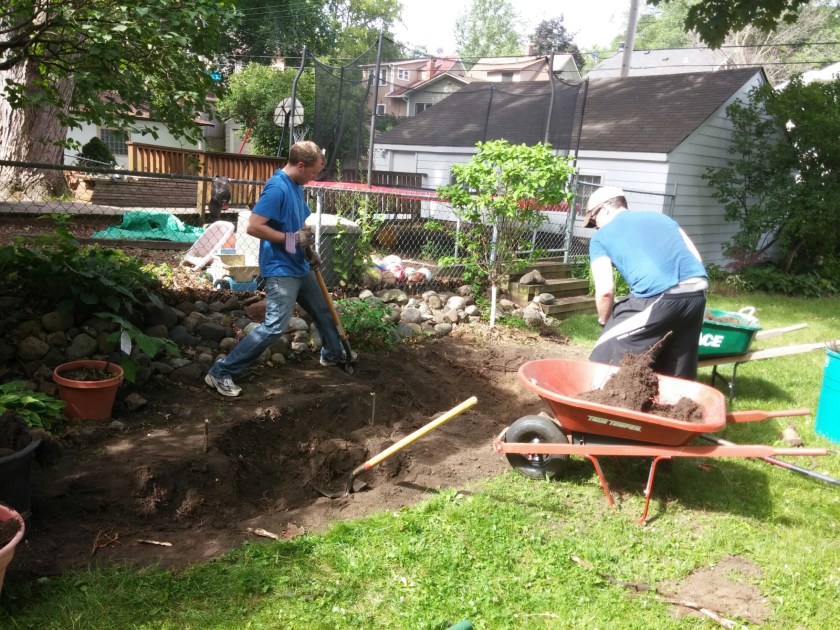
1. Remove the sod and dig a hole. It must be at least 10 feet from your house and where you can direct a drain-spout, driveway or sidewalk to drain rain water. Most rain garden holes are about 12 inches deep with wide 3 feet slanted sides surrounding the garden. The bottom of the garden should be flat.
Digging the hole for the garden
2. Mix in about one inch of compost to the bottom and sides of your new garden
3. Cover the garden with a layer of several inches of double or triple shredded mulch.
Spreading the compost, next add the shredded mulch
4. Plant deep-rooted plants. Most of the plants you love will work matching the degree of sun and shade. Also, always work to have a variety of plants that bloom at different times for the bees and butterflies.The bottom plants need to be water tolerant. Some bottom plants I have used are: liatris, swamp milkweed, turtlehead, Culver’s root, blue flag iris, sensitive fern, cardinal-flower, blue lobelia and many kinds of sedges.
5.. Water–If it is dry, you need to water the new plants for the first couple of months.
The below ideas for protecting our lakes is from the Superiorforum.org , Sigurd Olson Institute, Northland college, and the EPA, and Great Lakes Restoration Initiative:
1 .Be conservative with your water use.
2. Recycle as much as you can with the 4 Rs: reduce, reuse, recycle and repair. And….NEVER burn trash.
3. Curb Yard Pollution. Put your lawn on a chemical-free diet!!
4. Stop aquatic invasives by cleaning plants and animals off your boat.
5. Plant native plants, and reduce turf grass.
6. Plant native trees According to Audubon, oak trees are the best for attracting insects and birds.
7. Install a rain barrel
8. Create an energy-efficient home.
9. Bring hazardous waste to waste collection sites.
10. Love our lakes!
I would add several more:
1. Rain gardens are excellent for capturing harmful water runoff.
2. Keep leaves and trash out of streets and storm drains-Adopt a storm drain!
Love our lakes, rivers and streams. Take care of them!
3. Never use cleaning products or hand sanitizer with triclosan.
4. Reduce all plastic use–If you must use plastic bags and bottles, be sure you recycle them. 5. Pick up all liter.
Minneapolis is a city of lakes. “Walking the lake” is a big deal for most of us, and the lakes are magnets for people from all over the Twin Cities metro area and state. I am impressed with this educational campaign taking place along the walking paths of the Minneapolis lakes.
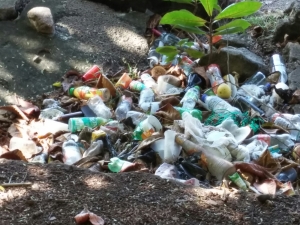
Is this how lakes should look? We all need to do better.
It looks like a thirsty future for the world. The Pacific Standard Magazine has just publish a map of the world’s troubled waters and some of the politics around water. More things you can do to protect our water bodies here.
An important thing you could do for the earth this week is recycle those plastic bags and plastic wrap, but DO NOT place them in your regular recycling! They need to be recycled at the stores that issued them.
Landfills are full of plastic bags. The best thing is not to take a plastic bag at all, but sometimes they are hard to avoid. Most groceries and big box stores now have places to recycle bags. Ask if you don’t see plastic bag recycling.
This is an argument against Jeff Bridges video. Fish, birds, other wildlife, our oceans and all of us are being harmed by plastic. The below argument is very weak:
The Oceans Are Rising Faster than they have in 3,000 years
2015 was the warmest year on record, and January 2016 was the warmest recorded. Alaska, Minnesota and Wisconsin have enjoyed a mild winter. The winter warmth has been pleasant, and because this is just weather, it will probably be brutal next year. It is the long-term trends that are troubling. Sadly, the problem lies in our oceans. Eighty to ninety per cent of this heat goes into the oceans. So of course the oceans are rising with the melting glaciers. Also, as the oceans heat they expand taking up more space. With record warm years, no wonder that the oceans are rising at a very fast rate.
Our planet is already in crisis as migrants are leaving Syria, Iraq, Afghanistan and other countries. We haven’t seen anything in compared to the migrant crisis that will be created by the rising oceans. Those living on the ocean coasts and the islands that will be inundated and disappear will need to find new homes .
The Syrian crisis was caused in part by our warming earth, the continued rising of warm oceans will create migrant problems that will be an even greater challenge! Miami, Venice, Bangladesh and London are a few that could disappear. Where will these people forced out of their disappearing cities, farms, and villages go?
Denial of our man-made climate crisis will not continue to work, and everyone needs to take personal responsibility to reduce their carbon footprints. Just committing to turning off lights and to drive less can make a big difference. What is one thing you do?
Most of us in the north county enjoy a beautiful snowfall, but hate ice. Even with a mild winter, there is thawing, refreezing and ice! As I walk through neighborhoods I see salt residue sitting on sidewalks and streets. Please sweep this up. The salt runs into our lakes and streams and is very harmful to fish and plant life. Highway departments, businesses and homeowners all need to be conscious of the salt they use. My local hardware store has a corn-based product they claim works well that is lake-friendly.
It takes only one teaspoon of road salt to permanently pollute 5 gallons of water. Once salt is in the water, there is no way to remove it. Salt harms fish, plant life and the over all quality of the lake or stream.
Suggestions to protect our lakes and waterways:
Always shovel sidewalks and driveways.
Remove ice on days when melting is occurring.
Redirect your drain-spouts so they don’t drain on to the sidewalk. Capture water run-off in a rain-garden.
Be safe, and try to avoid the ice in the first place which I know can be impossible. A tiny amount of salt can go a long way.

 Have you been caught in a record rain storm and flooding this summer? Chances are that most of us in the United States and Europe have experienced a heavier than normal rainfall. My travel this summer has brought me to see displaced people following storms (nothing like Louisiana or California). I have seen lakes created from heavy rain submerging homes, closed roads and bridges, yards with 20 uprooted trees, and experienced power outages.
 There are consequences to our warming earth according to meteorologist Paul Douglas, “More moisture in the air, higher dew points and heat indexes, more thousand-year rains, wet basements with greater regularity, and more expensive insurance policies.”






 Health4earth