
|
|
|
|

 Yours for all life,
Marvelous Sounds of Nature
This is best time of year to be outside and listen to the symphony of nature!

When many of our nesting birds reach their nesting area, they sing their beautiful unique song. Many are trying to attract a mate. In our yard the house wren sings constantly. Up north the songs of the red start warblers, song sparrow and white-throated sparrows just have to make you happy. Listen to the White-throated sparrow:
http://www.allaboutbirds.org/guide/White-throated_Sparrow/sounds
I loved this op-ed in the Star Tribune:
“The reason I dwell on how I do my yardwork is because this is the one task of homeownership that does not seem like a chore. Being outside with the sights and sounds of nature is something I would miss if I used a timesaving, noise-producing gadget.
I wish some of my neighbors would also stop, look and listen to nature’s surround sound theater.” Ben Cherryhomes in http://www.startribune.com
http://www.startribune.com/opinion/commentaries/261171421.html Stop and listen to the sounds in nature! Turn off your noisy yard machines.
You do not need to do yard work to enjoy the sounds of May/June. Just walk around the block or walk to a nearby park. This marvelous symphony doesn’t last long. Many birds will stop singing after the eggs of the next generation are laid.
Get With It, Build Some Habitat!

We are all worried about our bees and our butterflies! Have you ever wondered why in a city full of gardens of flowers there are so few bees and butterflies? In contrast, I observe a large diversity of bees and butterflies walking roads in northern Wisconsin where deer eat every flower within reach. The city, teaming with flowers, has less pollinators?
What is the reason?
- Chemicals: “The U. S. Fish and Wildlife Service says homeowners use up to 10 times more chemicals per acre than http://www.nytimes.com/2014/05/11/opinion/sunday/the-toxic-brew-in-our-yards.html?_r=0
- Unattractive flowers: Many of the attractive flowers we purchase have been hybridized so they don’t appeal to bees and butterflies.
- Habitat: A combination of the two above. Have we destroyed so much native habitat that pollinators are not interested in the flowers we plant?
The purpose of this post is to encourage you to reduce or eliminate the chemicals you use in your yard. and build habitat for our pollinators by planting more native plants in your yard. Native plants do not need chemicals. With their deep root structure natives are flood and drought resistant. Also, they are resistant to invasive pests. But the best about natives is that the bees , butterflies and birds love them, and they love areas without chemicals!
It is important we plant for our pollinators. What can you do to help?
** Take a pledge not to use chemicals nor dump them into drains: The Great Healthy Yard Project http://tghyp.com/
** Build Habitat: Find a sunny place in your yard to plant pollinator loving plants or some native shrubs or trees. Plant bee balm, milkweed, liatris, cone flowers, asters and golden rod. www.xerces.com
**Enjoy and appreciate your new visiting pollinators, healthier air, and cleaner water to drink https://www.youtube.com/watch?v=XqmUDEEJ-J4 http://tghyp.com/ Take a pledge to not use chemicals in your yard!
** Always ask if plants you purchase have been treated with neonicotinoids, and NEVER use these products or plants with neonicotinoids.

http://www.salon.com/2014/05/17/how_to_save_the_worlds_bees_before_its_too_late/ An interview with Dave Goulson
http://www.pollinatorsnativeplants.com/
http://www.thebeezkneezdelivery.com/ http://mnhoney.net/
http://earthjustice.org/features/the-case-of-the-vanishing-honey-bee
http://ecowatch.com/2014/05/16/alarming-effects-pesticides-young-brains-kids/
http://www.greenphonebooth.com/2014/05/unpaving-paradise-starting-wildlife.html?spref=fb

Styrofoam: Who should take responsibility?
Letter published in the Minneapolis Star Tribune:

STYROFOAM
It is a real, and lingering, problem
Styrofoam is not an imaginary problem. My husband and I have spent this spring picking Styrofoam out of Lake Harriet and off the banks of the Minnehaha Creek. We have been shocked to see how it breaks into tiny particles that cannot be picked up. These particles will not dissolve, and probably will be in our lakes for generations. In contrast to a May 20 commentary (“Minneapolis: City of lightweight leaders”), we applaud the Minneapolis City Council for its concern for our lakes and waterways.
Styrofoam is expensive and difficult to recycle. Minneapolis is trying to get residents to recycle cans and bottles; adding Styrofoam would add another enormous expense. Businesses that offer polystyrene cups and containers should be forced to offer and manage the recycling of these containers. Why does government need to be there to pick up the mess of business?
Health4earth
Ban Styrofoam Cups and Containers

I am encouraging Minneapolis and other city governments to ban Styrofoam. The past 42 days I have done daily litter pick-ups on my walks in Minneapolis. I was picking up Styrofoam along with wrappers, cans and plastic. Some of what was picked-up could be recycled, but Styrofoam, which is recyclable, is hard to find a place to recycle. I think the Twin Cities area has one place to recycle Styrofoam which is miles from my home.
At an Earth Day pick up along the Minnehaha Creek . I was surprised to notice how much the Styrofoam along the creek was breaking down into little pieces. Pieces so small it was impossible to pick up. Water and sun cause it to break up faster. The past few days I have been picking Styrofoam out of Lake Harriet. It has broken into pieces that might never dissolve and survive in the lake for generations. I wonder what harm this does to the birds and fish?
Banning restaurant containers is only a very small piece of this, but it is a start. The best part of banning Styrofoam could be that it heightens awareness for individuals who never think about the consequences of Styrofoam.
Finally, I have never figured out why businesses that sell products that are so harmful to the environment are not held responsible for what they spew. Why aren’t they at least required to offer recycling?
“People are already paying a price for allowing this packaging (styrofoam), noting the cost to remove the materials from the recycling stream, uncloging storm drains and picking up litter. You’re paying for it in so many different ways,” Minneapolis Council Member Andrew Johnson http://www.startribune.com/local/minneapolis/258989321.html
The Mississippi River, Everyone’s Responsibility!
“Minneapolis, On the banks of the Minnehaha Creek!” Garrison Keillor

This blog is in response to an article on buffers along streams and rivers:
http://www.startribune.com/lifestyle/health/256920531.html
Water, Our most valuable resource! It’s everyone’s responsibility to keep our rivers, lakes and oceans clean! Living in the City of Lakes, Minneapolis, and the first major city draining streams into the Mississippi River, we take our relationship with water quality seriously. I have an easy way for those lucky enough to live along a stream, river or lake to create sustainable pollinator habitat and keep our waters clean.
The Minnehaha Creek, a few blocks from my home is often part of my walks, bird watching and litter pick up. This Creek runs through south Minneapolis, and flows into the Mississippi River. Both Minneapolis and St. Paul sit on the banks of the Mississippi River which divides them into two cities. Last weekend my neighborhood, boy scouts and high school students did a big clean up of the creek. Every piece of litter we picked up was one more piece kept out of the Mississippi River and possibly the Gulf of Mexico.
It is also important to keep pollutants from running into the creek. Cleaning storm drains, installing rain barrels, rain gardens, and redirecting drain spouts are initiatives we promote in trying to do our best for the mighty Mississippi.
What is the problem? I was sad to read that some that farmers and others that live along water ways are not following Minnesota law to keep our rivers clean. Minnesota has a state law that requires farmers and others to create small 50 foot buffers of grasses, trees or shrubs along creeks and rivers to keep pollutants from washing into the rivers and lakes.
What can you do? An easy way to create and maintain these buffers is to plant a 50 foot strip of native plants. Why native plants in these buffer zones? Native plants have deep root structures that keep the soil in place and filter contaminants. Planting buffers of natives would build habitat for our struggling bees and butterflies, and keep our streams and lakes nitrate and phosphorous free. It’s a win-win! Unfortunately, the buffer law isn’t enforced like it should be. Many don’t like government regulation, well then…. Take responsibility to protect of our water from pollutants.
What are some plants to use? I would recommend seeding the buffer area with native perennials that take care of themselves. Some of following natives would be great water filters and create bee and butterfly habitat: Golden Alexander, swamp milkweed, Culver’s root, bee balm, little blue stem, cone flowers, vervain, asters, golden rod and any native sedges. Purchase seeds from http://www.prairiemoon.com/ Native plants are almost maintenance free once they start growing. Mowing in the spring, just once a year, would keep out trees. Good Luck!
http://www.startribune.com/lifestyle/health/256920531.html (Drainage buffers needed)
http://www.minneapolismn.gov/publicworks/stormwater/green/stormwater_green-initiatives_rain-barrel
http://www.dnr.state.mn.us/restoreyourshore/pg/npc.html
http://www.dnr.state.mn.us/restoreyourshore/st/bufferzone.html
Earth Day on Lake Superior
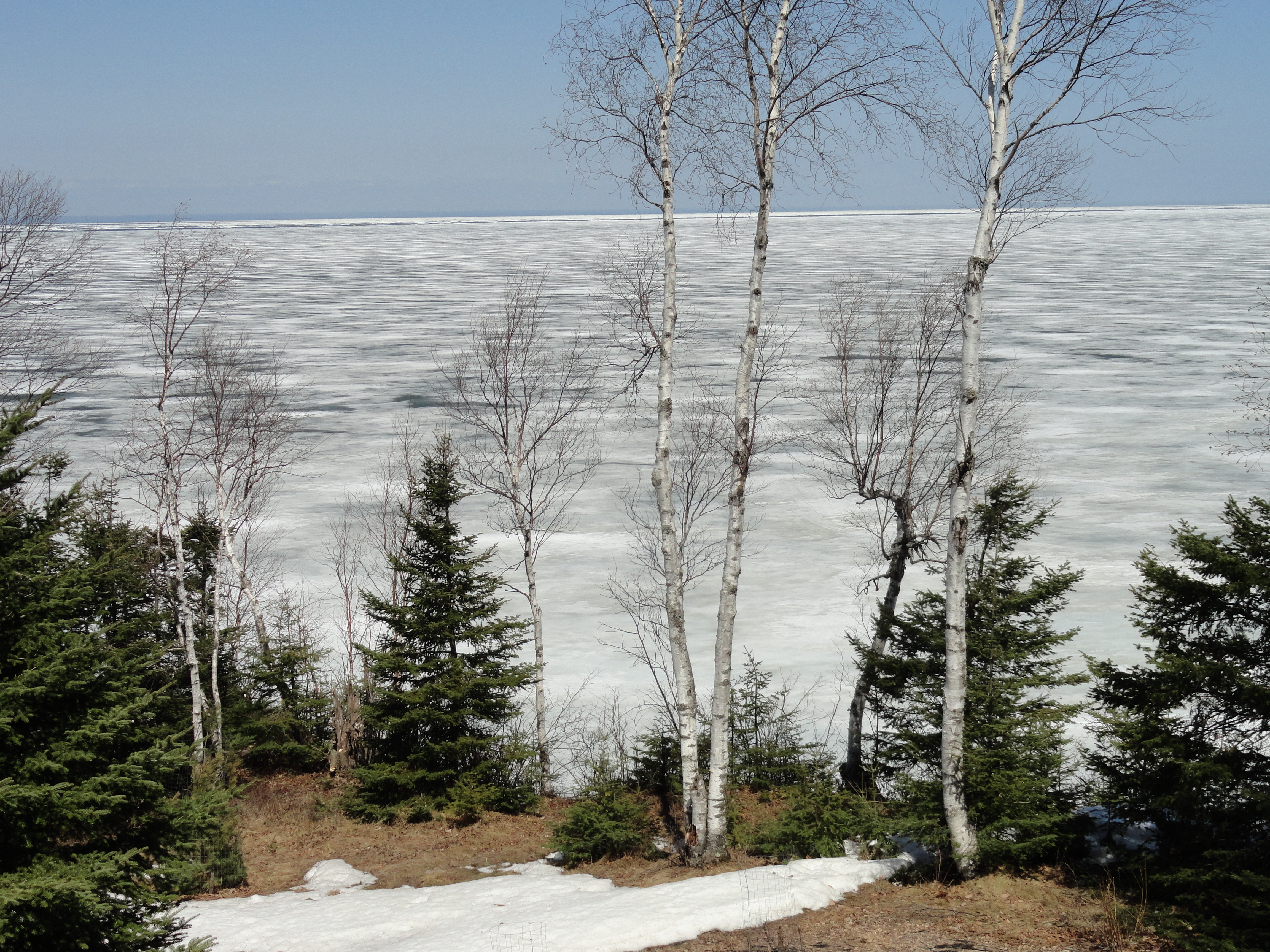 Lake Superior is still covered with thick ice, but it is very alive, and it talks and groans. Everything surrounding the lake radiates the hope of spring. The song sparrow sings his spring song as he sits overlooking and lake, and a juvenile eagle watches for ice-out from his favorite white pine post.
New migrating birds arrive daily. Some stay, but most rest up and journey across the lake. The ancient sand hill cranes,and purple finch will be nesting in the neighborhood. Busy flickers and yellow-bellied sap suckers explore new trees before they travel further, and the flitting kinglets and yellow rumps will soon be on their way north.
A hermit thrush is exhausted and rests on a tree branch.
Our fox friend is marking his territory and the wolves/coyotes howl under the clear starry nights.
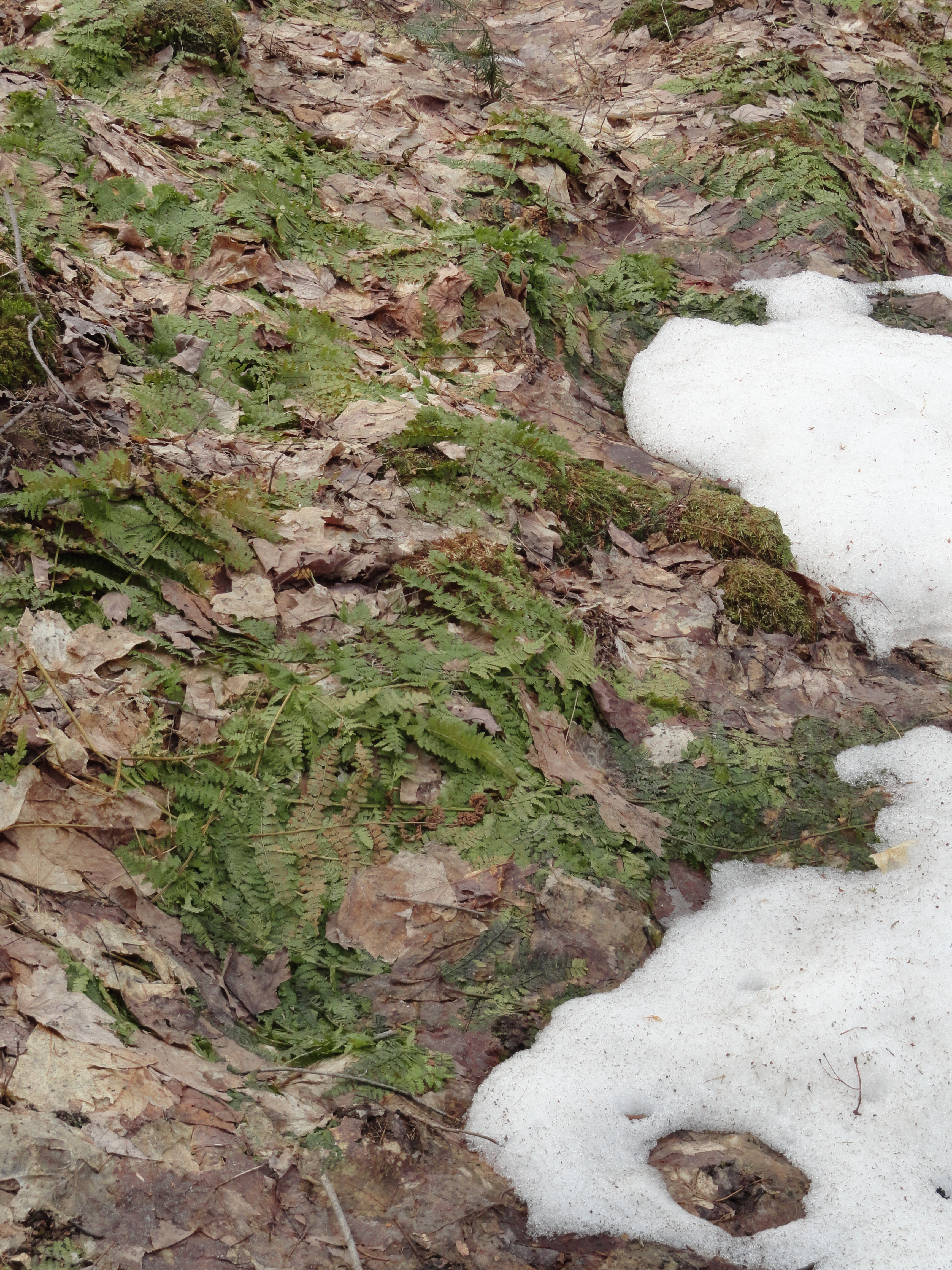
Every day is unique and bring constant challenges to the vegetation and wildlife
Everyday Is Earth Day!
Happy Earth Day! 
The weather is close to perfect, and it is a fabulous time of the year. Get outside and enjoy our magnificent planet.
Our earth’s water, air, birds, bees and butterflies need better care, and extreme weather has become the norm. I wish our earth was healthier, and hopefully on this special day we can make a new commitment to do more to help her.
Six easy things you can do to love our earth:
1. Everyday appreciate our beautiful earth.
2. Recycle, recycle, and recycle some more, and remember to recycle those plastic bags–Many stores collect them. We should recycle 74 % of our trash according to the EPA.
3. Ask when you purchase plants if they have been treated with neonicotinoids (imidacloprid, clothianidin, thiamethoxam, acetamiprid, dinotefuran) and never apply these chemicals to your yard. Some bird seed is also treated with these poisons-ASK and read labels!
4. Add native trees and plants to your landscape. http://findnativeplants.com/
5. Purchase quality products, and products that can be reused. Also, look for products made from recycled materials. EcoFact If the entire world lived like the average American, we’d need 5 planets to provide enough resources.
6. Leave your car at home one day a week, and turn off lights when not in use.

30 Days of Earth Day

The following letter was printed in the Minneapolis Star Tribune on April 3,
Our planet, Literally Trashed
One of the revelations to come out of the Flight 370 tragedy is the sorry condition of our oceans. One headline noted that the search for the plane was hindered by a “sea of garbage.” On a recent trip to Ohio from our Burnsville home, I was shocked to see the garbage littering the highways after the winter thaw. I saw a car bumper, a vacuum cleaner, tires, mattresses and thousands of plastic bags. Yes, global warming is a threat to this planet and the solutions are complex, but the solution to the trashing of our planet is relatively simple. We need to take responsibility for the waste that we generate. A good start would be the end of plastic-bag use on the part of our retailers. Target, Wal-Mart and others: Spend the extra 3 cents a bag and help in the cleaning up of our planet.
Don Lohrey, Burnsville
My letter in response: Printed on April 4,
To the editor:
I too have been on a road trip through the middle of our country and the plastic bags littering the landscape is disheartening(In response to Our planet, literally trashed 4/2) Personal responsibility is needed to get those plastic bags and all trash recycled. Also, businesses need offer recycling opportunities for individuals away from home. Hennepin County offers grants to businesses to improve their recycling. Look on their website.
For the next 30 days I challenge each of you to “Thirty Days of Earth Day.” Please pick up one piece of trash or more for the next 30 days. Yes, each one of us can make a difference.
Health4earth.com
For 30 Days of Earth Day, pick up one piece of trash or more everyday for 30 days https://www.facebook.com/pages/Pick-up-One-Piece-of-Trash-a-Day/267910856667805
Climate Data Slapping Us in the Face!
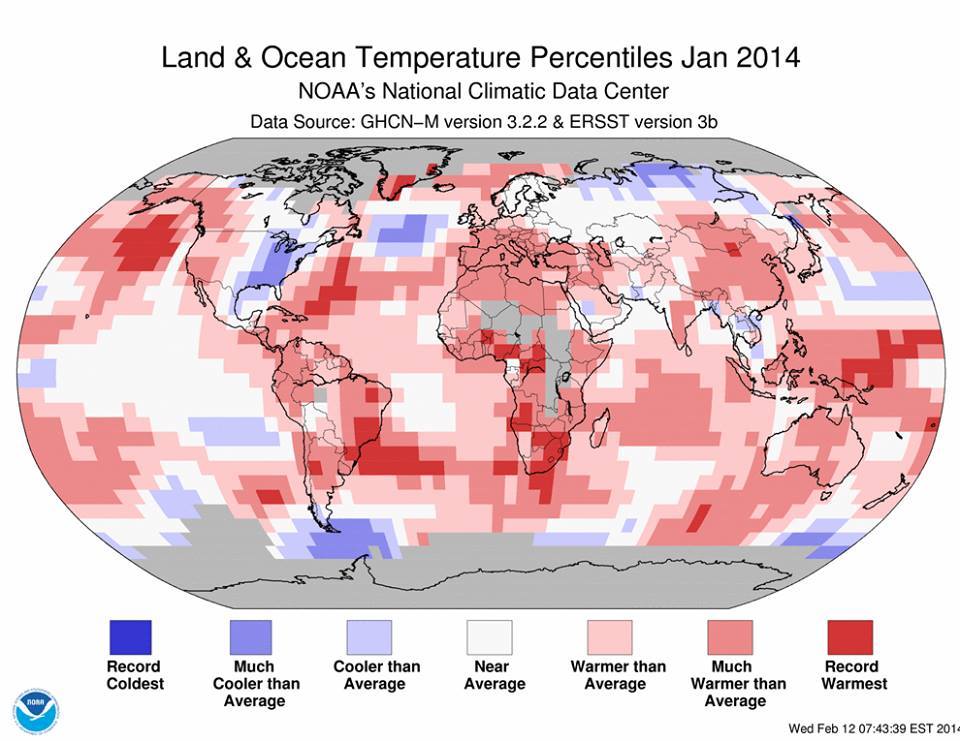
Yes, it has been a hard winter for most of us in North America. Drought, heavy snow, and the Polar Vortex all have contributed. Minnesota has experience the 6th coldest meteorological winter on record and Wisconsin the 5th coldest. Yet Alaska, and most of the earth are hotter than average. Globally it has been the 8th warmest winter! See map below. A few weeks ago I heard Mark Seeley from the University of Minnesota, http://www.climate.umn.edu/ speak on climate change. Seeley says that the climate data is, “slapping us in the face” telling us the climate is changing.
Several things he said were new and interesting. First, not all places are experiencing climate change to the same degree. The Southeastern part of the United States has not seen the changes we have experienced in the north. Second, there a latitude bias–The further from the equator the more evidence of change. Third, there is a winter bias, winters are showing more temperature warming. Fourth, the minimum daily temperature is warming more than the high daily temperature. In other words, our night temperatures are warming! Finally, there is more moisture in the air which he says is the “ultimate greenhouse gas.” And more moisture in the air can cause more violent storms.
Unfortunately, the change is happening so fast we will have to adapt quickly. We need to limit the carbon we are pumping into the air, and make preparation to prepare for the future.
https://health4earth.com/easy-things-you-can-do-to-help-stop-climate-change/


