Here is your country. Cherish these natural wonders, cherish the natural resources, cherish the history and romance as a sacred heritage, for your children and your children’s children. Do not let selfish men or greedy interests skin your country of its beauty, its riches or its romance.
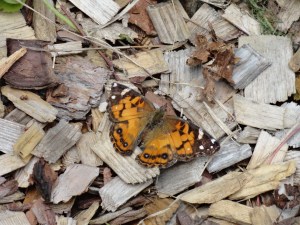
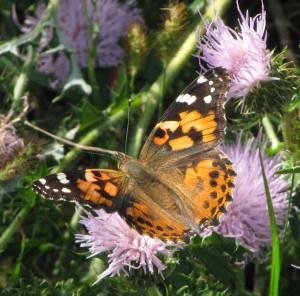
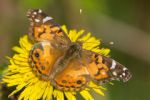
Painted lady butterflies are one of my favorites. This week in Minneapolis we had an explosion of painted ladies as they migrate south. Other cities have experienced painted lady migration also. Read about their migration at Fargo and Lawrence.
Pearly everlasting, painted lady host plant.
Pearly everlasting is a host plant for the painted lady caterpillars and I watch their lives cycle all summer in my yard as they transform from caterpillar, to chrysalis to butterfly on these interesting white flowered plants.
Want to know more about the painted lady? Thoughtco has more information on them. Read at painted lady
Go for a walk and see if you can find migrating monarchs and painted lady butterflies.
Painted Lady by Dave Carpenter, Nokomis Naturescape
This is an exciting time for my yard! At this time of year my yard is overrun by monarch butterflies and hummingbirds. Total enjoyment!
The hummingbirds are gorging on the nectar feeder and on the cardinal flowers, and monarchs are obsessed with the blazing star flowers.
Then just like, that they are gone on a perilous journey, migrating to warmer climes. First the hummingbirds are gone, then a week or so later, no monarchs! I hope they aren’t caught in storms, or hit by cars, and that they all arrive in Mexico or Central America safely.
Cardinal flowers
Female ruby-throat hummingbird
How can you have monarchs and hummingbirds in your yard? First, never use chemicals. Second, plant lots of milkweed, cardinal flowers and blazing star. Good Luck!
September 2. is National Hummingbird Day! A day to celebrate these amazing birds.
I had just seen a hawk fly along Lake Superior, but was surprised when two large birds came crashing into a window where was sitting. This created a 45 minute ordeal below my window. The flicker cried, fought and cried some more, but the talons of the hawk had a firm grip. Blue jays and crows came to watch the commotion. The persistence of the hawk ruled and she was too strong and determined for the flicker. An unusual number of hawks in our neighborhood this August have changed the lives of chipmunks, squirrels, and the birds.
On a happier note, A a fresh bright monarch was drying her wings after emerging from her cocoon, and a monarch caterpillar was weaving herself into a cocoon and will hopefully evolve into a new monarch in two weeks.
The great south migration has started with groups of night-hawks and yellow-rump warblers migrating through, and in another week the hummingbirds will be gone, also. Harbingers of fall.
Common Wood-nymph
The flowers are at their peak and the bees are crazy for bee balm and anise hyssop. The wood-nymph butterflies have been plentiul, but they too are at the end of their life cycle to be replaced by white admirals, cabbage whites, and fritillaries.
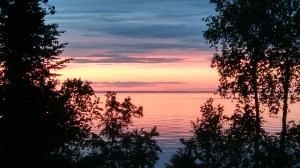
June is a month of variety, fresh green plants, and interesting skies. As the month ends, I reflect on the beauty of Lake Superior and the landscape that surrounds it. The length of the days and natural beauty is energizing. Everyday differs with the direction of the wind, and the big lake is usually part of this equation.
The birds are secretly nesting and raising their young, but I watch an unaware flicker fly in and out of her nest hole with food.
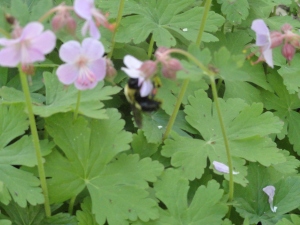
Wild geranium, easy to grow, is loved by bees and butterflies.
White Admiral ButterflyLupine on Lake Superior
The lupine, wild geraniums, Canada anemone, thimbleberry, and raspberries bloom while the milkweed takes over the garden path.
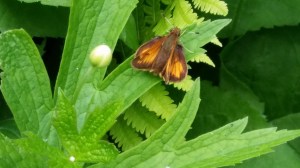
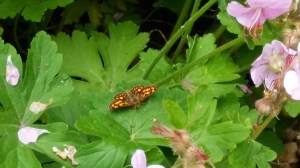
I love butterflies, and National Pollinator Week gives me an excuse to concentrate on what brings butterflies to my yard and to my walking routes. This week I learned two new skipper butterflies: the hobomok skipper and Arctic skipper. Both are crazy for wild geranium, The yellow swallow-tail, painted lady and admirals are plentiful now also, and a few monarchs are checking out the milkweed. Also, this week I saw one pearl crescent and a silvery blue.
Arctic skipper on wild geraniumFavorite butterfly books
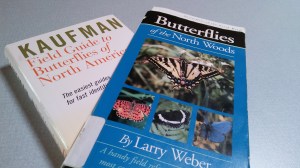
Below are two books that help me identify butterflies, and here is an on-line butterfly guide.
Have fun land I hope you enjoy butterflies as much as I do! Get out for a walk and look!
I know people get tired of my harping on plastic, but plastic is a serious world problem. According to the Plastic Pollution Coalition the average shopper uses 500 plastic bags a year, and that is just bags, not all the other plastic products. This is not sustainable!
I love thinking of how my grandparents lived, and how it is different from today. I loved this post from One Green Planet about what we can learn from the past and from our grandparents. Read it here.
Below is a quote from One Green Planet which show how serious this plastic issue is!
“In the past 30 years alone, the amount of plastic produced worldwide has increased by 620 percent! On average, that equates to 300 million tons of plastic a year. Of this 300 million tons, about 8.8 million tons find their way into the world’s oceans where they are left to slowly photodegrade into smaller pieces – and by slowly, we mean over the course of 100 to 1,000 years. When you consider the huge volume that is added to the oceans every year and the fact that plastics never really “go away,” we find our oceans crowded with a massive soupy mixture of harmful plastic products. This sadly has a massive impact on the marine animals who call our oceans home. Around 700 marine species are in danger of extinction due to entanglement, ingestion or general pollution caused by our plastic trash.”
Our grandparents didn’t have the choices and variety we do. They cooked and ate hearty food on real dishes, but most important they conserved, reused, and didn’t throw everything away like we do today! I would stay with my grand parents for a week and we didn’t need to run to the store to buy buy buy. We used what we had.
What do you remember about how your grandparents did things?
Even remote islands are collecting our plastic trash
Deep-rooted plants absorb more water than turf grass. Cone flowers, bee balm, and black-eyed Susan
Just making a few adjustments to your yard can make big difference for our climate. If everyone does a little bit, it adds up to a lot! Some amazing statistics on our lawns from “greener lawn” below:
*Grass covers more land in the US than any other crop.
*It’s estimated that there’s up to three times more acres of lawns than corn, according to NASA
Fritillary butterfly on bee balm.
*Homeowners use up to 10 times more chemical pesticides per acre on their yards compared to what farmers use on their crops, according to the U.S. Fish and Wildlife Service.
Some other ideas to slow climate change and help pollinators:
Adding new pollinator plants is not easy if you are a hosta gardener or a new gardener.
I would start small by adding a few of these: purple cone flowers, black-eyed Susan, bee balm, a few asters, and columbine. I suggest these because many garden stores sell them, they are easy to grow, add diversity, and are loved by pollinators.