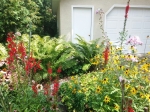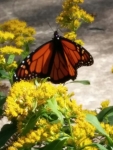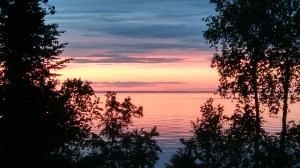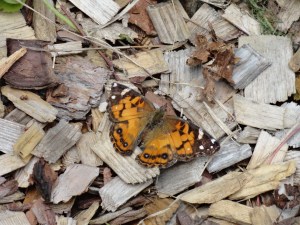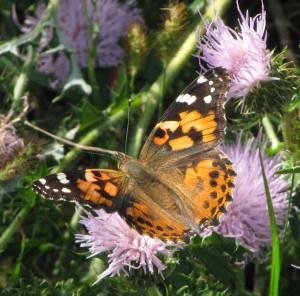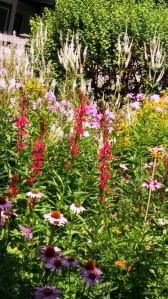
My August pollinator garden. Lake Superior is in the background.
Oh August, what an enjoyable month on Lake Superior! The cold wind off the lake subsides making for sunny calm 70 degree days,and the quiet ripple of the waves is soothing. Eagles and sea gulls still screech at each other in their constant conflicts, and a pileated woodpecker bangs on dying trees, but like the hummingbirds most birds are getting ready to head south and are unusually silent.
White Admiral Butterfly
August is one of my favorite months for watching butterflies. They bring joy as they flit around from plant to plant. The most common in my neighborhood is the white admiral, with frequent sighting of monarchs, fritillaries, and the tiny eastern-tailed blue.
Climate change is affecting the big lake. Weather patterns get stuck, and the rain and high water of the past few years is causing banks to collapse into the lake. Also, plastic is becoming a serious problem. Read about it here.
Goldenrod dominates the August Lake Superior wild flowers.
I think most of us would agree we don’t want polluted air and water, or a world without interesting animals, birds, and butterflies. Can we accept a world where people are staving to death? Do we want to live without diversity, in a mono-culture where we can’t accept anything different from how we live? Do we want a world where disrespect is accepted?
How can you use those leftovers?
Several recent studies and events should wake us up and shake us to action. First a study from the United Nations that says we are going to have a food crisis if we don’t change our land use. We just aren’t going to have food for everyone if we continue on our path of land use and wasting food. The study encourages a reduction in our meat consumption. The raising of meat, especially beef and lamb takes an enormous amount of energy, land, and water resources. It also states we must stop wasting so much food. Read the study comprised by over a hundred scientists here.
Lake Superior
Second, how about some plastic in your drink? Plastic is everywhere, and it might never break down. The amount of plastic microfibers in our water and air is troubling. Read about it at Plastic. Read about the plastic in the big lake at Lake Superior.
Smart environmental policy brought back the bald eagle
Finally, the quality of life will decline if we don’t have song birds and crickets singing, if we don’t have eagles, hummingbirds or happy chickadees to entertain us. We all want a world with penguins, giraffes and elephants. Our changing climate makes it necessary that we protect and support animals that will take longer to adjust to this change. Protecting some animals might be as simple as keeping oil and gas companies from drilling in certain areas. Read at Endangered Species Act . The Trump administration intends to end special protections of some of our most cherished animals.
Wasting food wastes water, energy and labor!
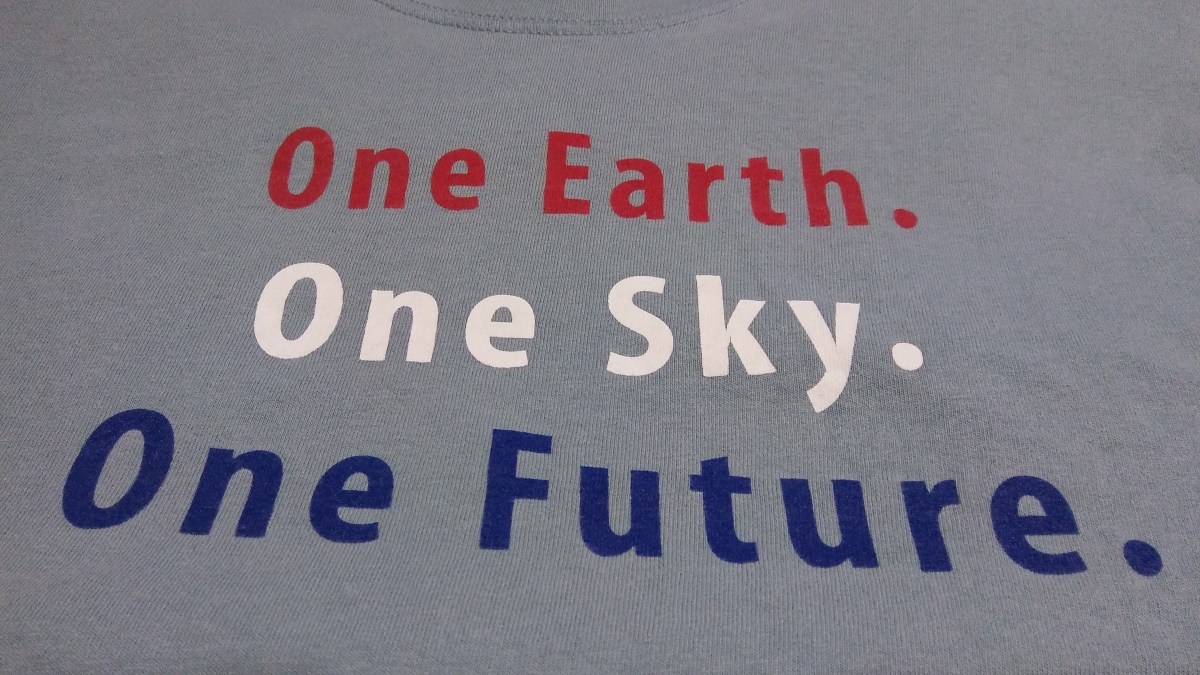
What actions matter? These are the things my household tries to do everyday. If everyone does a little, it adds up to a lot! 1. Reduce food waste. This is the hardest, but the most important! https://savethefood.com/ 2. Eat less meat, https://damndelicious.net/2014/12/02/15-best-quick-easy-meatless-recipes/ 3. Reduce our plastic foot-print and work for zero waste 4. Buy less stuff, and purchase items that will last, not junk! 5. Be kind. It would be a boring world if everyone had blue eyes, blond hair, tiny noses, and a perfect weight. Be respectful of our differences.
Thanks for making a difference!
If everyone does a little, it adds up to a lot! Our warming planet is real, and we need to find ways use our land more efficiently, and to slow down our warming planet. What do you think? What kind of world do you want to live in?
What joy to look out the window and see monarch butterflies and ruby throated hummingbirds enjoying the plants in my yard. Bees, butterflies and hummingbirds thrive on native plants. Hummingbirds are especially crazy about the cardinal flowers, and because cardinal flowers are a pop-up flower* and I am a pop-up gardener they are everywhere one looks in our yard. Where ever you look you see a hummingbird enjoying a native plant. Native plants are now at their peak and bees and butterflies are happy. Because the rainfall has been so heavy this year, many plants are taller with more blossoms than usual. Thriving plants attract thriving pollinators.
Plant and they will come!
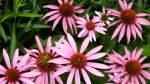
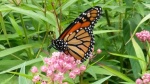
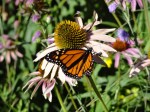
A monarch on swamp milkweedMany pollinators like purple cone flowers.
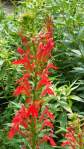
Cardinal flowers pop-up everywhere.
*pop-up flower -You never know where they will re-seed and pop-up. I let them grow where they are happy!
Suggestions for easy to raise native plants: 1. Never use chemicals, native plants like compost, but not chemicals. 2. Strive to have plants that bloom in different seasons. 3. Work for plant diversity, and you get a variety of happy pollinators. 4. Native plants are very easy to grow if you put them in a place that meets their needs for sun and moisture. There are natives that will thrive in almost every condition. 5. Native plants are a process, we weren’t born knowing this, it takes time, and you will be surprised by their energy and persistence. 6. Whatever you do to add plants to your yard, be sure to add some milkweed.
This is a week to appreciate and celebrate our pollinators. In my yard there are many baby monarch caterpillars eating on milkweed, and eggs of the painted lady butterfly on pearly everlasting and pussy toes. A dragon fly has been following me around as I work, and the hummingbirds stop to check things out. It is a beautiful exciting time! Get outside and enjoy.
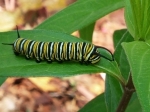
Monarch Caterpillars
Our insects and pollinators have been in serious decline the past few years. This is a week is to heighten our awareness of pollinators. Make an effort to spot some butterflies, bees, dragon flies, or maybe a hummingbird.
Create a yard pollinators want to visit.
Unfortunately, we have become a mono-culture world of asphalt, concrete, turf grass and hostas. Maybe you live in corn and soy bean country, more mono-cultures. Most of us can make changes to our environment to help pollinators. Maybe just place a pot of flowers on your deck, something that bees and butterflies like, or maybe replace a hosta with a wild geranium or native violets, maybe stop using chemicals on your lawn and turn it into a clover yard, or plant some bee balm, milkweed, coneflowers or sunflowers.
A new extensive UN study says we are on track to loose over a million spieces in the next few decades. Pesticides are a problem for bees and insects, but the study says the lack of plant diversity is also a big problem. Our farmers plant too much corn and soybeans, and yards have too much turf grass and too many hostas!
Each one of us can make a difference, think diversity in your yard! How can you brighten your yard and make it more attractive to pollinators?
Find ideas from the Xerces Society or native plants from Audubon for your area here.
The urban and rural gardener all have an important part to play in the health of our pollinators. Diversity is important. Keep it simple to start, native plants are easy to grow, but don’t forget native trees, especially oaks, are excellent at adding diversity. Last, but most important, purchase plants from serious nurseries, and ask to make sure plants haven’t been treated with neonicotinoids.
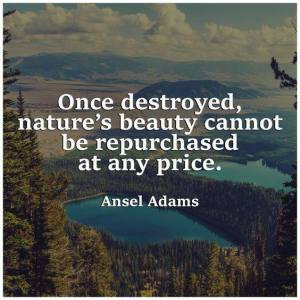
“Nature needs to be appreciated for itself and viewed as natures health dictates our human health. Without healthy water, land and soil and wildlife we will not survive as human beings. We must set aside of land, and water bodies and protect them from development. We must be aggressive protecting our land water and wildlife.” Ecowatch, read more here.
We need some good news, and thoughts of what is possible!
After a summer of hot weather, wildfires, and now hurricane season, some positive thinking energy is needed. This a collection of people, businesses and governments working to do good for our Earth. The following good news stories caught my eye:
I am going to start with two stories from France that were surprising.
A theme park has trained crows to pick up trash, especially cigarette butts. France also has a creative idea to put a tax on packaging that can’t be recycled. It would better if it was a tax on materials that don’t biodegrade, but any kind of tax is a great motivator, and a worthwhile education tool!
Also, in the European Union, the Greek Island of Tilos is going to be the first in the Mediterranean to power itself entirely with wind and solar. Read at renewable energy. And in Eastern Europe, Estonia is offering free public transport nationwide.
And good news in the United States, a non-profit in Durham North Carolina has started a program to use reusable containers for take-out. It is inspiring that Anchorage has banned plastic bags and Kroger stores say they are going to start phasing out single-use plastic bags. Like plastic bags, balloons cause litter and harm wildlife. Think twice before you use balloons, and read what is happening at balloons . Also, very good news, a judge has ruled that the Trump administration can’t change an Obama clean water rule
Good news from the Nature Conservancy: Inspiring stories of climate progress across the globe are a sign of what’s possible. http://bit.ly/2w6ozCt
“Too often leaders believe protecting nature … is at the expense of the economy or human well-being. I couldn’t disagree more strongly. We’ve made great progress quantifying what you can achieve by investing in nature.”
Standing in that sea of color, watching Lake Superior’s never-ending blue waters meld with the sky, I wanted to stay there for the rest of my days” Melanie Radzicki McManus
Yes, this big lake has a spiritual effect on many of us. I love mornings the as the sun rises and noisy birds are busy with their day. The eagles whistle and screech as they fly along the shoreline. I watch two adults and one juvenile land on a white pine, they sit and watch the lake, and chatter among themselves as they fly away. I wonder what the adult eagles are telling their child about life and survival? The hummingbirds are also active in August. They are eating and drinking and squeaking as they prepare for their journey south. What do they tell their young about the journey that lies in front of them? This all typical of August on Lake Superior
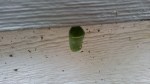
Monarch chrysalis under a step
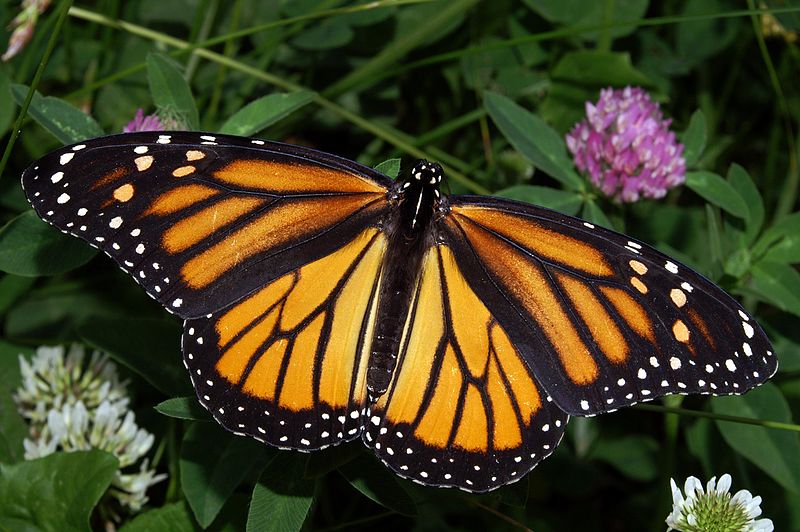
Sphinx moths and many bees are loving my late-blooming pollinator garden. The monarch caterpillars have become chrysalis , and I watch for new monarchs to emerge, and to my excitement they do!
A new monarch dries its wings.
Sadly, August is not like Melanie (above) describes in June. Signs of our warming climate are wearing on this big lake. Canadian wildfire smoke is creating a milky white sky and foggy horizon. Also, blue-green algae has been found along the south shore, probably caused by the yearly hundred year rains in the lake watershed. The watershed streams over-flow into the lake. Heavy rain run-off of lawn and agriculture chemicals causes a nutrient rich brown lake. Along with warm water these nutrients can lead to a blue-green algae problem. After the brown sediment filters out a greener color lake remains that has not been the Lake Superior norm. Read at blue-green algae
It makes me so happy when butterflies dance along as I walk the road by my house. One day there were dancing sulfurs, another day monarchs, swallow-tail and white admirals. I was watching a northern pearly eye, it flew at me, and decided to sit on my hand for 10 minutes as I continued my walk. July is easy to see painted ladies, red admirals, wood nymph butterflies, checkerspots, fritillaries and many skippers. This is the best time of the year to see butterflies! Get outside and look.
Northern pearly-eye by wikimedia
Seeing butterflies is so much easier than seeing birds, but the birds sing their ”I love life” song? some of them must have raised their first family and ready to start again? Song sparrows, red starts, chickadees, chestnut-sided warblers, vireos, and white-throated sparrows seem to sing just for me. I sure appreciate their happy songs.
They dance not for me
Yet mine is their glee!
Thus pleasure is spread through the earth
In stray gifts to be claimed by whoever shall find;
Thus a rich-loving kindness, redundantly kind,
Moves all nature to gladness and mirth.
What can you do to help our birds, bees and butterflies? Can you plant some milkweed or other native plants? Can you become aware and reduce the chemicals you use? Can you learn about neonicotinoids and be sure you never purchase plants that have been treated with them? For your information, neonicotinoids have recently been banned from use by the European Union.
Yesterday I had a mourning cloak, a painted lady, a red admiral, hummingbirds, and monarch caterpillars in my yard. Milkweed and native plants make a big difference for pollinators. I am not a fan of lists because experience is better, but here are some native plant lists to get you started: https://www.nwf.org/NativePlantFinder/About and from Audubon
Planting purple cone flowers, bee balm, black-eyed Susan and milkweed are easy ways to get started. After years of trying to get milkweed to grow, I now have swamp milkweed everywhere. It has reseeded itself and thrives in my yard. Also, common milkweed and butterfly weed have sprouted up, but only a few monarch butterflies. The few monarch butterflies have a big job ahead of them, and I am still hopeful we can get their numbers to improve! If everyone does a small part, it can make a big difference!
Below is a video from PBS about monarch caterpillars, enjoy!
I love the following stories of businesses, people, and governments doing the right thing for our Earth. These stories give me hope, and I hope they inspire you, too. Click on the links to read more of the articles.
** California will require solar on all new homes!
** Fabulous news on the plastic pollution front:
* The Chicago White Socks baseball team ban straws!
** Some really good business news…. General Mills is growing crops for their organic products that are organic, help the soil, and don’t harm water, regenerative agriculture.
** And more good agricultural news, the European Union has banned neonicotinoids which are so harmful to our bees and butterflies!
Hope for wildlife
Regenerative Agriculture. Regenerative Agriculture is a system of farming principles and practices that increases biodiversity, enriches soils, improves watersheds, and enhances ecosystem services