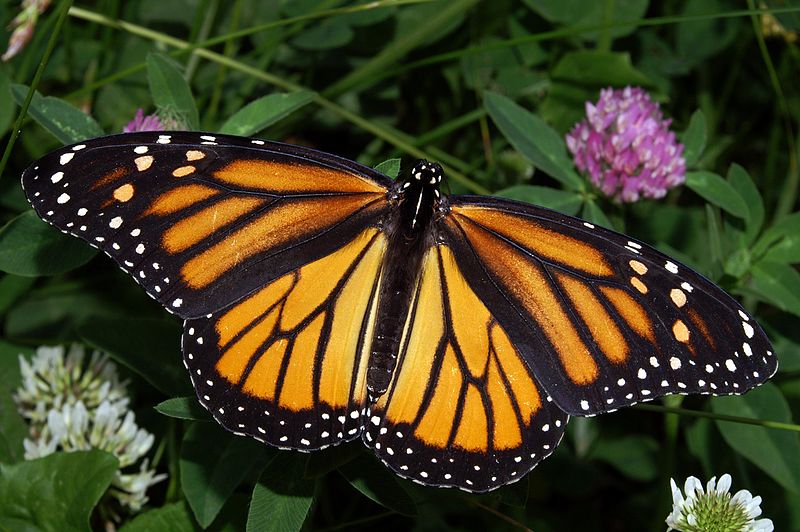
It makes me so happy when butterflies dance along as I walk the road by my house. One day there were dancing sulfurs, another day monarchs, swallow-tail and white admirals. I was watching a northern pearly eye, it flew at me, and decided to sit on my hand for 10 minutes as I continued my walk. July is easy to see painted ladies, red admirals, wood nymph butterflies, checkerspots, fritillaries and many skippers. This is the best time of the year to see butterflies! Get outside and look.
Northern pearly-eye by wikimedia
Seeing butterflies is so much easier than seeing birds, but the birds sing their ”I love life” song? some of them must have raised their first family and ready to start again? Song sparrows, red starts, chickadees, chestnut-sided warblers, vireos, and white-throated sparrows seem to sing just for me. I sure appreciate their happy songs.
They dance not for me
Yet mine is their glee!
Thus pleasure is spread through the earth
In stray gifts to be claimed by whoever shall find;
Thus a rich-loving kindness, redundantly kind,
Moves all nature to gladness and mirth.
What can you do to help our birds, bees and butterflies? Can you plant some milkweed or other native plants? Can you become aware and reduce the chemicals you use? Can you learn about neonicotinoids and be sure you never purchase plants that have been treated with them? For your information, neonicotinoids have recently been banned from use by the European Union.
Yesterday I had a mourning cloak, a painted lady, a red admiral, hummingbirds, and monarch caterpillars in my yard. Milkweed and native plants make a big difference for pollinators. I am not a fan of lists because experience is better, but here are some native plant lists to get you started: https://www.nwf.org/NativePlantFinder/About and from Audubon
Planting purple cone flowers, bee balm, black-eyed Susan and milkweed are easy ways to get started. After years of trying to get milkweed to grow, I now have swamp milkweed everywhere. It has reseeded itself and thrives in my yard. Also, common milkweed and butterfly weed have sprouted up, but only a few monarch butterflies. The few monarch butterflies have a big job ahead of them, and I am still hopeful we can get their numbers to improve! If everyone does a small part, it can make a big difference!
Below is a video from PBS about monarch caterpillars, enjoy!
Everyday 500 million straws are used and thrown away in the United States. Many end up in the ocean where they do lots of harm. Watch Gutsy Grackles video
The wind is constantly moving the slushy ice around the lake.
Who would ever think you would wake up to 9 degree temperatures on April 9? It has been a cold two weeks of 20 to 30 degrees below normal! Meteorologist Paul Douglas calls it “Weather Weird!” One theory is that the warm weather in the Arctic and Alaska could be hijacking jet streams causing polar air to move south. I recollect some of this happened during the famous Polar Vortex.
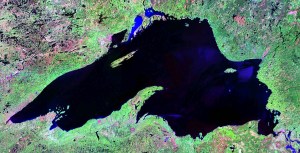
NASA picture of Lake Superior
Yes, it is cold but the days on Lake Superior are sunny and beautiful. Deer are feeding wherever they find open snow-free ground, the eagles are protecting their new babies, and the migrating seagulls and Canadian geese are back. Mourning cloak butterflies are finding sunny muddy patches, and ore boats are again crossing the big lake. All are signals that spring is finally on its way!
April can be the cruelest month, but April can also be one of the best months to be outside. I hope you get outside to experience the changes and new beginnings. Make a daily walk part of your routine. Enjoy!
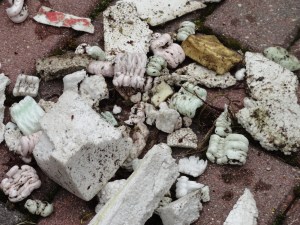
Styrofoam/polystyrene. It is breaking into small pieces and could last forever!
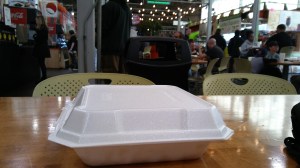
Imagine eating or drinking your coffee/tea or dinner out of a Styrofoam container. ICK! I can’t imagine, but many people do??? Styrofoam makes food taste terrible, and it is made from cancer causing material. Why would you eat/drink from it?
I am on a road trip through the southern part of the United States. Styrofoam is just the normal at many food establishments. Places I refuse to patronize.
Not only is Styrofoam unhealthy to eat on,
How can we do better than this? We need a sustainable alternative
it is awful for the environment. It breaks down into tiny pieces harmful to oceans/lakes, water animals and fish that think it is food.
Unfortunately, Styrofoam has powerful lobbying interests behind it, people who don’t care about your health or the health of our waterways.
Beth Terry, author of My Plastic-Free Life, wrote this terrific guide explaining how producing and using plastic pollutes the air. When it comes to the foamy Styrofoam in particular, here are some other objections to using it:
It does not biodegrade. It may break into small pieces, even minuscule pieces. But the smaller EPS gets, the harder it is to clean up.
It is made of fossil fuels and synthetic chemicals. Those chemicals may leach if they come in contact with hot, greasy or acidic food. Yes, they keep your coffee hot – but they may also add an unwanted dose of toxins to your drink.
Animals sometimes eat it. Turtles and fish seem to mistake EPS for food, and that can kill them. Not only can they not digest it, but the foam could be full of poisons that it has absorbed from contaminants floating in the water.
It can’t be recycled. Some commercial mailing houses may accept packing peanuts, but for the most part community recycling centers do not accept throwaway foam food containers.
Evidence regarding the sustainability and toxicity of expanded Styrofoam/polystyrene (EPS) single-use containers supports replacing them with a more sustainable and safe material. EPS food and beverage containers are single-use, yet persistent and not economically feasible to recycle. Thus, millions of single-use EPS items are sent to a landfill each day, where they will remain for hundreds to thousands of years. Moreover, its lightweight makes it difficult to manage which is one reason EPS is one of the top litter items found on beaches and in the environment. Lastly, EPS containers may pose a hazard. Some studies have found they can leach chemicals into our food and others have demonstrated that their leachate is toxic to laboratory animals. Replacing EPS with a more sustainable material supports a healthy environment for both wildlife and people.
So what can you do?
I boycott places that use Styrofoam, but that might not be possible for you. 1.Bring your own container, or ask for a real plate, many places can provide that for you! 2. Tell establishments how awful their packaging is. 3. Work to get Styrofoam bans in your community 4. Pick up Styrofoam litter so it doesn’t end up in our waterways.
If everyone does a small part, it can add up to a lot! Speak out.
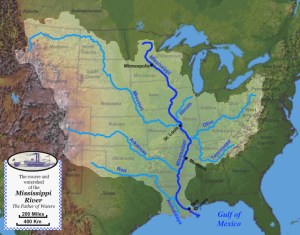
Minnehaha Creek drains into the Mississippi River which runs to the Gulf of Mexico
I’ve pledged to reduce single-use plastic in my life, Refuse plastic straws & cutlery, use refillable water bottles, coffee cups, & bring my own bag to the store. Together we can do this! Join me & take the challenge Mick Jagger
Why would you ever purchase bottled water? It contains plastic fibers. Read here
Two thirds of our earth is covered by ocean, and our oceans are paying a price for our behavior on land.
The Mississippi River water shed drains much of the United States.
This afternoon I walked over the Minnehaha Creek, and saw plastic bags stuck in the ice. I live 1,500 miles from an ocean, but this creek, a few blocks from my house, drains into the Mississippi River which runs into the Gulf of Mexico over a thousand miles away. When the ice melts, this plastic will probably take a long journey down the Mississippi River and end up in our oceans.What we do to the land, we do to our water. Most ocean pollution starts out on land and is carried by wind and rain to the sea. Plastic from the land ends up in the ocean and plastic is so durable that the EPA reports “every bit of plastic ever made still exists.”Even the pristine Arctic Ocean is being inundated with plastic. Read at Arctic.
The second threat to oceans is our warming planet. Oceans in 2017 were warmer than they have ever been. Most of the heat from our warming planet is absorbed by the oceans. More than 90 percent of the Earth’s heat related to global warming is absorbed by the ocean. Read at ocean heat.
What are the consequences of warming oceans? Warmer oceans could bring storms, rain droughts and winds like we have never seen. The hurricanes in Houston and Puerto Rico are just examples of what could come. The warming ocean melts the glaciers faster causing sea rise. Cities and countries will be under water if this trend continues, and many people will become refugees having to move inland causing refugee crisis to get worse and worse. Unfortunately, this is only going to continue with extreme drought in some places and too much water in others!
What does that mean? It means Audubon, National Geographic, Cornell, BirdLife International, and most importantly, bird lovers everywhere are teaming up for a year of action for birds! 2018 is the centennial of the Migratory Bird Treaty Act and what better way to honor our most important bird-protection law than with our own small ways of protecting birds. Sign up to take a pledge to help birds here.
My bird friendly yard. The birds eat the seeds of these cone flowers all winter
Birds are struggling because of loss of habitat, and heavy use of pesticides and other chemicals by farmers, corporations and gardeners. My thing is creating a friendly habitat for birds. Audubon has plants for bird friendly yards. Read at Audubon
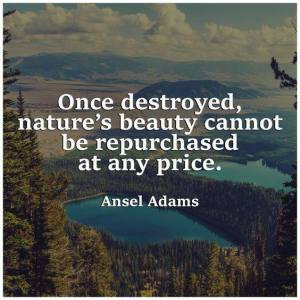
Here is your country. Cherish these natural wonders, cherish the natural resources, cherish the history and romance as a sacred heritage, for your children and your children’s children. Do not let selfish men or greedy interests skin your country of its beauty, its riches or its romance.
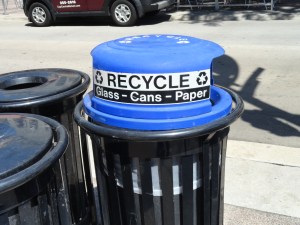
Find a place to recycle your bottles, cans and paper.Say “No” to plastic bags!Bring you own shopping bag
We now have plastic in our water and in the fish we eat. Do we really want to put plastic fibers into our bodies every time we eat and drink?
I have three simple thoughts about litter and recycling today: First, countries that have less plastic have less litter. Second and third, if everyone would recycle more, and change the plastic bag habit, it would make a big difference on our planet.
Here is an interesting plastic comparison for you. This is based on observation during the past month while I have been travelling through Central Asia and Iran. Central Asia uses very little plastic except for black plastic bags for purchases and plastic bottles for soda. Iran by contrast uses lots of plastic. Beside plastic bottles, restaurant food, hotel towels, and many things that don’t need to be, are wrapped in plastic. Plastic cups and straws are used in Iran, but I saw none in Central Asia. Where would you guess there is a terrible litter problem? The contrast was enormous. I brought Iranian plastic home to recycle.
Governments clearly need to become aware of the problem, and businesses like Coca Cola need to take more responsibility for the plastic they produce.
While I was thinking about this I came across an excellent essay by ECOwatch with great suggestions for everyone (see below) But keep it simple and by recycling and reducing plastic bags you can make a big difference on our earth!
From Ecowatch:
Complain to retailers. Pressure retailers to do away with over-packaging.
Support plastic bag bans, polystyrene foam bans and bottle recycling bills.
Use natural clothing fiber rather than synthetic clothing, as synthetic cloth releases plastic fiber in every wash cycle.
Choose to reuse. Neither plastic shopping bags nor plastic water bottles can be easily recycled.
Deposit return schemes are highly effective ways to reduce plastic bottle waste. In Germany, where a bottle-return program is in place, nearly 98 percent of plastic bottles are returned.
Recycle. If you must use plastic, try to choose #1 (PETE) or #2 (HDPE), which are the most commonly recycled plastics.
Avoid plastic bags and polystyrene foam as both typically have very low recycling rates.
Seek out alternatives to the plastic items that you rely on.
Pressure politicians. Governments should be funding research into microplastics and regulating and incentivizing changes in plastic production and consumption.

 It makes me so happy when butterflies dance along as I walk the road by my house. One day there were dancing sulfurs, another day monarchs, swallow-tail and white admirals. I was watching a northern pearly eye, it flew at me, and decided to sit on my hand for 10 minutes as I continued my walk. July is easy to see painted ladies, red admirals, wood nymph butterflies, checkerspots, fritillaries and many skippers. This is the best time of the year to see butterflies! Get outside and look.


 W
W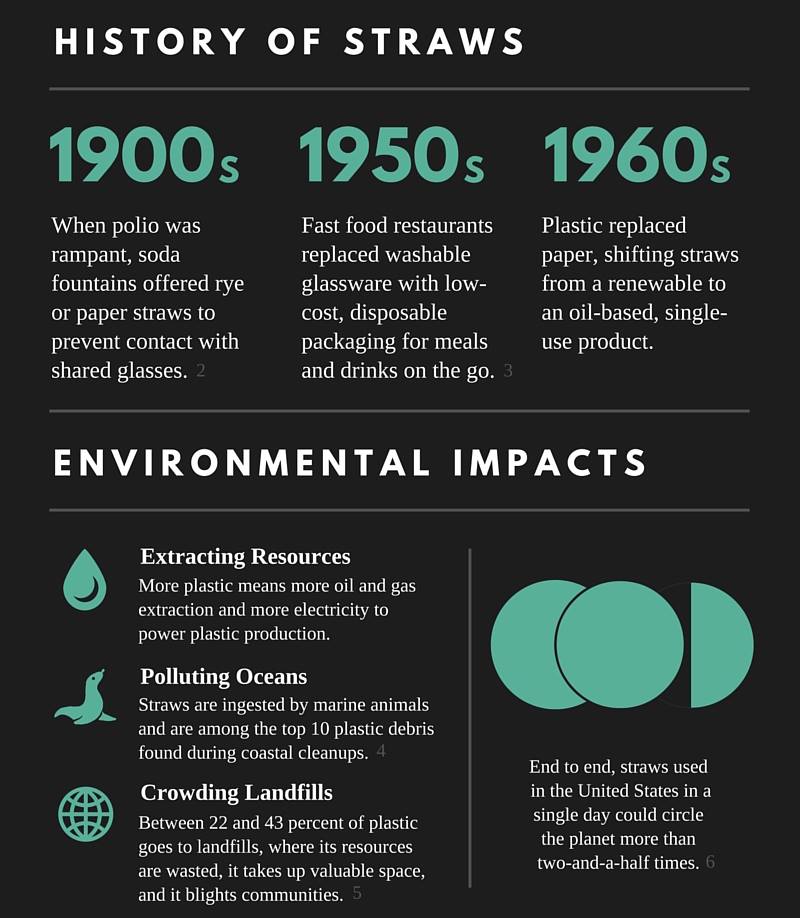







 Health4earth