Plastic Cutting Boards

In honor of Plastic-free July, buy yourself a wooden cutting board.

Plastic cutting boards (made from chemicals sourced from fossil fuels) are a staple in many of our kitchens. But did you know that they have actually been found to be a significant source of microplastics in our food? This study estimated that a person, on average, consumes between 7.4g-50.7g of microplastics from a polyethylene cutting board each year, and 49.5g from a polypropylene one. These microplastics have many potential health risks such as increased risk of disease, artery blockage and inflammation.

In this NBC News article, Victoria Fulfer, a postdoctoral fellow at the University of Rhode Island, gives a demonstration to show how easily microplastics can end up in food and water. After cutting two slices of a white onion and rinsing the slices, she filtered the water used in the rinse. When the filter was placed under a microscope it revealed small pieces of plastic that had transferred from the cutting board to the onion.

All cutting boards, including plastic ones, should be replaced when there is evidence of excessive wear and tear, such as deep grooves in the surface. These grooves can make it harder to properly clean the board, and it makes it easier for microplastics to transfer from plastic cutting boards. This article talks about how damage to the surface of plastics further increases the release of microplastics, and goes more in depth on possible health risks associated with them.

Maybe replacing your plastic cutting boards with wooden or bamboo ones could be your first step to reducing plastic use in your daily life, or maybe you have already started the process and this is another step in your journey. Above is from The Carbon Almanac

For the health of your family, switch to a wooden cutting board

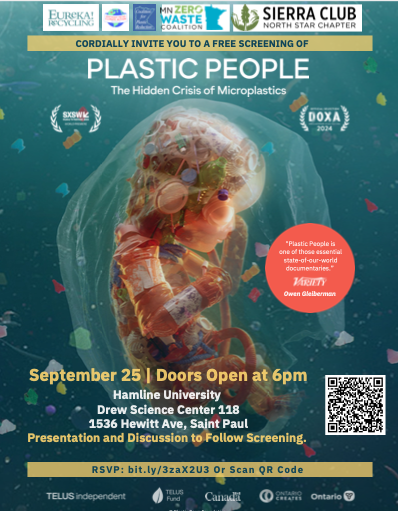
Plastic People

The ground-breaking feature documentary Plastic People investigates our addiction to plastic and the growing threat of microplastics on human health. Almost every bit of plastic ever made breaks down into “microplastics.” It was first shown at SXSW and this is one of the first community showings in the country. 

  • Date: Wednesday, September 25th
  • The doors open at 6:00 for tabling and the film starts at 6:30.
  • There will be a short discussion following the screening lead by Lucy Mullany with Eureka Recycling and Mary Kosuth, who is finishing a PhD in microplastics at the University of Minnesota and is a featured scientist in the film.
  • The film is free.
  • The location is Hamline University, Drew Science 118, 1536 Hewitt Ave, St Paul, MN 55104. 
  • RSVP: bit.ly/3zaX2U3

I hope it works for you to join us. 

Water for Peace, Water for Life

Water is Life, we must do a better job of protecting our waters.

World Water Day March 22, 2024 is the United Nations observance day dedicated to highlighting the importance of freshwater. It serves as a reminder of the critical role water plays in our lives and ecosystems. 

 “Water for Peace” is this year’s theme. fostering peace, prosperity, and conflict prevention in the role water plays in the world.

It is shameful the poor job we do to take care of our fresh water. Our fresh waterways are teaming with microplastics, nitrates and forever chemicals. None of these safe for human exposure. In some places invasiive speciaes have been introduced that also change the entire ecosystem of our water ways.

73 percent of Minnesota nitrate pollution comes from cropland, primarily through agricultural drainage systems below cropped fields and by nitrate pollution leaching into groundwater, and then moving underground until it reaches streams. 78% of nitrate pollution to the Mississippi River in our state is fr…See more on fmr.org

At least 70 million Americans get their water from a system where toxic PFAS “forever chemicals” were found at levels that require reporting to the Environmental Protection Agency. That’s according to new data the EPA released in its ongoing 5-year review of water systems across the nation. The number will almost certainly grow as new reports are released every three months. USA Today, March 21.2024

Careless humans have transported invasive plants and animals with their boats and equipment. Invasive species disrupt aquatic ecosystems, endanger native species, and have far-reaching consequences that harm the eco-system of waterways.

Things are out of balance as we have allowed industry and farmers and all of us the right to pollute our waterways. We can all do better!

https://besjournals.onlinelibrary.wiley.com/doi/10.1111/1365-2664.14387

https://extension.psu.edu/nitrates-in-drinking-water

https://fmr.org/minnesota-nitrate-study-highlights-farm-runoff-pollution

https://www.npr.org/2022/06/22/1106863211/the-dangers-of-forever-chemicals

What are a few things you can do to protect our waterways?

1. Always clean your boats and equipment before entering lakes.

2. Pick up litter

3. Keep the storm drains near your home free of leaf debris and plastic waste.

4. Reduce the plastic you use, and always make sure your plastic waste is in the correct place, either recycling, landfill waste or hopefully to be reused again.

5. Plant deep rooted plants that absorb water runoff, like native grasses and native plants.

6. Create rain gardens or adjust your drain spouts to drain onto your lawn or gardens.

7. Never use artificial turf for landscaping!

Microplastics, a Problem!

Microplastic particles are found everywhere on the planet. They are in the air, water, and soil, and they are in us, in every organ of our bodies. This cannot be healthy and we need to decrease our exposure to plastic.

A new study on microplastics finds evidence that that micro plastics could be the cause of heart attacks and strokes. Scary stuff!

Scientists have long known that microplastics can infiltrate the human body. But they didn’t know what the presence of these tiny plastic particles might mean for human health. Until now. A new study published in the New England Journal of Medicine finds that people with microplastics in their heart are at higher risk for heart attack, stroke, and death.

Easy ways you can reduce your plastic footprint:

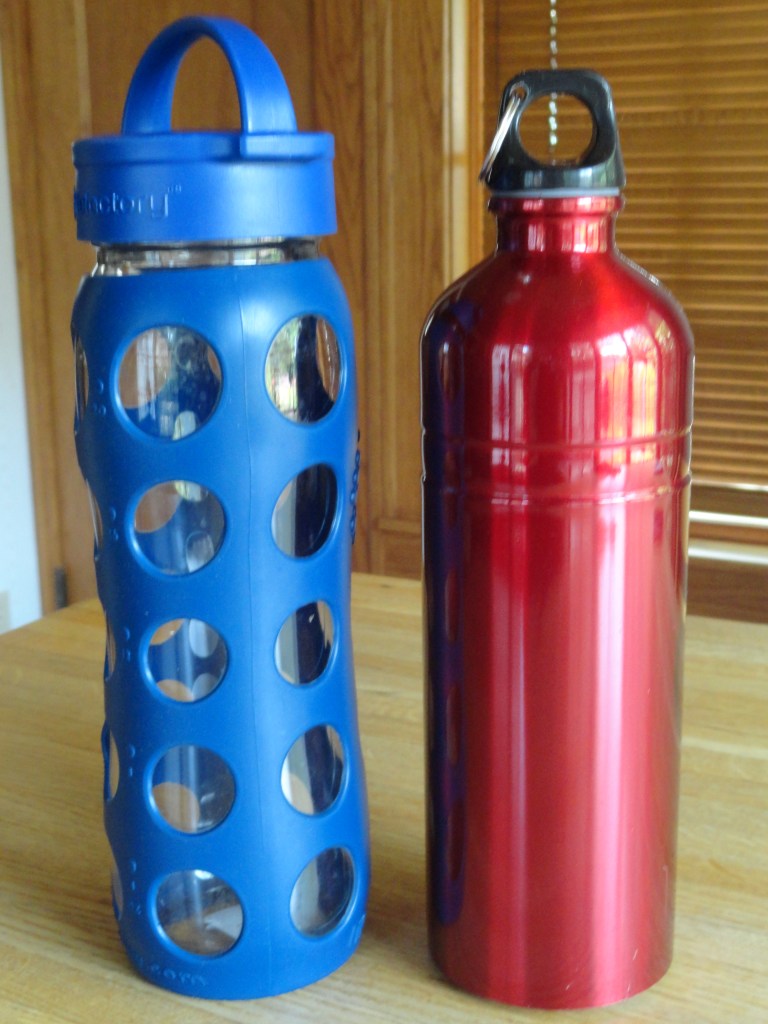
  • Always carry a reusable glass or metal water bottle, and reusable shopping bags with you.
  • Learn to refuse single-use plastics, such as plastic water bottles and coffee cups, straws, plastic bags and plastic utensils. 
  • Purchase fruit and produce in the bulk section, and don’t place items in plastic bags. 
  • Always search out products in glass jars instead of plastic containers. 
  • When you must buy plastic products, choose ones that you can recycle rather than ones you must put in the trash. 
  • Bring your own containers and shop the bulk section of your local food coop.
  • Purchase clothing made from cotton and wool instead of polyester or poly fibers. https://www.npr.org/2023/07/19/1188343293/is-toxic-fashion-making-us-sick-a-look-at-the-chemicals-lurking-in-our-clothes
  • Store food in glass containers instead of plastic.
  • Ditch the baggies!

Plastic in our Food and Water

Many reasons to use a non-plastic reusable water bottle.

New studies on plastic start to emerge.

In a trailblazing new study, researchers have discovered bottled water sold in stores can contain 10 to 100 times more bits of plastic than previously estimated — nanoparticles so infinitesimally tiny they cannot be seen under a microscope.

Disposed plastic water bottles blanket a beach in New Taipei, Taiwan in 2022.

The plastic water bottle industry is booming. Here’s why that’s a huge problem

At 1,000th the average width of a human hair, nanoplastics are so teeny they can migrate through the tissues of the digestive tract or lungs into the bloodstream, distributing potentially harmful synthetic chemicals throughout the body and into cells, experts say.

One liter of water — the equivalent of two standard-size bottled waters — contained an average of 240,000 plastic particles from seven types of plastics, of which 90% were identified as nanoplastics and the rest were microplastics, according to the new study. https://www.cnn.com/2024/01/08/health/bottled-water-nanoplastics-study-wellness/index.html?utm_term=17051508781315d4f59f626ee&utm_source=cnn_Weekly+LBB+Automated&utm_medium=email&bt_ee=uul4Fxg9FZKZA30rzJn08%2BUBxjUR1MOAuPwj1fjq3OFfXysulwJVn0gwksla8rm%2B&bt_ts=1705150878134 Source CNN

And from Consumer Reports:

Another new report finds that 84 out of 85 supermarket foods and fast foods had plastic chemicals in them — including cereal, yogurt and even baby food.1

We shouldn’t be so nonchalant about harmful chemicals in the food we eat, and especially not in the food we serve to babies.

Tell the U.S. Food and Drug Administration: Test for, limit and, wherever possible, eliminate plastic chemical contamination in food.

Among the chemicals found in the food were “plasticizers” like BPA, once found in so many plastic water bottles, and phthalates, a chemical used to make plastic more durable.

Companies have allowed these plasticizers into a dizzying range of food products. But they seem to have forgotten to ask themselves: Should we?

After all, chronic exposure to plasticizers can disrupt the production and regulation of estrogen and other hormones, and potentially increase the risk of birth defects, cancer, diabetes, infertility, neurodevelopmental disorders, obesity and other health problems.2

We can’t keep letting companies get away with this “ask for forgiveness, not permission” approach to harmful substances in our food.

Join PIRG in urging the FDA to help get plastic chemicals out of our food. Add your name

1. Jonathan Stempel, “Consumer Reports finds ‘widespread’ presence of plastics in food,” Reuters, January 4, 2024

Plastic and our Health

Plastic pollutes our environment and bodies every phase of its life, from extraction, to production, to its use, and then disposal. Also, plastic harms our bodies and contributes to climate change every step of its long plastic life.

This is all depressing, but it is information everyone should know.

Plastic particles can cause heart attacks and strokes, cancer and dementia, but absolutely the worst is plastic and children. Please pay attention.

A group heavily harmed by use of plastics are fetuses and newborns, who absorb microplastics through the mother’s body and breast milk, and young children, who are especially sensitive to plastic chemicals that leach into our food and beverages because their bodies and systems are developing so fast. Landrigan, who is co-author of the book “Children and Environmental Toxins. What Everyone Needs to Know,” said, “Toxic chemicals can damage babies and children at the lowest detectable levels.”

“Brain damage caused by plastic chemicals can contribute to autism, ADHD and IQ loss, The only treatment is prevention of exposure.”

Pediatrician Describes Health Risks and Solutions to Country’s Plastics Problem

Posted on August 24, 2023

Microplastics infiltrate all systems of the body, causing behavioral changes.
Neuroscience Pharmacy Professor Jaime Ross’ study finds ‘widespread’ infiltration, potential for serious health consequences, including Alzheimer’s.

“The brain blood barrier is supposed to be very difficult to permeate. It is a protective mechanism against viruses and bacteria, yet these particles were able to get in there. It was actually deep in the brain tissue.”

Another article

How Plastic Created One of the Most Dire Crises Humanity Faces Today  by THOM HARTMANN, AUG 29, 2023

https://hartmannreport.com/p/how-plastic-created-one-of-the-most-598
“The researchers found that the particles had begun to bioaccumulate in every organ, including the brain, as well as in bodily waste.”
 Microplastics and nanoplastics can have a wide variety of negative effects on There are studies showing microplasstics and nanoplastics can contribute to or cause everything from heart attacks and strokes to cancer and dementia. … and breast and colorectal cancer.

https://pubs.acs.org/doi/full/10.1021/acs.est.3c01942 This article deals with storing food in plastic. I think it is very worthwhile. Plastic pouches are the worst!

Twelve Rs for December

Happy December! Being kind is so easy, and December should be a month of kindness. The Actions for Happiness Calendar is below. Earth kindness is also so important.

During December plastic waste and food waste increases. This December see how you can apply the some of the twelve Rs to reduce your plastic waste footprint. Start by banning all glitter from your home and always bringing your reusable shopping bags.

REMEMBER

REKIND

REDUCE  

REUSE  

REFUSE  

REFILL 

REPAIR  

REPURPOSE 

RETHINK  

REGIFT  

RESEARCH 

RECYCLE 

Plastic-Free Presents: Mindful Gifting for Healthier Holidays – YouTube 

Another video from Plastic Pollution Coalition:

Kindness creates a ripple, spread it every day, and everyday do something kind for the planet by reducing your plastic consumption!

Tips to use less plastic: https://health4earth.com/2022/02/27/tips-to-use-less-plastic/

Plastic In Our Food and Air

Do we have too much plastic in our world?

Do we really want to ingest plastic microbeads every time we eat and drink?

Currently I am participating in a community plastic challenge working to reduce the plastic we send to landfills. I’m challenging myself to think of new ways I can reduce plastic in my home and for my family. It is impossible to eliminate all plastic, but we can be healthier by reducing plastic’s impact in our homes and lives.

These are the things I am working on to reduce plastic in my home:

1. Purchase fresh unpackaged produce. Always travel with reusable bags and reusable bottles and containers.

2. Store leftovers in glass containers and jars.

3. Never purchase take-out unless their containers are reusable or compostable.

4. Only cook in glass or metal pans

5. Purchase glass containers over plastic containers. Good examples are mustard, honey, and vinegar.

6. Make a conscious effort to purchase clothes, towels and sheets made of organic cotton and wool, and keeping our surroundings dusted and vacuumed will eliminate some of the microplastics we breathe.

What are the facts we know about plastic?

-Plastic production pollutes our water and air

-Plastic microfibers have been found in the food we eat.

-Micro fibers of plastic are in the clothes we wear and therefore in the air we breathe.

­-Plastic is the most common litter found in the oceans.

-Studies are just beginning on how harmful plastic is to our health.

Using glass containers gives me confidence we are reducing our plastic contamination

Reading list:

Plastics in our Food? – FOOD, FACTS and FADS (foodfactsandfads.com)

8 Everyday Foods That Contain Plastic and Safe Alternatives (nestandglow.com)

Toxic Nanoplastics Found at North and South Poles – EcoWatch 

Industrial plastics found in some fast food, researchers say | TheHill

UN to Create Global Treaty on Plastic Pollution – EcoWatch  

We Have Breached the Planetary Boundary for Plastics and Other Chemical Pollutants, Scientists Say – EcoWatch

U.S. Is World’s Biggest Producer of Plastic Waste, Report Finds – EcoWatch

California Just Passed 5 Mega Laws to Fight the Plastic Crisis – EcoWatch 

Holiday Sustainability

“We have the choice to use the gift of our life to make the world a better place–or not to bother” Jane Goodall


Our actions and daily choices speak to the world we want to create. This holiday, we can choose to make friendly choices for our planet. Instead of buying new decorations use what you have and follow these simple steps to make your decorations, gifts, and gatherings more sustainable: Seven tips for an earth-friendly holiday season (worldwildlife.org)

Look at the materials gifts are made from and keep sustainability in mind. Use paper products made from recycled materials and avoid single-use plastics that can’t be recycled. Buying secondhand items like vintage clothes, furniture, and refurbished technology is another great way to gift more sustainably.

Look for cards and wrapping paper made from recycled materials. Avoid foil-backed cards or those with **glitter—which aren’t recyclable.

ban glitter

Glitter is a microplastic!

** Reasons to avoid glitter:

A few facts about glitter will surprise you!

  • Glitter is made of a microplastic known as Mylar, which is hurting ocean life
  • This plastic accounts for 92.4% of the 5.25 trillion pieces of plastic in the ocean
  • Marine life is mistaking glitter for food, which is damaging their livers
  • Every tiny sparkly bit takes thousands of years to break down

Seven tips for an earth-friendly holiday season (worldwildlife.org)

5 Changes to Make Your Holiday Celebrations More Sustainable (thespruce.com) 

3 Major UK Retailers Are Banning Glitter This Christmas Over Environmental Concerns – EcoWatch

Glitter is a Microplastic


ban glitter
Glitter does more harm than good.

My least favorite thing about the December holidays is glitter! How many of the holiday cards will you receive that contain glitter? TOO MANY! Please do not purchase cards wrapping paper or anything containing glitter. Some spread it everywhere by putting it in their hair or in their make-up.

I know some think glitter is festive, but glitter is something we can live without! We know what a mess glitter is to clean up and it creates the same problem in our waterways. It’s impossible to manage and I am sure we ingest some of it also. It is not healthy and some scientists are calling for it to be banned.

A few facts about glitter will surprise you!

  • Glitter is made of a microplastic known as Mylar, which is hurting ocean life
  • This plastic accounts for 92.4% of the 5.25 trillion pieces of plastic in the ocean
  • Marine life is mistaking glitter for food, which is damaging their livers
  • Every tiny sparkly bit takes thousands of years to break down

3 Major UK Retailers Are Banning Glitter This Christmas Over Environmental Concerns – EcoWatch