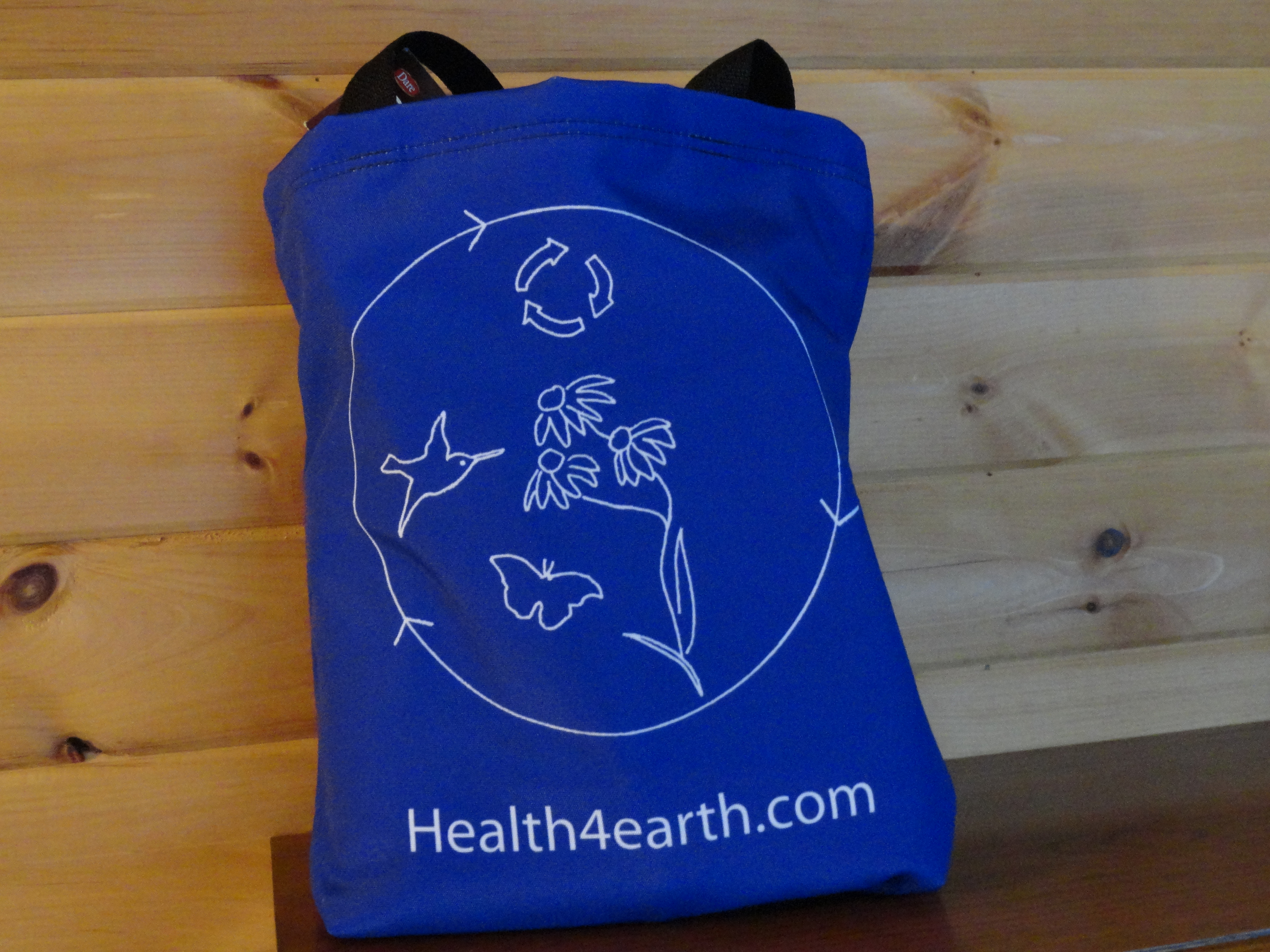
When you shop, do you try to purchase products made from recycled materials? This green business, Banner Creations, in Minneapolis is a hero of mine. They sew and make products from material made from recycled plastic. I purchased my reusable shopping bags (above) from them, and not only did they make a fabulous product, they were creative and efficient to work with.
With a little planning, it’s easy to make your Fourth of July celebrations red, white, blue and GREEN. Follow these tips to make your Independence Day celebration a little more environmentally friendly:
• Recycle! Provide your 4th of July guests with recycling containers or ask your host for one. Print recycling labels for free at http://www.hennepin.us/eventrecycling.
• Use your own dishware instead of disposable paper or plastic plates and silverware. Although you may spend a few extra minutes at the sink, the extra effort goes a long way in reducing waste!
• Grocery shopping for the 4th? Remember to bring your own reusable shopping bag.
• Provide reusable food containers for guests to bring leftovers home, or encourage your guests to bring their own. You’ll have less to clean up and avoid food waste!
• Look for air quality updates and avoid having a bonfire during poor air quality days. MPC.com
• Traveling around town for the 4th? Bike or use public transportation instead of driving if possible.
• Buy 4th of July decorations that can be reused every year instead of decorations that can only be used once.
I thank Pope Francis, along with millions throughout the world, for encouraging churches and all of us to discuss and think about our unsustainable habits. Pope Francis is concerned with the lack of fresh drinking water, the loss of bio-diversity, and the diminished quality of life many on our planet are experiencing. The Pope and I would disagree on birth control, and the sustainability large families, but I think his other ideas are right on! The list below is the best list I have seen on things we can all do to reduce our carbon use. Below is from Priest Father Rocky:
10 things you can do to implement “Laudato Si.”
1. Use 10% less air conditioning — in home and in car 2. Use 10% less fuel — at home and in car 3. Drive 10% slower 4. Use scrap paper for your first draft 5. Use natural light instead of electric whenever possible 6. Turn off the lights when you leave the room 7. Use real plates, napkins, and cups: not paper and plastic 8. Reduce water consumption (recycle shower water into the holding tanks for toilets) 9. Be respectful at home: “please and thank you” 10. Say Grace BEFORE and AFTER meals.
Use Glass Containers. I gave these for Christmas gifts this past year
I continue to try to get everyone to think about the amount of plastic we use in our lives. Below are some ways we can reduce plastic. When I shop I constantly think how I can avoid products packed in plastic, and how to reuse any plastic I already have.
Below are some surprising facts about plastic from Thegreendivas.com and ecowatch.com
22 Preposterous Facts about Plastic Pollution.
• In the Los Angeles area alone, 10 metric tons of plastic fragments—like grocery bags, straws and soda bottles—are carried into the Pacific Ocean every day.
• Over the last ten years we have produced more plastic than during the whole of the last century.
• 50 percent of the plastic we use, we use just once and throw away.
• Enough plastic is thrown away each year to circle the earth four times.
• We currently recover(recycle) only five percent of the plastics we produce.
• The average American throws away approximately 185 pounds of plastic per year.
• Plastic accounts for around 10 percent of the total waste we generate.
• The production of plastic uses around eight percent of the world’s oil production (bioplastics are not a good solution as they require food source crops).
• Americans throw away 35 billion plastic water bottles every year (source: Brita)
• Plastic in the ocean breaks down into such small segments that pieces of plastic from a one liter bottle could end up on every mile of beach throughout the world.
• Annually approximately 500 billion plastic bags are used worldwide. More than one million bags are used every minute.
• 46 percent of plastics float (EPA 2006) and it can drift for years before eventually concentrating in the ocean gyres.
• It takes 500-1,000 years for plastic to degrade.
• Billions of pounds of plastic can be found in swirling convergences in the oceans making up about 40 percent of the world’s ocean surfaces. 80 percent of pollution enters the ocean from the land.
• The Great Pacific Garbage Patch is located in the North Pacific Gyre off the coast of California and is the largest ocean garbage site in the world. This floating mass of plastic is twice the size of Texas, with plastic pieces outnumbering sea life six to one.
• Plastic constitutes approximately 90 percent of all trash floating on the ocean’s surface, with 46,000 pieces of plastic per square mile.
• One million sea birds and 100,000 marine mammals are killed annually from plastic in our oceans.
• 44 percent of all seabird species, 22 percent of cetaceans, all sea turtle species and a growing list of fish species have been documented with plastic in or around their bodies.
• In samples collected in Lake Erie, 85 percent of the plastic particles were smaller than two-tenths of an inch, and much of that was microscopic. Researchers found 1,500 and 1.7 million of these particles per square mile.
• Virtually every piece of plastic that was ever made still exists in some shape or form (with the exception of the small amount that has been incinerated).
• Plastic chemicals can be absorbed by the body—93 percent of Americans age six or older test positive for BPA (a plastic chemical).
• Some of these compounds found in plastic have been found to alter hormones or have other potential human health effects.
Choose to reuse when it comes to shopping bags and bottled water. Cloth bags and metal or glass reusable bottles are available locally at great prices.
Refuse single-serving packaging, excess packaging, straws and other “disposable” plastics. Carry reusable utensils in your purse, backpack or car to use at bbq’s, potlucks or take-out restaurants.
Reduce everyday plastics such as sandwich bags and juice cartons by replacing them with a reusable lunch bag/box that includes a thermos.
Bring your to-go mug with you to the coffee shop, smoothie shop or restaurants that let you use them, which is a great way to reduce lids, plastic cups and/or plastic-lined cups.
Go digital! No need for plastic cds, dvds and jewel cases when you can buy your music and videos online.
Seek out alternatives to the plastic items that you rely on.
If you must use plastic, try to choose #1 (PETE) or #2 (HDPE), which are the most commonly recycled plastics. Avoid plastic bags and polystyrene foam as both typically have very low recycling rates.
This land is your land, this land is my land: In honor of Earth Day this Wednesday, April 22, make a resolution to do one thing new for our earth. Pledge to use your reusable water bottle, use reusable shopping bags, turn off lights and electronics, plant native plants and milkweed, or walk more and drive less. It makes a big difference if everyone does just a small part!
Definition of precycle: Tomakepurchasingdecisionsthatwillreducetheneedtorecycleor throw into the landfill trash. You precycle so there is less trash to throw away.
Today I was at my local coop refilling my containers, reusing my produce bags, and reusing egg cartons for bulk eggs. #BuyBulk
My 5 ideas for precycling are first, and then five from David Suzuki’s Queen of Green
First, always bring your reusable bags.
Shop with your reusable bags
Second, choose products that use minimal packaging.
Third, carry your own reuseable water bottle, choose glass over plastic, and reuse glass containers and jars
Fourth, Bulk purchases allow you to purchase the amount you need. I fill my reusable containers with nuts, spices, oatmeal, tea, grains, beans, eggs, and soaps. Whole Foods and coops have recyclable/compostable brown paper bags for bulk items. Placing your bulk items in a “one use” plastic bag negates the environmental advantage of bulk purchases.
Fifth, use washable reusable cloth bags for produce purchases. Avoid products on Styrofoam trays wrapped in plastic film. If you purchase meat or fish, ask for a compostable wrapping.
Some co-ops have fabulous selections of soaps and lotions to refill your bottles
Below are ideas from David Suzuki’s Queen of Green and what prompted me to do this post. She has great ideas below to reduce our waste:
Five tips to recycle less http://www.davidsuzuki.org/blogs/queen-of-green/2015/03/five-ways-to-recycle-less/
Tip one: Shop smarter. Beware of excess packaging from all consumer goods — food, personal care products and electronics, even organic, local, non-toxic and GMO-free stuff.
Tip two: Never recycle another glass jar!
Tip three: Reduce is the first “R”.
It’s time for a plastic diet! Buy fewer prepared foods, buy in bulk and pack waste-free lunches.
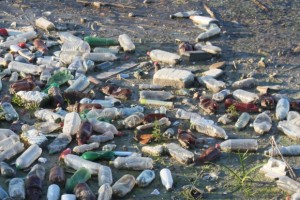
This trash could end up in our lakes and oceans breaking into little pieces that last many years.
#TalkingTrashTuesday
The snow has melted, the sun is shining, it is time to pick up litter from the winter. Carry a bag with you to pick up trash. It makes our world look SO much better, and it keeps trash from washing into our lakes, streams and oceans.
Pick up One Piece of Trash a Day https://www.facebook.com/pages/Pick-up-One-Piece-of-Trash-a-Day/267910856667805?fref=nf
Take The Pledge to Use Less Plastic Every Day http://actnow.surfrider.org/app/sign-petition?0&engagementId=58936
Change Begins Onshore
Plastic lasts forever… our oceans are turning into plastic soup.
It doesn’t biodegrade and no naturally occurring organisms can break it down. Plastic photodegrades, which means that sunlight breaks it down into smaller and smaller pieces. Those small pieces drift in the ocean and are mistaken for food by fish and birds.
It is undisputable that plastic pollution is killing marine life through ingestion and entanglement in plastic marine litter.
Up to 80% of the plastic in our oceans comes from the land – us. Single-use is ocean abuse. So, make a pledge today to make these simple 5 changes, which will have a huge impact on our oceans health:
1) Use cloth shopping bags. For each reusable bag you use, it’s estimated that another 400 plastic bags will be kept from being used. 2) Forget bottled water and carry a reusable canteen. Every reusable water bottle will keep another 167 plastic bottles from entering the environment. 3) Bring a reusable mug when you go to your local coffee shop. 4) Skip the straw, which are one of the top 10 items found on beaches. 5) And, of course, Recycle!
TAKE THE PLEDGE: COMMIT to Rising Above Plastics! http://actnow.surfrider.org/app/sign-petition?0&engagementId=58936
Avoid plastic, fill your glass or metal bottles with water or other liquid
Talking Trash Tuesday
Please take a reusable bottle with you today, and say “No” to plastic!
Today I start my new series on trash that should be recycled! In 2015 there is no excuse that recyclables fill our landfill trash cans. I am guilting everyone into recycling more. Because this is World Water Week, I am worried about the plastic that fills our water bodies. Plastic makes up 80% of the trash found in the ocean. This plastic could be part of the ocean forever breaking into little tiny fragments ingested by fish and other sea life and eaten by us??
Styrofoam I pulled out of lakes breaking into small pieces
This past January when I was visiting one of the most beautiful places on earth, the Caribbean, I observed litter that upset me. Yes, I am obsessed with litter and clean water. Litter along waterways is unacceptable. The shock was that some local restaurants only served their food in Styrofoam boxes. The Styrofoam boxes were littering the street gutters and shoreline. I wanted no part of this Styrofoam disaster, and searched for food on real plates. Often they had to wash plates just for us.
Trash in the Caribbean
Why does this upset me? Styrofoam breaks into tiny pieces and no one knows how long it will last in our oceans, maybe forever. Not good for sea life or ocean health. Styrofoam can be recycled, but it is very hard to find. Manufacturers of Styrofoam as well as Coca-Cola and plastic bottle industry should recycle the harmful products they produce, and we should all avoid Styrofoam and plastic bottles as much as possible.