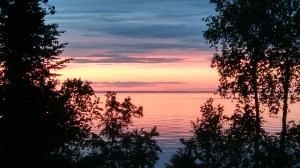
June is a month of variety, fresh green plants, and interesting skies. As the month ends, I reflect on the beauty of Lake Superior and the landscape that surrounds it. The length of the days and natural beauty is energizing. Everyday differs with the direction of the wind, and the big lake is usually part of this equation.
The birds are secretly nesting and raising their young, but I watch an unaware flicker fly in and out of her nest hole with food.
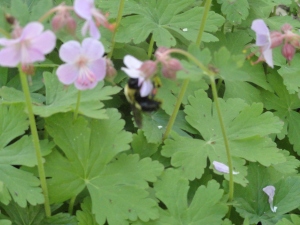
Wild geranium, easy to grow, is loved by bees and butterflies.
White Admiral ButterflyLupine on Lake Superior
The lupine, wild geraniums, Canada anemone, thimbleberry, and raspberries bloom while the milkweed takes over the garden path.
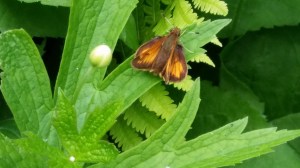
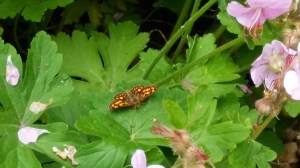
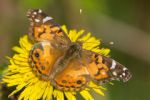
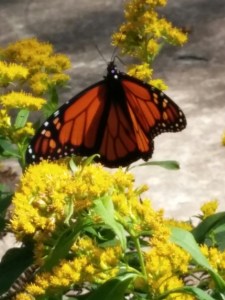
I love butterflies, and National Pollinator Week gives me an excuse to concentrate on what brings butterflies to my yard and to my walking routes. This week I learned two new skipper butterflies: the hobomok skipper and Arctic skipper. Both are crazy for wild geranium, The yellow swallow-tail, painted lady and admirals are plentiful now also, and a few monarchs are checking out the milkweed. Also, this week I saw one pearl crescent and a silvery blue.
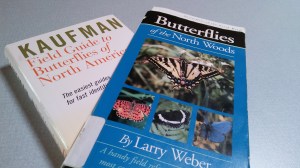
Arctic skipper on wild geraniumFavorite butterfly books
Below are two books that help me identify butterflies, and here is an on-line butterfly guide.
Have fun land I hope you enjoy butterflies as much as I do! Get out for a walk and look!
I know people get tired of my harping on plastic, but plastic is a serious world problem. According to the Plastic Pollution Coalition the average shopper uses 500 plastic bags a year, and that is just bags, not all the other plastic products. This is not sustainable!
I love thinking of how my grandparents lived, and how it is different from today. I loved this post from One Green Planet about what we can learn from the past and from our grandparents. Read it here.
Below is a quote from One Green Planet which show how serious this plastic issue is!
“In the past 30 years alone, the amount of plastic produced worldwide has increased by 620 percent! On average, that equates to 300 million tons of plastic a year. Of this 300 million tons, about 8.8 million tons find their way into the world’s oceans where they are left to slowly photodegrade into smaller pieces – and by slowly, we mean over the course of 100 to 1,000 years. When you consider the huge volume that is added to the oceans every year and the fact that plastics never really “go away,” we find our oceans crowded with a massive soupy mixture of harmful plastic products. This sadly has a massive impact on the marine animals who call our oceans home. Around 700 marine species are in danger of extinction due to entanglement, ingestion or general pollution caused by our plastic trash.”
Our grandparents didn’t have the choices and variety we do. They cooked and ate hearty food on real dishes, but most important they conserved, reused, and didn’t throw everything away like we do today! I would stay with my grand parents for a week and we didn’t need to run to the store to buy buy buy. We used what we had.
What do you remember about how your grandparents did things?
Even remote islands are collecting our plastic trash
Deep-rooted plants absorb more water than turf grass. Cone flowers, bee balm, and black-eyed Susan
Just making a few adjustments to your yard can make big difference for our climate. If everyone does a little bit, it adds up to a lot! Some amazing statistics on our lawns from “greener lawn” below:
*Grass covers more land in the US than any other crop.
*It’s estimated that there’s up to three times more acres of lawns than corn, according to NASA
Fritillary butterfly on bee balm.
*Homeowners use up to 10 times more chemical pesticides per acre on their yards compared to what farmers use on their crops, according to the U.S. Fish and Wildlife Service.
Some other ideas to slow climate change and help pollinators:
Adding new pollinator plants is not easy if you are a hosta gardener or a new gardener.
I would start small by adding a few of these: purple cone flowers, black-eyed Susan, bee balm, a few asters, and columbine. I suggest these because many garden stores sell them, they are easy to grow, add diversity, and are loved by pollinators.
“It is horrifying we have to fight our own government to save the
My yard without chemicals
environment” Ansel Adams
We now have a government that is dismantling all protections the American people have from corporate America. Corporate profits now take priority over the health of people, wildlife and the entire planet earth. The United Nations released a report this week stating how harmful pesticides are to people and the planet.
“The chronic overuse of pesticides across the world has caused “catastrophic” harms to human health, human rights and global biodiversity, according to a report presented to the United Nations human rights council Wednesday.
The UN-solicited study on toxic chemical impacts to global food sources criticizes pesticide manufacturers’ “systematic denial” of the broad harms caused by their products and calls for a transition to healthier farming methods that move away from the current dependence on pesticides.” Read about it here. And more about it from Ecowatch.
And read about the state of our bees from pesticide use and habitat loss.
“It is simply not possible to understand why the EPA behaves the way it does without appreciating the enormous power of American’s industrial farmers and their allies in the chemical pesticide industries, which currently do about $40 billion per in year business. For decades, industry lobbyists have preached the gospel of unregulated capitalism and Americans have bought it. Today, it seems the entire government is at the service of the private interests of America’s corporate class.”
We can only control our corner of the world. I hope you will think twice before putting pesticides on your yard, and speak out against the use of chemicals in agriculture and in our parks!
Jane Goodall: How Can We Believe It Is a Good Idea to Grow Our Food With Poisons?
This is a collection of hopeful stories I have read the past week.
I love the hopeful stories of this past week. These are stories that give an exciting projection of what the world is going to be like in the future. This is my occasional series on hopeful good news stories happening throughout the world.
1. Cedar Rapids, Iowa is planting 1,000 acres of native prairie to create bee/butterfly/bird/wildlife habitat by planting native prairie plants. 99.99% of Iowa’s native habitat is gone. Information at Iowa Let’s hope other communities will do the same!
2. IKEA has created growrooms which are large, multi-tiered spherical gardens that are designed to sustainably grow enough food to feed a neighborhood.
3. India: This one is beyond my understanding: Scientists in India have captured carbon and are turning it into baking soda. Read about it at India
4. Indonesia: Indonesia, a nation of many islands, has strong goals to cut plastic use. Read about it here.
5. Texas: “I never thought that wind would pay more than oil,” said a Texas landowner. Wind power is paying ranchers more money for wind than oil. Read about it at Texas.
6. Hope for the Paris Climate Agreement. Ivanka Trump and her husband seem to support the historic climate deal.
7. Copenhagen now has more bikes than cars which is no surprise if you visit this biking city. Their bikes lanes are as wide as car lanes. See video bikes in Copenhagen
A few weeks ago I wrote how stressful the American election was for everyone. The post-election has been even more stressful. The surprise results, disrespect for diversity, uncertainty and anger have been difficult for my circle of people. Today is World Kindness Day which makes me think of my late mother. She was a role model for being kind in everything she did.
Change and uncertainty are scary. We have lost control of our futures and the future of our earth. With all the verbal garbage of the past year no one has a vision of what the future holds. Today as I read the conservative views in the newspaper, I felt they were uncertain and scared also.
We love the diversity of our choices
Diversity is so important whether you are talking about people, ideas, plants, foods, wildlife, everything. Mono-cultures can’t survive. They are not sustainable. Does anyone want to live in a world where only one kind of plant or tree grows? A world where we eat only one food? What if every dog was exactly the same? What if everyone thought exactly the same, and golf was the only sport to play? How boring!! I know this is silly, but it is diversity that makes life interesting. Diversity makes our freedoms and choices important, we are not all alike.
The uncertainty will not go away, but we can all be more kind. This week I plan to smile more, criticize less, listen better, and appreciate the diversity of our human family and diversity of our earth, and ….
I have a love-hate relationship with spiders. They are a mess to pick up after, leaving droppings on my floors and the outside of my house. They build webs in every corner and under chairs and furniture. And Spiders are scary.
BUT
They do so much good for the earth and are one of the most interesting living things on our planet. Spiders eat more insects than birds and bats combined, and they are valuable food source for birds and bats. Hummingbirds use spiderweb material to build their nests. The most fascinating thing about spiders are those incredible webs, and famous stories in literature are Charlotte’s Web and Arachne. Some spiders build a new nest every day, and in Ukraine Christmas spiders are good luck. Factretriever.com has put together 83 amazing facts about spiders. Read them here.







 “It is horrifying we have to fight our own government to save the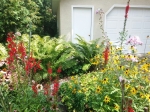




 Health4earth