The Trump Administration needs to restore all the cuts they have made to the National Weather Service!
I am fascinated by weather, but I am also frightened by it. It is not something we can control, and we need the best scientists to help us understand the weather and the impending dangers.
This past weekend more than 40 people were killed in the Southern United States because of high winds, tornadoes, fires, and weather related accidents.
At the same time the Trump administration is cutting and firing the same people that warn us of these raging dangerous storms.
This is from Paul Douglas in the Minnesota Startribune:” Words matter, especially to the NOAA scientist and National Weather Service meteorologists trying to keep you alive when skies become violent. Watches, warnings. And then there are emergencies, which pose the greatest threat to life and property. The country with the most severe weather on Earth (the U.S.) deserves the best National Weather Service on Earth.” Paul Douglas
I’m calling on the Trump Administration to restore all cuts they have made to the National Weather Service.
Everyday people throw away single-use plastic “stuff” without thinking twice — plastic bottles, bags, utensils, cups, containers and more.
But this “stuff” never truly goes away. Instead, it clogs our landfills, threatens our health, trashes our parks, litters our streets and even washes into our rivers and oceans. Nothing we use for a few minutes should threaten our health and pollute our future for hundreds of years.
Join the February Plastic Challenge!
The Plastic-Free Challenge is a month-long effort starting February 1 to reduce how many plastics you use in ways that fit best in your lifestyle and have the most impact on reducing your plastic footprint.
Do something positive for yourself, your family and for the planet in February. With so many plastic items in our lives avoiding them may feel impossible, but there is a lot we can do to reduce our plastic footprint. Please Join with us to learn ways we can reduce our exposure to plastic. There are many activities to choose from, but you can also create your own challenge. Keep it simple, and even choosing one activity will make a difference. You will learn a lot, and have fun during this February challenge. Sign up here:
The Plastic-Free Challenge is a month-long effort starting February 1 to reduce plastic consumption, in ways that fit best in your needs. You only need to choose one activity that works for you like bringing your reusable shopping bags, or asking not to be given a straw with your drink, or bringing your reusable cup with you for February. Many other ideas will be suggested when you register. Keep it simple. Do a good job on one thing!
“Darkness cannot drive out darkness, only light can do that. Hate cannot drive out hate, only love can do that!” Martin Luther King
Be kind!
Today is the National Day of Service. Read about it here
What are you doing this week? Pick up litter, donate to a food self, visit someone who needs to be visited, send a thank you note or a letter of gratitude to someone, and ..smile.
“Sooner or later all the people of the world will have to discover a way to live together in peace, and thereby transform this pending cosmic elegy into a creative psalm of brotherhood. If this is to be achieved, man must evolve for all human conflict a method which rejects revenge, aggression and retaliation. The foundation of such a method is love.” Martin Luther King
Learn ways to reduce single-use plastic. Join my team here.
Do something positive for yourself, your family and for the planet in February. With so many plastic items in our lives avoiding them may feel impossible, but there is a lot we can do to reduce our plastic footprint. Be part of our Lynnhurst community team, Lynnhurst plasticfree. Please Join with us to learn ways we can reduce our exposure to plastic. There are many activities to choose from, but you can also create your own challenge. Keep it simple, and even choosing one activity will make a difference. You will learn a lot, and have fun during this February challenge. Sign up here:
The Plastic-Free Challenge is a month-long effort starting February 1 to reduce plastic consumption, in ways that fit best for your needs. You only need to choose one activity that works for you, like bringing your reusable shopping bags, or asking not to be given a straw with your drink, or bringing your reusable cup with you for February. Many other ideas will be suggested when you register. Keep it simple. Do a good job on one thing to reduce plastic!
Plastic is made of fossil fuels; it contributes to climate change and is composed of harmful chemicals. Plastic sheds microfibers into our bodies, into our air, and into our water. Studies are showing plastic is unhealthy for us and for the planet. It is important we limit our plastic exposure.
Take care of our bodies, our families and our planet. Reduce your plastic footprint!
Plastic is everywhere. Plastic breaks down into harmful pieces called microplastics. We consume them when we use plastic water bottles, plastic containers and utensils. Below is an article from Wirecutter on how to avoid plastic. It is excellent.
Our bodies are taking in plastic, and it’s more than nature intended.
1. Cut back on bottled water
Some research indicates plastic bottled water may be a significant source of microplastics. While scientists are still studying just how significant, one study from 2019 of water and other commonly consumed food and drink found it to be the most concentrated source.
There is emerging evidence that on average, bottled water contains more microplastics than tap. (One study published in 2024 suggests that we have underestimated measured concentrations.)
Drinking bottled water in a pinch isn’t the end of the world, but if you have concerns about it, you could always consider carrying a reusable steel or glass bottle or tumbler when out and about.
2. Get an NSF-certified water filter
Switching to tap water from plastic bottled water will likely significantly reduce your routine exposure to plastics. But while the average plastic water bottle contains more microplastics and nanoplastics than tap, research shows that tap water may also be a source of microplastics.
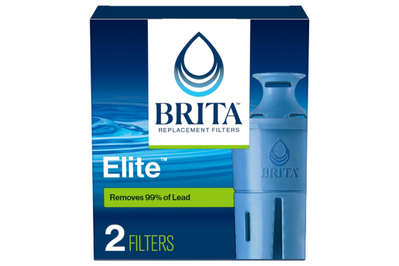
Several of our water filter picks are specifically NSF/American National Standards Institute–certified to reduce microplastics, which means they’ve been rigorously tested in an accredited lab. They’re certified only to reduce since the filters cannot guarantee total elimination. Our picks include under-sink filters, such as the Aquasana AQ-5200, and the Brita Elite.
Yes, it’s ironic that most NSF/ANSI-certified water filters contain plastic. But any microplastic shedding from using the plastic filter is likely to be minimal, as long as you avoid running hot water through the filter and store your water in the fridge, since heat accelerates plastic degradation.
Research suggests that boiling tap water, cooling it, and then filtering it may be especially effective at reducing microplastics, although it’s less practical for most people than simply using a filter.
3. Don’t use plastic to store food
Plastic food storage and packaging is so common that it’s difficult to avoid entirely. But your safest bet is to avoid storing food or liquid in plastic when possible and to minimize exposing any plastic (even those that say they’re BPA-free or microwave-safe) to high heat. Sunlight, acids, and physical erosion can also degrade plastic.
4. Don’t reuse single-use plastics for food and drinks
It’s great to reuse single-use plastic—just not for food. Unless you’re using the plastic in the freezer, save it for something that isn’t food storage or reheating, said Dr. Gillian Goddard, an endocrinologist and author at ParentData, a science-based online resource for parents. That means don’t reuse plastic takeout containers, breastmilk bags, or drink bottles.
5. Don’t microwave in plastic
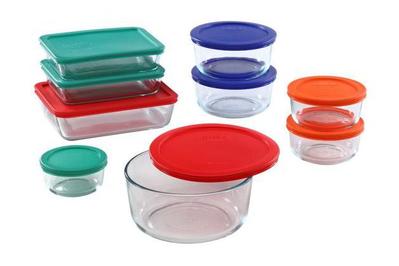
Avoid microwaving or heating food or water in plastic—even if it says it’s microwave-safe, said Tracey Woodruff, director of the Program on Reproductive Health and the Environment at University of California San Francisco. Instead, consider glass or ceramic. The Pyrex Simply Store 18-Piece Set is our pick for the best food storage containers, and they survived our drop tests, stack neatly, and come with user-friendly lids (although you may not want to microwave the plastic lids). Our runner-up, the leakproof Glasslock 18-Piece Container Set, is another great option.
Top pick
6. Wash plastic by hand
Dishwasher temperatures run very hot and can degrade plastic—even dishwasher-safe plastic—and lead to microplastic shedding. Try to wash your plastic food containers by hand.
7. Use wood or bamboo cutting boards
Some research suggests that plastic cutting boards can be a significant source of microplastics in your diet, since repeated cutting on their surface can dislodge particles that adhere to food. Wood cutting boards also have some other advantages: They’re better for your knife blades and last longer than plastic when properly taken care of.
Take special steps for infants and young children
Infants may be exposed to microplastics and nanoplastics in much higher concentrations than adults. Research shows that this exposure may be cause for concern, particularly at critical stages of early development. But much like health risks to adults, it’s important to think of microplastics exposure as just one piece of a child’s overall health.
“I emphasize that before putting much energy and resources into minimizing unknown risks, it is worth attending to reducing the risks we know about,” said Dr. Carlos Lerner, a pediatrician and professor of clinical pediatrics at UCLA Health. He cited following safe sleep recommendations for infants, avoiding secondhand smoke, and practicing good nutrition as examples.
If you want to take a more precautionary approach, avoid using plastic to warm formula or breastmilk. This is the main point of advice from the experts I spoke with, as well as the Cleveland Clinic.
1. Avoid microwaving or heating formula in plastic
Recent evidence shows that polypropylene-bottle-fed babies may swallow very high levels of tiny plastics due to the high temperatures used to sterilize bottles and prepare formula, as well as shaking the bottles to mix. If you want to feed your baby warmed formula and use plastic bottles, consider premixing the formula in a glass container, then cooling it down before transferring it to the feeding bottle.
2. Rinse heat-sterilized plastic bottles before adding formula or breastmilk
If you use heat to sterilize plastic bottles, leave them to cool then rinse them several times before filling them with formula or breastmilk, Lerner suggested.
3. Consider glass or silicone over plastic bottles
If your baby prefers warmed milk or formula, consider heating it in a glass or silicone bottle. (If you don’t use a bottle warmer, we have advice about how to safely do this without one.)
4. Wash hands before eating
For young kids who eat with their hands, try to establish a habit of handwashing before eating, said Woodruff. While handwashing is not always possible, it can help reduce exposure from touching microplastics in dust and soil (and maybe, just maybe, stem the tide of germs).
How worried should you be about microplastics?
Scientists are still studying the exact connections between these teeny tiny pieces of plastic and human health. But it’s clear that exposure to plastic—whether it’s those tiny particles, the chemicals they leach, or a combination—is being linked to a variety of worrying health issues.
Some of those connections still require more research, such as ties to colon cancer, respiratory disease, metabolic function, and disruption to endocrine systems, while others—like a recent study that found those with levels of plastics in their arteries were at a higher risk for heart attacks, strokes, and death—seem a little more clear.
It’s important to remember that these links point to concerns about the impact of microplastics on public health, but they are not specific, predictable outcomes. “What I’m thinking about is population risk, not a risk to a specific individual,” said Goddard.
The tricky thing is that microplastics and nanoplastics are impossible to avoid, no matter how diligent you are: They’re in the air we breathe, our drinking water, and our food. But scientists aren’t sure what levels of microplastics and nanoplastics we’re each taking in from those sources.
The oft-cited estimate that the average person eats a credit card’s worth of plastic every week has been called into question. But our bodies are certainly taking in plastic, and that’s more than nature intended.
Given the growing body of evidence, it’s possible that we’ll start to see more public health measures that address microplastic pollution. Until then, taking care of your overall health is the first line of defense, followed by taking reasonable steps to reduce microplastic exposure.
Melissa Clark is an extraordinaire food writer for the New York Times. She has set her food resolutions for 2025.
She is missing the most important food resolution: REDUCE your food waste! Food waste is an enormous waste of energy. time and water. Food waste is an enormous contributor to our climate crisis. Read about it here:
New Year’s resolutions are fast upon us, and chances are that your list will include some version of trying to eat better. I’m here to help.
Food is both my profession and my obsession, which means it’s my job to consume delicious things every single day, reveling in each bite of tangy arugula salad, silky roasted salmon or gooey blackout cake. The key for me is to maximize the pleasure while also leaning into moderation, and to generally eat more sustainably.
I want to share this balancing act with you. Here’s my approach, broken down into easily digestible morsels.
1. Learn to cook something — or something new.
If you’re just starting out in the kitchen, make 2025 the year you learn to cook. The recipe columnists and editors at New York Times Cooking have compiled a recipe collection for absolute beginners, and in the course of 10 dishes you’ll acquire basic skills to bolster your confidence.
Start with Eric Kim’s tuna mayo rice bowl, which doesn’t even require turning on the stove if you have leftover rice or a rice cooker. Genevieve Ko’s cheesy eggs on toast is equally good for breakfast as it is for dinner. And my lemony chicken with potatoes and oregano is easy to make on a sheet pan, and it’s just the thing to slather with your favorite condiment, be it chile sauce, mayonnaise, mustard or all three.
Keeping your pantry well stocked will get you halfway there — and here are some tips on how to do just that. Even on nights when I don’t have time to plan or run to the store, I know I’ll still be able to cook something incredibly satisfying that’s often faster and cheaper than getting takeout.
If you’re a seasoned cook but feel tapped out for inspiration, commit to making one new recipe per month. You get bonus points if it includes ingredients or techniques you’ve never tried before. Dishes like one-pot mushroom and ginger rice (which calls for velveting the mushrooms) and crunchy scrunched cabbage salad with fried almonds are just waiting to help you get back in your groove. You can also sign up for our What to Cook newsletter for even more suggestions.
2. Eat less meat.
Cutting back on meat gets easier for me as the years go by. As it turns out, the less meat I eat, the less of it I crave. (That is sadly untrue of cookies, though.) And replacing animal-based foods with whole grains, legumes and nuts has been linked to a lower risk of Type 2 diabetes and cardiovascular disease.
Now, I mostly use meat as seasoning for vegetables, beans or pasta. A little prosciutto, a sprinkle of bacon or a few ounces of ground turkey go a long way.
Drinking more moderately is about emphasis in my book. I’ve come to realize that drinking more low- or no-alcohol cocktails and mocktails is just as satisfying as drinking alcohol.
I’ve also discovered that the ceremony of having a drink is just as important as what’s in the glass, if not more so. Give me something with a deep bittersweet tang in a fancy coupe as a gateway to a congenial evening, and I won’t ever miss the hangover.
The world is facing a trash crisis a climate crisis and a plastic crisis and they are all related to our overconsumption.
So few people connect the climate crisis to the purchases they make. Overconsumption is harmful to our air, to our water and to our health. Landfills and incinerators harm our health. We need to stop competing to be just like everyone else. When we shop purchase items that are of high quality and items that will last a long time. None of us need more junk!
Instead of a season of overconsumption and waste, make it a season of friendship, love and community. That doesn’t mean buy me a gift!
Whether it’s choosing to shop secondhand rather than buy new or simply pausing before you hit the checkout button, we can all rethink the way we consume.
Unsubscribe from sales communication and unfollow brands on social media: We all get those pesky marketing emails, physical mail, and texts, not to mention an onslaught of social media sales messaging, around the holidays. We encourage you to ditch the noise – join over 2 million people who did here. Catalog Choice is a free, online service that will help you save trees, prevent fraud, and fight junk mail. What’s not to love?
The holiday season doesn’t have to be about more Stuff. Together, we can turn the tide against corporate-driven overconsumption and reclaim the real joy of the holiday season.
An estimated 20 million people are thought to earn their livelihoods in the global waste industry by collecting, disposing, repairing or repurposing a wide range of materials and products. However, the cost and consequences of handling waste are borne far more heavily in developing nations. In partnership with the Pulitzer Center, Fred de Sam Lazaro reports on the impact of waste from textiles.




 Health4earth