In my meetings some are wondering what big thing they can do to stop climate change. I think many people doing lots of little things to help our planet amount to a lot! We can all make a difference by buying less and wasting less. Thank you!
From Thanksgiving to New Year’s Day, household waste increases by more than 25%. Added food waste, shopping bags, packaging, wrapping paper, bows and ribbons all adds up to an additional 1 million tons a week to our landfills. (Source: EPA)
Enjoy your leftovers!
Make a plan for your holiday left over food. What do you generally do with left over food? 40% of the food in the United States is not eaten, and ends up in our landfills causing an enormous waste of our precious resources. Wasting food is an enormous waste of water, money, time, labor, energy and transportation. The Natural Resources Defense Council (NRDC) has an incredible education campaign to inform the public how much we are wasting. For example the production of one egg takes 55 gallons of water! Their website is savethefood.com
Not only does wasting food, waste valuable resources and lots of water, but also food in our landfills decomposes creating and giving off methane gas which is a harmful air pollutant contributing to global warming
So let’s get creative and “Save the Food.” One of my favorite cooking activities is to reinvent leftovers into a new lunch or dinner stir fry, soup, tacos, enchiladas, salads, fried rice, quinoa bowls and many other things lend themselves to create special meals of leftover food.
Have a fun holiday, and make a creative difference by reusing, planning, seriously cutting waste, and saving food from the garbage!
Plastic recycling is very challenging. There is very little regulation of plastic in the United States. Plastic producers claim recycling is the answer to their products, but they don’t want any responsibility to pay for recycling or disposal of their products. They often they say their plastic is recyclable, when in fact it might be just one per cent recyclable or not at all.
Why is plastic recycling so hard? First there are those recycle 1-7 numbers. For something to be recycled it first needs to be collected, and then sorted into those numbers. Next, it needs a market, or someone to buy it. All this makes plastic recycling expensive for communities (tax payers) and it is labor intensive.
I am fortunate to live in a county (Hennepin) that makes this a priority, and I can’t express my gratitude to them enough!
Both Maine and Oregon have passed legislation to hold producers responsible for recycling and disposing of their products. This is a beginning and it is hopeful that more regulation of plastic could happen. As consumers we also have responsibility, when we purchase plastic we reinforce the idea that this is OK, and more of it is produced. The plastic chemical companies are gearing up to produce more plastic for the future, lets work to hold them accountable! Talk to your elected officials about how plastic producers should be held responsible for what happens to long lived plastics after disposal. Manufacturers also need more integrity in labeling what is in their plastic products.
On America Recycles Day recycle more of your paper/cardboard, glass and tin cans, and recycle plastic bottles and containers, but also begin to REDUCE your PLASTIC consumption. Always bring your reusable cups/bottles, and bags for a start.
World Kindness Day is a global day that promotes the importance of being kind to each other, to yourself, and to the world. The purpose of this day, celebrated on November 13 of each year, is to help everyone understand that compassion for others is what binds us all together. This understanding has the power to bridge the gap between nations.
Make a special effort to be kind.
We all want to live in kind healthy communities. We want to live where we are respected and can thrive. Each of us can work for kinder environments by limiting the noise we create, picking up litter and after our dogs, sweeping our sidewalks, and listening and smiling more. How hard is that? We can create environments that are pleasant places to live. Kindness doesn’t cost any money! Kindness creates a ripple, it radiates out, and together we create happier and healthier places to live.
The world climate summit is taking place in Glascow, Scotland. The world has known for a long time it needs to do something about our warming earth. There has been such a lack of leadership to get something done, and now we have reached a point where it has become hard to ignore. During the first week some important promises to protect forests, reduce methane and reduce coal. Will it be enough? No, but the conversation has begun. Russia and China didn’t attend so continued efforts are needed to keep them moving forward and integrate them into the discussion
In the United States the powerful lobbyists and oil industry have been able to control and stop action, and it is still happening with Joe Manchin as he hauls in the cash to resist a move away from fossil fuels.
Strong leadership and a desire to work together needs to come out of this important conference. Together everyone is the solution to our climate, We must all set this as a priority over greed, lies and waste.
Everyday we make an impact, make it positive!
Speak out for change! Work for a healthy future!
During the pandemic 2020 carbon emissions were reduced and we can do it again. Everyday with just a little effort, we can make an impact, and move to a new future of sustainability Let’s start now by buying less junk, reduce our plastic use**, stop idling our engines, and a couple days a week eat meatless. Try walking and riding public transportation, you might like it!
There are some hopeful things happening in the world:
Amazing: Cars powered by combustion engines now make up less than 10% of sales in Norway, and forecasts suggest the country’s last sale of a new petrol or diesel car will come in April 2022, three years ahead of what was already the world’s most ambitious target. Drive
Russia has committed to carbon neutrality by 2060, Turkey has finally ratified the Paris Agreement, and the UAE has become the first petro-state to commit to net zero by 2050. Critics say these pledges aren’t enough, but they’re missing the point. They’re not promises. They’re ratchets – once announced, they only increase in ambition.
China has begun construction on the largest and most ambitious clean energy project of all time, 100GW of wind and solar in its western desert. That’s more than the entire existing wind and solar capacity of India, and will be able to generate four times as much power as the Three Gorges Dam. Bloomberg
More than 100 countries have joined the Global Methane Pledge with $300 million in funding to cut dangerous methane emissions.
Wealthy nations and billionaires promise billions to support green tech, end deforestation, end coal use, and more but much more is needed.
The important question is what happens after the summit? Countries should be meeting yearly to report their progress and set new goals. Also, continued work needs to be done getting all countries involved.
**Why we need to reduce our use of plastic: Plastics are on track to contribute more climate-change-causing emissions (to the tune of at least 232 million tons of greenhouse gases annually) than coal plants by 2030, according to a new report out of Bennington College. The reason? As fossil fuel companies seek to recoup falling profits, they’re increasing plastics production. REPORT: The New Coal: Plastics & Climate Change — Beyond Plastics – Working To End Single-Use Plastic Pollution
Thousands of years ago the Celtics celebrated November 1, as the New Year. This year in November the world climate summit is happening in Glascow. As New November converges with the climate summit lets create new positive goals to reduce our use of fossil fuels. Let’s all work together to make a difference for the earth.
Have fun reducing your carbon footprint.
The Actions For Happiness calendar below is about doing something new, perfect for setting new goals. You know what works for you and your household. Maybe you can reduce food waste or reduce the plastic that comes into your home. Maybe try back yard or drop-off composting or bring reusable bags shopping. Each one of us knows something positive we can do to make a impact. Good Luck.
This November we don’t know what will happen in Glascow, Scotland, but each one of us can make a difference. Every action counts. Lets focus our energy on making a healthy world for everyone! If everyone does a little, it adds up to a lot! What are some New November ideas you are excited to try?
Ruffed grouse scare me as they fly up as I walk into my yard. A flock of juncos fly into our yard, robins are devouring the Mt. Ash berries, yellow-rumped warblers are diving to eat flies off our house. The nuthatch and blue jays are emptying the feeder, the goldfinch are munching on something in a dead white pine, and woodpeckers are busy making their marks on trees. Yes, it is October on the big lake and we are all getting ready for the winter months ahead. All the energy and activity makes us happy.
For many days thick Fog hung thick over the lake signaling the drought has subsided and rain is again common. After many dark days the sun is welcome
Beautiful October
It has been an unusual Superior Views summer with a sun that seemed more intense than usual, and winds off the lake that were calmer than most summers. Sadly, wild fires from Canada and Northern Minnesota polluted the air quality for weeks at a time.
The warmer than normal summer changed the pattern of the plants and trees. The leaves turned earlier than normal and the flowers bloomed weeks earlier than usual. Actually, I think the native plants and flowers enjoyed the warm temperatures and milder winds, but the trees suffered with the heat and drought.
Lake Superior is not for sale! A local resident is trying to sell ground water for profit.
We are at the end of World Clean Up Month. As we pick up trash and works to keep our Earth clean, I always wonder, “What can we all do to keep the Earth cleaner and healthier?”
Bring your reusable water container.
My reuseable lunch containers
Today I walked by a car that had it’s back seat full of bottled water, and too often I see people with grocery carts full of bottled water. Why not purchase a large reusable container and fill that at a store? You could save hundreds of plastic bottles from ending in the landfill and live a more sustainable life.
I have confidence in our public water supply. I know where I live it is safe!
What are the costs of bottles water to our environment? A study done in Spain answers this question. Recycling and water in every community is different so we can’t make big generalizations, but in the United States recycling of plastic is only 9 tp 11% which makes bottled water awful for the environment. Also, the production of plastic uses fossil fuels and pollutes our air.
The study found that the environmental toll of bottled water was 1,400 to 3,500 times higher than that of tap water.
Another problem with bottled water is that companies like Nestle take free public water from aquifers to bottle and sell to the public. This is happening on Lake Superior right now (Lake Superior is not for sale). What a racket! Maine has passed a law to make companies responsible for recycling their products instead of the taxpayers. Read about it here Maine Will Make Companies Pay for Recycling. Here’s How It Works. – The New York Times (nytimes.com)
Being kind to others, and being kind to the Earth are actions for self-care!
The best weather of the year!
September is a huge leap from August. It is the end of meteorological summer, and after too much extreme weather, fires, flooding and a sad pandemic, many are ready to hope for a better month. Actions for Happiness ideas are below.
September has some of the best weather of the year, and it is a perfect time to be outside watching for changes and appreciating the beauty of each day. It is a big month for bird and butterfly migration.
The Actions for Happiness group has ideas below for September self-care. Biking or walking are the ultimate in self-care. I challenge you to have outside time every day in September.
Take three breaths for peace
We can’t control the violent weather, but we can work for peace. On your daily walks, I hope you will take three deep breaths for Peace. Collective actions for peace are good self-care. If we all imagine a more peaceful world the earth will be become more peaceful and more kind.
“Nature is a way to escape to a healing place!” John Caddy
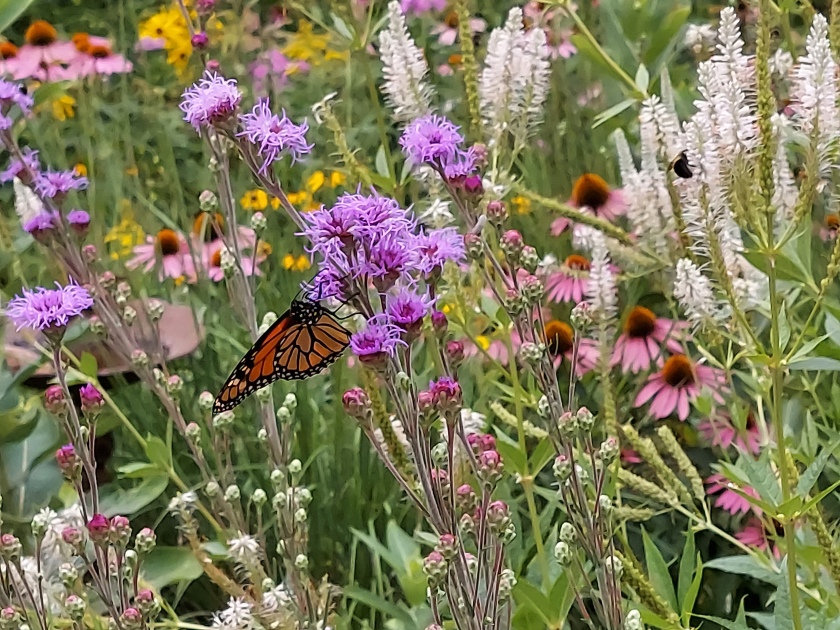
First there were four, then there were seven, now there are over ten monarch butterflies playing tag in my yard. This has been going on for two months. Monarchs are passionate for meadow blazing star (Liatris), and they get excited when the blazing star is blooming. Watching them makes one happy.
Monarch butterflies love blazing star!
Our world is in crisis and we need to find ways to lessen stress on our Earth. We know droughts, incredible heat, fires, floods, and smoky air are causing people, trees and wildlife to move to safer places or even die. Human behavior has helped to create this awful situation, and new paradigms are needed to lessen our carbon footprint. We already know that the world needs us to drive less, use less water, eat less meat, buy less, and reduce our plastic footprint.
What can we do more of that is actually good? Making a healthy change to your yard by planting native plants is a positive action you can take. Deep-rooted native plants are a win-win for our earth! They do not need chemicals and they do not need watering.
The native plants growing in my yard have produced way beyond my expectations during this harsh summer environment. Because deep-rooted plants don’t need to be watered and don’t use chemicals they create a healthier environment, and an important way to help our Earth. Planting earth friendly plants will bring more birds and butterflies to visit your yard. A pollinator garden brings joy many months of the year, but especially in July and August when the pollinators are crazy over nectaring plants.
How do you create this healing place for yourself and the birds and butterflies in your neighborhood? Remove some hostas and turf grass and replace them with native deep-rooted plants. You can create your own eco-system of life in your own yard. Start simple!
Start by planting some milkweek and bee balm
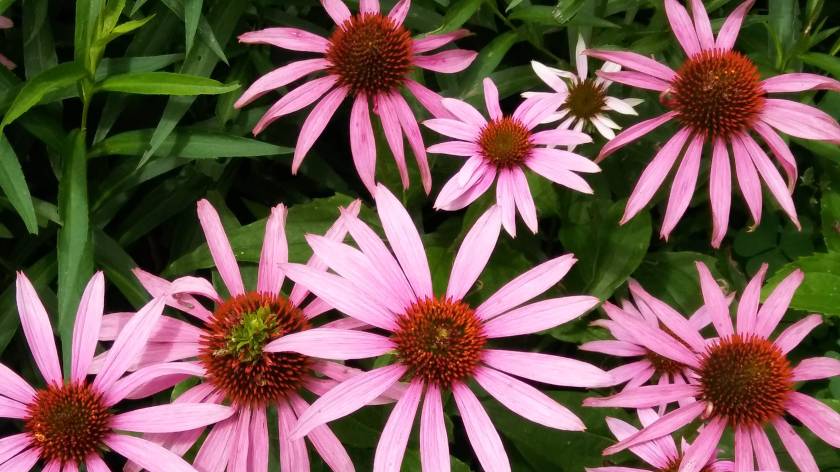
and purple cone flowers.
Deep rooted plants don’t need to be watered
Native gardens are an eco-system of their own creating food and joy for pollinators and humans alike! Create your own escape from the world by using deep-rooted plants to invite birds, butterflies and other wildlife into your space. Many birds raise their babies on the insects and caterpillars they find in the pollinator garden. Birds eat seed from the native plants all year. The goldfinch are already eating away on the bee balm, cone flowers and brown eye Susan.
Cardinal flowers will bring humming-birds to your yard, but cardinal flower is not drought tolerant.






 Health4earth