Something for you to watch on Plastic-free Tuesday:
Category: climate change
The Cost of Bottled Water
We are at the end of World Clean Up Month. As we pick up trash and works to keep our Earth clean, I always wonder, “What can we all do to keep the Earth cleaner and healthier?”

Bring your reusable water container.

My reuseable lunch containers
Today I walked by a car that had it’s back seat full of bottled water, and too often I see people with grocery carts full of bottled water. Why not purchase a large reusable container and fill that at a store? You could save hundreds of plastic bottles from ending in the landfill and live a more sustainable life.
I have confidence in our public water supply. I know where I live it is safe!
What are the costs of bottles water to our environment? A study done in Spain answers this question. Recycling and water in every community is different so we can’t make big generalizations, but in the United States recycling of plastic is only 9 tp 11% which makes bottled water awful for the environment. Also, the production of plastic uses fossil fuels and pollutes our air.
The study found that the environmental toll of bottled water was 1,400 to 3,500 times higher than that of tap water.
Another problem with bottled water is that companies like Nestle take free public water from aquifers to bottle and sell to the public. This is happening on Lake Superior right now (Lake Superior is not for sale). What a racket! Maine has passed a law to make companies responsible for recycling their products instead of the taxpayers. Read about it here Maine Will Make Companies Pay for Recycling. Here’s How It Works. – The New York Times (nytimes.com)
Read the Spain study here:
What Is the Environmental Cost of Bottled Water? – EcoWatch
https://www.lakesuperiornotforsale.com/home
https://www.plasticpollutioncoalition.org/blog/2021/9/10/watch-story-of-plastic Watch the excellent documentary, The Story of Plastic.
September Peace
Being kind to others, and being kind to the Earth are actions for self-care!

The best weather of the year!
September is a huge leap from August. It is the end of meteorological summer, and after too much extreme weather, fires, flooding and a sad pandemic, many are ready to hope for a better month. Actions for Happiness ideas are below.
September has some of the best weather of the year, and it is a perfect time to be outside watching for changes and appreciating the beauty of each day. It is a big month for bird and butterfly migration.
The Actions for Happiness group has ideas below for September self-care. Biking or walking are the ultimate in self-care. I challenge you to have outside time every day in September.

Take three breaths for peace
We can’t control the violent weather, but we can work for peace. On your daily walks, I hope you will take three deep breaths for Peace. Collective actions for peace are good self-care. If we all imagine a more peaceful world the earth will be become more peaceful and more kind.
Ideas for September self-care:
I wish you a September of peace and kindness!

Pollinator Passion
“Nature is a way to escape to a healing place!” John Caddy
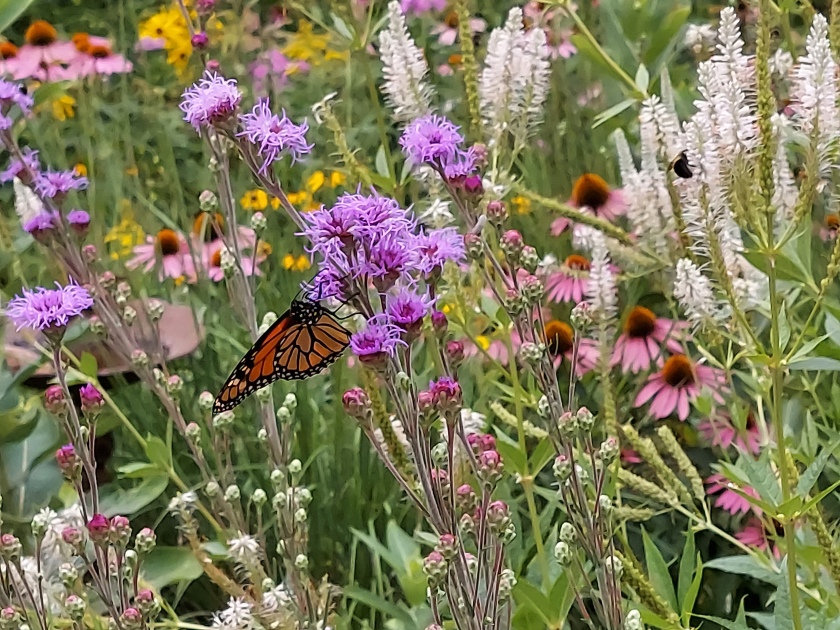
First there were four, then there were seven, now there are over ten monarch butterflies playing tag in my yard. This has been going on for two months. Monarchs are passionate for meadow blazing star (Liatris), and they get excited when the blazing star is blooming. Watching them makes one happy.

Monarch butterflies love blazing star!
Our world is in crisis and we need to find ways to lessen stress on our Earth. We know droughts, incredible heat, fires, floods, and smoky air are causing people, trees and wildlife to move to safer places or even die. Human behavior has helped to create this awful situation, and new paradigms are needed to lessen our carbon footprint. We already know that the world needs us to drive less, use less water, eat less meat, buy less, and reduce our plastic footprint.
What can we do more of that is actually good? Making a healthy change to your yard by planting native plants is a positive action you can take. Deep-rooted native plants are a win-win for our earth! They do not need chemicals and they do not need watering.
The native plants growing in my yard have produced way beyond my expectations during this harsh summer environment. Because deep-rooted plants don’t need to be watered and don’t use chemicals they create a healthier environment, and an important way to help our Earth. Planting earth friendly plants will bring more birds and butterflies to visit your yard. A pollinator garden brings joy many months of the year, but especially in July and August when the pollinators are crazy over nectaring plants.
How do you create this healing place for yourself and the birds and butterflies in your neighborhood? Remove some hostas and turf grass and replace them with native deep-rooted plants. You can create your own eco-system of life in your own yard. Start simple!

Start by planting some milkweek and bee balm
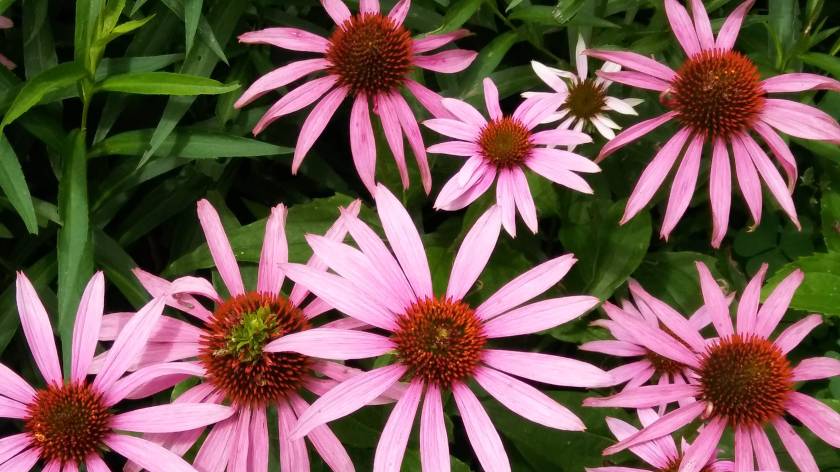
and purple cone flowers.

Native gardens are an eco-system of their own creating food and joy for pollinators and humans alike! Create your own escape from the world by using deep-rooted plants to invite birds, butterflies and other wildlife into your space. Many birds raise their babies on the insects and caterpillars they find in the pollinator garden. Birds eat seed from the native plants all year. The goldfinch are already eating away on the bee balm, cone flowers and brown eye Susan.

Cardinal flowers will bring humming-birds to your yard, but cardinal flower is not drought tolerant.
Reading list:
Study: Birds Are Linked to Happiness Levels – EcoWatch
Wild Ones Introduces Free, Native Garden Designs – Wild Ones: Native Plants, Natural Landscapes
Earth Overshoot Day Moves Forward By Nearly a Month – EcoWatch
How Non-Native Plants Are Contributing to a Global Insect Decline – Yale E360
Could Las Vegas’s Grass Removal Policies Alter the Western US Drought-Scape? | Sierra Club
Pollinator-Friendly Alternative to Hosta and Daylily – Monarch GardensCornus alternifolia Pagoda Dogwood | Prairie Moon Nursery
Weed garden wins RHS gold at Tatton Park flower show – BBC News
Soft Landings – Bee and Pollinator Books by Heather Holm (pollinatorsnativeplants.com)
Every Action Matters

Personal responsibility is needed for clean air.
This has been an unusual summer in an unusual world. Wild fires, pandemic. drought and excess heat dominate the conversation and the media. Many now check the morning air quality just like they check the weather. A local weather expert says there is no normal anymore. In Minnesota and Wisconsin we are used to fresh Canadian air, but more and more we are getting dirty wildfire smoke!
Many of us have no idea how we should change our behavior when the air quality is poor. Lawn mowers, leaf blowers, fire pits, and car trips continue to pollute the already dirty air. Hennepin County has some suggestions below.
Dirty air can make cases of Covid-19 and other respiratory diseases much worse. Be careful, and wear a mask!
I am a firm believer in community health and working together for healthy communities. We can all take more personal responsibility for clean air and clean water. Many minority communities deal with polluted air on a daily basis, and have lived with bad air for many years. Wildfires don’t discriminate like chemical plants, hazard waste dumps, and garbage burners. We all experience the smoky air, and see what breathing is like in other polluted places. Clean air is necessary for everyone, do your part!

Our actions count, make them positive!
The largest county(Hennepin) in Minnesota posted ideas to manage bad air days.. I think it is worthwhile.
Below is from Hennepin County:
Stay healthy during air quality alerts
In July, the Twin Cities area experienced air quality alerts due to an increase in fine particles from Canadian wildfire smoke. This made the air unhealthy for sensitive groups, which includes those with asthma, heart or lung disease, older adults, children, and people doing extended physical activity outside.
Stay healthy
Everyone should take precautions when the air quality is unhealthy:
| Take it easy, listen to your body, and limit, change, or postpone your physical activity. Stay away from local sources of air pollution, like busy roads and wood fires, if possible. If you have asthma, follow your asthma action plan and keep quick relief medicine handy. |
Reduce pollution
There are also steps people can take to reduce pollution to avoid contributing more to unhealthy air quality. These include:
| Reduce driving by combining trips, avoiding unnecessary idling, carpooling, and walking, biking, or taking public transit. Postpone backyard fires. Postpone the use of gasoline powered lawn and garden equipment. If possible, invest in electric lawn equipment. Learn more about air quality and how to stay healthy during poor air quality days on the Hennepin County Climate Action website. |
Minnesota’s air quality is poor. Here’s how to stay healthy on bad air days. | MinnPost
Wildfire smoke, poor air quality taint Minnesota summer (sahanjournal.com)
5 Big Takeaways From the New UN Climate Report (gizmodo.com) 5 Big Takeaways From the New UN Climate Report (gizmodo.com)
‘Nowhere to run’: UN report says global warming nears limits – StarTribune.com
A Simple Solution
Do you love clean air? Are you curious? Do you live in a city? What does your city need to do to improve it’s quality of life? This is simplistic, but it is something I believe in, and I loved this solution for the problems of urban living. City living can become safer and healthier if we would all walk more.

Urban living is safer and healthier when we walk more!
When is the last time you walked to the store, a coffee shop, or a park near you? How about walking to a meeting the library, or to a friend’s house? Do you need more exercise and more time outside?
walk walk walk
This ancient solution, walking, has solved the problems of cities for thousands of years. Urban life can become much better if people get out and walk more. I think communities would be safer and healthier! A recent study from Wisconsin shows walking more can be the critical difference leading to mental, physical and community health. One Centuries-Old Trick Can Solve Your City’s Problems | streets.mn
As a person who walks to almost everything I do, I am passionate about safe walking, and hope you will become a walker too. Start by walking to your nearest park as often as you can. Next, choose something close by, and make a habit to walk instead of driving. Leave your phone and music at home or in your pocket, pay attention, and discover something that you hadn’t seen before. What do you see? You will like it and feel better too.
Urban planners need to do better to make cities walkable. Sidewalks need to be free of holes and bumps. Some streets need to be designated for walkers, and an extra effort needs to be made so street crossing is safe. Law enforcement needs to enforce the laws to keep all pedestrians safe, and all drivers need to be alert and stop for stop signs. One urban planner I talked to wanted to take out stop signs, another is obsessed with putting bikes on the sidewalk. We must do better!

Pay attention to pedestrians
One Centuries-Old Trick Can Solve Your City’s Problems | streets.mn
Twin Cities get serious about crosswalk etiquette – StarTribune.com
Paris, Barcelona and Vienna are implementing policies to discourage car traffic and favor pedestrians and cyclists. The French capital aims to ensure residents have all necessary services within 15 minutes by foot, bike or public transit. Barcelona is restricting traffic to major roads, while Austria this year is rolling out nationwide access to public transport for a flat annual fee of 3 euros ($3.60) a day. Read more: A 15-Minute City Without Cars or Commutes Emerges as New Utopia
“Today, we are able to breathe again”
Philonise Floyd, George Floyd’s brother
“More than four in ten Americans breathe unhealthy air, with a disportionate impact on people of color” Paul Douglas
Last year on Earth Day I wrote how happy I was that because so many were staying home during the pandemic our air was cleaner. I loved it! This year we have moved to backward mode. Again exhaust fills our air. Many have breathing issues and dirty air makes their health difficult. What can we do different as we recover from the Covid pandemic and the murder of George Floyd? Let’s work so we all experience healthy breaths of air.
I am a firm believer that awareness helps people to take responsibility to do better. That is what this blog is about. So what bugs me, and what can we all do better? We need to have a better awareness of how we pollute the air what black and brown people experience just a few blocks away.
Many idle their cars in on my street in South Minneapolis as they read and talk on their cell phones. They sit in parking lots with their engines running, polluting everyone’s air. I don’t get it? Turn off your engine, save gas, and make the air cleaner for all!
Another rage is yard pit fires, Yuck, they pollute our air!
Million of tons of plastic end up in our landfills and oceans. Have you thought of how the production of plastic harms our air? Chemical plants making plastic are enormous contributors to air pollution, and often they spew chemicals polluting poorer communities. Also, some cities have garbage burners burning plastic polluting neighborhoods of people without power and without a voice. Plastic pollution is a social justice issue. Maybe if we think of plastic pollution/air pollution when we purchase plastic items we can say, “No plastic!”
See the story of plastic: The Story of Plastic (animated short) – Story of Stuff
This year for Earth Day, think of ways you might be causing air pollution: Turn off your car engine, drive less, limit yard fires, and say “No!” to single-use plastic.
We can create sustainable communities where we can breathe and live healthy lives. Let’s come together, become more aware, and work for cleaner air for all!
Reading and watching list
Watch Story of the Bottle! – Greenpeace
It’s Earth Month
Welcome to spring and the marvelous month of April. Earth Day is on April 22, and Arbor Day is on April 30. What can we all do to make April special? Small actions by many can make a big difference. So how can we all make a daily difference? Whether you have meatless days, pick up litter, leave your car at home, plant for butterflies or go plastic-free, make everyday Earth special.

Everyday Is Earth Day
By Kelly Roper
Every day is earth day,
Or at least it should be.
We should take steps every day
to save our planet, don’t you agree?
Try walking when it’s practical,
And skip driving a car.
It will help cut down emissions
And raise air quality by far.
Reuse, renew, recycle,
Think of how much you throw away.
Our earth can only hold so much trash,
One day there’ll be the devil to pay.
And when it comes to littering,
It’s not enough to clean up after yourself.
Leave places better than you find them,
And pick up litter left by someone else.
Don’t spray your garden with pesticides,
Protect the birds and the bees.
Choose natural ways of deterring pests,
That won’t carry poisons in the breeze.
These are easy things we all can do,
To protect the earth for future generations.
If we continue to ignore all the warning signs,
We’ll face sad and irreversible ramifications.


Reading List:
Climate Activist Spends More Than Year Picking Up Trash – EcoWatch
U.S. lawmakers target plastic pollution, producers in new legislation | Reuters
Butterfly: A Life | National Geographic – Bing video
How to Attract Butterflies (joyfulbutterfly.com)
Butterfly Plants: 16 Plants To Turn Your Backyard Into A Butterfly Paradise (bloomingbackyard.com)
Water: How to Stop Undervaluing a Precious Resource and Be Ready for the Future – EcoWatch


March Motivation

May March sunshine on your shoulders make you happy!
Happy March! Be kind to the Earth, be kind to yourself, and be kind to others! The Actions for Happiness calendar ( below) has many good suggestions to be more mindful and spread kindness.
March brings me joy. The longer days and the hope of spring are motivators to get outside and notice the changes, even if it is just melting snow. Everyday the outdoor world is waiting to be explored, your own neighborhood is perfect. Even 5 minutes of mindful observation will lighten your mood. Breathe, smell the earth, let the sun, rain and snow tickle your face, touch the wind, talk to the trees, hear the sunrise/night fall, smile and be kind.
This March pay attention to how you can reduce your carbon footprint: Can you reduce idling your car or drive less? Can you eat less meat and waste less food? How can you reduce the waste and plastic you generate? Can you buy less things and be a smarter consumer? Just doing a little bit can make a positive difference. Thank you and good luck!
Reading List:
Embrace Winter challenge: Go bird-watching or stargazing – StarTribune.com
Making ourselves worthy of our vaccine – StarTribune.com
UN Releases Scientific Blueprint to Address Climate Emergencies – EcoWatch
Sounds of Silence: The Extinction Crisis Is Taking Away the Earth’s Music – EcoWatch
Enjoy many good suggestions below to have a Mindful March:

The Challenge of Plastic

Covid-19 has been a plastic disaster. As we climb out of this abyss we must take single-use plastic seriously. We also need to hold companies accountable for bad packaging.
Why as taxpayers and citizens are we paying the price of this environmental disaster of plastic while the creators of this packaging have no responsibility? The landfills in the county where I live are full, and plastic trash can last for hundreds of years, maybe forever! What are the manufacturers of this plastic thinking other than profit? As consumers we are also at fault. If we keep buying this plastic packaging they will keep making it!

How can we all reduce our landfill trash? Surveying my garbage I find I have way too much plastic that cannot be recycled, and most of it is # 7 plastic that cannot be recycled. Why would companies use plastic that can’t be recycled? I decided to ask them. I sent an emails or telephoned Wyman’s Blueberries, Bob’s Red Mill, Morning Star and Gardein. A few companies admitted they wished their packaging was better, but it was a freshness and a cost issue to stay competitive. What about the costs to the environment and our health?
#7 plastic is a mixture of different plastics and it is designed to make it hard to know what it contains. It can contain harmful chemicals like BPA. Don’t purchase it, and don’t purchase any plastic that can’t be recycled!
Model a new way forward: “When we use disposable items, we send a message: this is what we want, keep it up, make more of this. When we refuse, and choose reusable, we model another way forward. Our choices can make a difference. Let’s make them count!” PlasticfreeTuesday
Also choose reusable masks and gloves!
Bob’s Red Mill was the most disappointing of the companies I contacted. They sell lots of products, many that are hard to find, and have a monopoly on some products. Bob’s has a trusted reputation of being healthy and sustainable. I am sad they use awful # 7 packaging, and at our house we won’t purchase their products or any #7 plastic until their packaging improves.

The good news is that by being a smarter shopper it is possible to find items that are packaged in recyclable #4 plastic. These #4 bags need to be dropped off at grocery stores for store recycling. They should not be placed with your normal plastic recycling because they disable the sorting machines.

Lets hold plastic producers accountable and avoid harmful plastic. It is always best to reuse bags and containers when possible, but sadly that often is not an option. However, with new awareness we can do better, one plastic item at a time.
Reading list:
Tips & tricks for grocery shopping with less waste (plasticfreetuesday.com)
Virginia moves closer to ban plastic foam containers | Environment | rappnews.com
Action item: Can you join me and take action demanding President Biden act on plastics? Click here: https://actionnetwork.org/petitions/president-biden-be-a-plasticfreepresident?source=email&