A month ago I spent a couple of weeks in Germany, and was I impressed! Other Americans I talked to shared my thoughts of awe with Germany. First they take care of their infrastructure. They maintain their roads, trains, bike lanes, public transport, even restrooms reach a high standard. As I enjoyed riding trains through the countryside, I saw many solar farms and some wind farms. Renewable energy has overtaken coal consumption in Germany.
Dresden Bohnhof
There is no litter in Germany. A twenty-five cent deposit is charged on plastic bottles. Germany leads the world in recycling. It’s just natural for Germans to be good to the Earth, and it is hopeful that when you do things right it does lead to success. Yahoo, awesome Germany!
Twenty-five cents for returned plastic bottles
More good news stories:
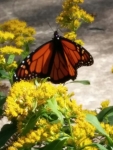
** Oklahoma has changed their mowing along highways to help the monarch butterflies.
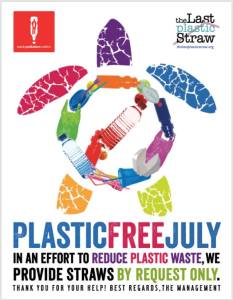
** Starbucks and Seattle are ending their consumption of plastic straws, and Penzance, Great Britain has become a plastic-free town.
** California has already made their green energy goals for 2020.
It makes me so happy when butterflies dance along as I walk the road by my house. One day there were dancing sulfurs, another day monarchs, swallow-tail and white admirals. I was watching a northern pearly eye, it flew at me, and decided to sit on my hand for 10 minutes as I continued my walk. July is easy to see painted ladies, red admirals, wood nymph butterflies, checkerspots, fritillaries and many skippers. This is the best time of the year to see butterflies! Get outside and look.
Northern pearly-eye by wikimedia
Seeing butterflies is so much easier than seeing birds, but the birds sing their ”I love life” song? some of them must have raised their first family and ready to start again? Song sparrows, red starts, chickadees, chestnut-sided warblers, vireos, and white-throated sparrows seem to sing just for me. I sure appreciate their happy songs.
How can you have a plastic-free, vegan holiday celebration? There are now many good vegan hot dogs available! Eco Watch has four good suggestions for an eco-friendly Fourth of July. They have ideas to be plastic-free, how to eat vegan/vegetarian, ways to create less pollution, and how to choose the correct sun screen. Read them here.
To their list I would add composting of your food waste, and controlling your noise pollution!
Yahoo, jump into July! We are half-way through 2018, so enjoy July and find extra time to enjoy the outdoors. Action For Happiness has a new July calendar. Always add a daily outdoor activity for your happiness. Load the Action for Happiness July calendar here.
It’s July and, yes, many places on Earth are hot, but I hope you still can get outside for walks, bike rides, or just sitting and listening. Appreciate the Earth’s amazing diversity and beauty this July. Will our hot temperatures create more climatarians, thinking about how our actions affect the earth as we consume, eat, drive around, travel and waste? A climatarian is aware of their complete footprint on Earth. Maybe in July, strive for #PlasticFreeJuly #ChemicalFreeJuly or #nofoodwasteJuly.
July happiness is being kind to yourself and others, being kind to our earth, and spending time in nature.
A song/poem for July
Sunshine on my shoulders makes me happy Sunshine in my eyes can make me cry Sunshine on the water looks so lovely Sunshine almost always makes me high
If I had a day that I could give you I’d give to you the day just like today If I had a song that I could sing for you I’d sing a song to make you feel this way
Sunshine on my shoulders makes me happy Sunshine in my eyes can make me cry Sunshine on the water looks so lovely Sunshine almost always makes me high
If I had a tale that I could tell you I’d tell a tale sure to make you smile If I…
If I had a tale that I could tell you I’d tell a tale sure to make you smile If I had a wish that I could wish for you I’d make a wish for sunshine for all the while
Sunshine on my shoulders makes me smile.John Denver
They dance not for me
Yet mine is their glee!
Thus pleasure is spread through the earth
In stray gifts to be claimed by whoever shall find;
Thus a rich-loving kindness, redundantly kind,
Moves all nature to gladness and mirth.
What can you do to help our birds, bees and butterflies? Can you plant some milkweed or other native plants? Can you become aware and reduce the chemicals you use? Can you learn about neonicotinoids and be sure you never purchase plants that have been treated with them? For your information, neonicotinoids have recently been banned from use by the European Union.
Yesterday I had a mourning cloak, a painted lady, a red admiral, hummingbirds, and monarch caterpillars in my yard. Milkweed and native plants make a big difference for pollinators. I am not a fan of lists because experience is better, but here are some native plant lists to get you started: https://www.nwf.org/NativePlantFinder/About and from Audubon
Planting purple cone flowers, bee balm, black-eyed Susan and milkweed are easy ways to get started. After years of trying to get milkweed to grow, I now have swamp milkweed everywhere. It has reseeded itself and thrives in my yard. Also, common milkweed and butterfly weed have sprouted up, but only a few monarch butterflies. The few monarch butterflies have a big job ahead of them, and I am still hopeful we can get their numbers to improve! If everyone does a small part, it can make a big difference!
Below is a video from PBS about monarch caterpillars, enjoy!
I love the following stories of businesses, people, and governments doing the right thing for our Earth. These stories give me hope, and I hope they inspire you, too. Click on the links to read more of the articles.
** California will require solar on all new homes!
** Fabulous news on the plastic pollution front:
* The Chicago White Socks baseball team ban straws!
** Some really good business news…. General Mills is growing crops for their organic products that are organic, help the soil, and don’t harm water, regenerative agriculture.
** And more good agricultural news, the European Union has banned neonicotinoids which are so harmful to our bees and butterflies!
Hope for wildlife
Regenerative Agriculture. Regenerative Agriculture is a system of farming principles and practices that increases biodiversity, enriches soils, improves watersheds, and enhances ecosystem services
Action For Happiness has a new calendar for May. I Hope your May is meaningful, and that you get outside to do something you love everyday. Going for a walk, time in my yard, and peaceful bike rides make me happy. What outside activities make you happy? Enjoy!
The interviews and stories make for an interesting read.
The Great Lakes are the largest body of fresh water in the world. This is a review of the award-winning book, Death and Life of the Great Lakes, by Dan Egan.
The pristine Great Lakes had always been isolated from other bodies of water, but all this changed with the building of canals in the 1800s. Then in 1959 the Saint Lawrence Seaway opened. This is a riveting account of what has happened to the Great Lakes and other lakes in the United States and Canada since the Great Lakes became an avenue of world commerce and transportation.
Death and Life is a must read for individuals that care about the quality of our water, fishermen and women, and every environmental decision maker. I was thrilled my local book club picked it to read, and excited when the New York Times/PBS Book Club chose it as well.
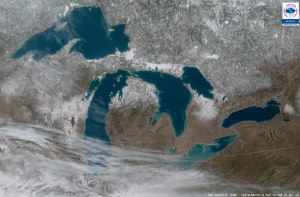
Lake Superior, Lake Michigan, Lake Huron, Lake Erie, and Lake Ontario make up the Great Lakes on the border of the United States and Canada. Photo: National Weather Service, Buffalo
The author, Dan Eagan, a reporter for the Milwaukee Journal Sentinel, has thoroughly researched and interviewed many of the decision makers and citizens involved. Why did they make the decisions they did? I was surprised how many of them were still living to tell their stories and defend their decisions. He has put their stories together to tell an interesting narrative.
Why would species from the Black Sea and Caspian Sea thrive in Lake Michigan? We have learned so much during the past thirty to fifty years about invasive species. I remember how surprised I was when I first learned about invasives. A new world opened! The learning curve has been steep for us, and even if you don’t read this book I encourage you to read about invasive species to learn the harm they do. Eagan delves into the sea lamprey, alewives, zebra mussels, coho salmon, Asian carp, and others that have thrived in this new environment, the Great Lakes, without any predators to control their numbers. Then there are the native lake trout that are native to the lakes, but they are too boring??
Fascinating was the Great Black Swamp that filtered run-off and helped keep Lake Erie clean. Like so many of the wetlands and swamps of the past, our ignorance couldn’t understand their purpose, so drainage began and we have new fertile farmland. Today the farm run-off creates the perfect conditions for toxic algae blooms threatening the drinking water taken from Lake Erie. Interesting stories continue as Egan interviews farmers, and those working to mitigate the effects of farm run-off.
The summer of 2017, a very rainy summer on Lake Superior, I was surprised by reports that for the first time Lake Michigan had better water quality than Lake Superior. The high water level of Lake Superior and the run off from the streams had caused a rusty-brown lake. You will have to read Dan Eagan’s book to discover why Lake Michigan now has cleaner water, and if this is a good thing?
Dan Egan leaves me hopeful. I think he believes, as do I, the earth is capable of healing itself to some extent if left alone to find its ecological balance. It is hopeful that Lake Huron has begun to heal, and that the white fish are adapting to eat zebra mussels. I hope a 10 year sequel is on the writing-table soon.
And finally a quote from the book, “A thing is right when it tends to promote the integrity, beauty and stability of the biotic community.” Aldo Leopold
A link to Dan Egan’s appearance on the PBS NewsHour:
“Huge news out of the UK today that major supermarket chains and companies are committing to a five-year plan to eliminate plastic pollution, especially in packaging. The video in this article also contains some great tips for personally moving beyond plastics.” Earth911
The Minnesota Legislature is debating preemption laws to keep cities from banning plastic bags and Styrofoam containers. Other legislatures throughout the country are prohibiting cities from banning plastic. In the United States we can’t depend on lawmakers to do what is best for our earth, so we must responsibly choose to do the right thing ourselves. See poster below. I would add to this Bristle poster, Never purchase products in Styrofoam.

 A month ago I spent a couple of weeks in Germany, and was I impressed! Other Americans I talked to shared my thoughts of awe with Germany. First they take care of their infrastructure. They maintain their roads, trains, bike lanes, public transport, even restrooms reach a high standard. As I enjoyed riding trains through the countryside, I saw many solar farms and some wind farms. Renewable energy has overtaken coal consumption in Germany.

 monarch butterflies.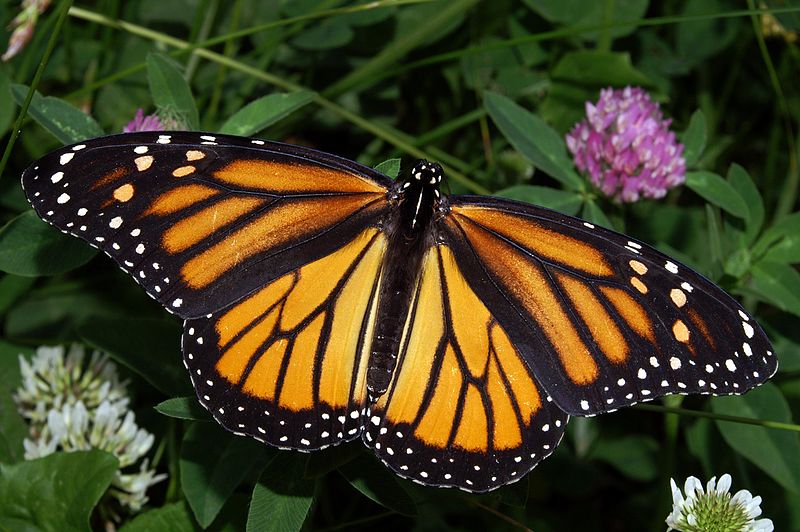






 W
W