In a world full of fear, be courageous. In a world full of lies, be honest. In a world where there is little caring, be caring. In a world full of copies, be an original. Because the world sees you. Because the world hopes for you. Because the world can be inspired by you. Because the world can get better because of you. Our own life is our message. ~ Thich Nhat Hanh ~ ✨️❤️✨️
“I have the power yo make me happy or unhappy. I can choose what it will be!” Dalia Lama
These are the results of this year’s World Happiness survey. The United States fell to 24th behind Saudia Arabia.
This year’s findings include:The Nordic countries retain the top spots in the world happiness rankings, Finland is No.1 (again!), followed by Iceland then Denmark; Costa Rica has jumped to 4th place. Young people’s happiness is falling in English-speaking countries. In places like North America and Western Europe, young people are significantly less happy than 15 years ago, unlike most of the world, where youth wellbeing has improved. Heavy social media use is linked to lower wellbeing. On average, those who use social media for longer periods report lower life satisfaction than light users. Not all screen time is equal. Activities like messaging, learning, and creating content are linked to higher wellbeing, while passive scrolling, gaming, and “browsing for fun” are linked to lower wellbeing. How social media is designed really matters. Platforms that encourage connection tend to support happiness, while those driven by algorithms, influencers, and comparison tend to harm it Many people feel ‘trapped’ using social media. A lot of users say they’d actually prefer social media didn’t exist, but they keep using it because everyone else does. Connection in real life matters far more. Feeling a sense of belonging (e.g. at school or in community) has a much bigger impact on happiness than reducing social media use alone.
The research is clear – we need to prioritise connection and community over scrolling and disconnection.
If you’re coming to Minnesota, wears some flowers in your hair!
An English family, the Marsh Family, wrote a song for Minnesota. See them sing below. Thank you for the support. People living in Minnesota are being attacked by their own government. The number one job of government is to keep people safe. What is going on?
A terrible situation in my city. Speak out for our democracy!
Lyrics to ‘Streets of Minneapolis’
Through the winter’s ice and cold Down Nicollet Avenue A city aflame fought fire and ice ‘Neath an occupier’s boots King Trump’s private army from the DHS Guns belted to their coats Came to Minneapolis to enforce the law Or so their story goes Against smoke and rubber bullets By the dawn’s early light Citizens stood for justice Their voices ringing through the night And there were bloody footprints Where mercy should have stood And two dead left to die on snow-filled streets Alex Pretti and Renee Good
Oh our Minneapolis, I hear your voice Singing through the bloody mist We’ll take our stand for this land And the stranger in our midst Here in our home they killed and roamed In the winter of ’26 We’ll remember the names of those who died On the streets of Minneapolis
Trump’s federal thugs beat up on His face and his chest Then we heard the gunshots And Alex Pretti lay in the snow, dead Their claim was self defense, sir Just don’t believe your eyes It’s our blood and bones And these whistles and phones Against Miller and Noem’s dirty lies
Oh our Minneapolis, I hear your voice Crying through the bloody mist We’ll remember the names of those who died On the streets of Minneapolis
Now they say they’re here to uphold the law But they trample on our rights If your skin is black or brown my friend You can be questioned or deported on sight
In chants of ICE out now Our city’s heart and soul persists Through broken glass and bloody tears On the streets of Minneapolis
Oh our Minneapolis, I hear your voice Singing through the bloody mist Here in our home they killed and roamed In the winter of ’26 We’ll take our stand for this land And the stranger in our midst We’ll remember the names of those who died On the streets of Minneapolis We’ll remember the names of those who died On the streets of Minneapolis
Lyrics to ‘Streets of Minneapolis’
Through the winter’s ice and cold Down Nicollet Avenue A city aflame fought fire and ice ‘Neath an occupier’s boots King Trump’s private army from the DHS Guns belted to their coats Came to Minneapolis to enforce the law Or so their story goes Against smoke and rubber bullets By the dawn’s early light Citizens stood for justice Their voices ringing through the night And there were bloody footprints Where mercy should have stood And two dead left to die on snow-filled streets Alex Pretti and Renee Good
Oh our Minneapolis, I hear your voice Singing through the bloody mist We’ll take our stand for this land And the stranger in our midst Here in our home they killed and roamed In the winter of ’26 We’ll remember the names of those who died On the streets of Minneapolis
Trump’s federal thugs beat up on His face and his chest Then we heard the gunshots And Alex Pretti lay in the snow, dead Their claim was self defense, sir Just don’t believe your eyes It’s our blood and bones And these whistles and phones Against Miller and Noem’s dirty lies
Oh our Minneapolis, I hear your voice Crying through the bloody mist We’ll remember the names of those who died On the streets of Minneapolis
Now they say they’re here to uphold the law But they trample on our rights If your skin is black or brown my friend You can be questioned or deported on sight
In chants of ICE out now Our city’s heart and soul persists Through broken glass and bloody tears On the streets of Minneapolis
Oh our Minneapolis, I hear your voice Singing through the bloody mist Here in our home they killed and roamed In the winter of ’26 We’ll take our stand for this land And the stranger in our midst We’ll remember the names of those who died On the streets of Minneapolis We’ll remember the names of those who died On the streets of Minneapolis
The progress to clean energy is hopeful in a world where it is difficult to be hopeful. The demand for electricity is soaring, and data centers are imposing an enormous load on our communities for energy. Unfortunately, some of our elected officials are pushing various types of burning as clean energy. They want to include the burning of garbage as a form of clean energy. Burning in any form from your backyard fires to burning garbage is NOT clean energy.
Today is the International Day of Clean Energy!
Today, let’s think positive and celebrate what is good and getting better!
Today, January 26th, is International Day of Clean Energy. Clean energy refers to electricity generated from sources such as solar, wind, geothermal and hydro that emit little to no greenhouse gas emissions.
The World Resources Institute has summarized the key statistics when it comes to clean energy in this article. The article highlights some positive news such as:
how clean energy is creating the majority of new electricity capacity
Investment in green energy is higher than fossil fuels
Growth in clean energy jobs
There are still challenges to overcome in the industry including distribution of investment and length of time to bring a project from ideation to production. But there is a lot of momentum behind green energy and it will be interesting to see how 2026 shapes up for it.
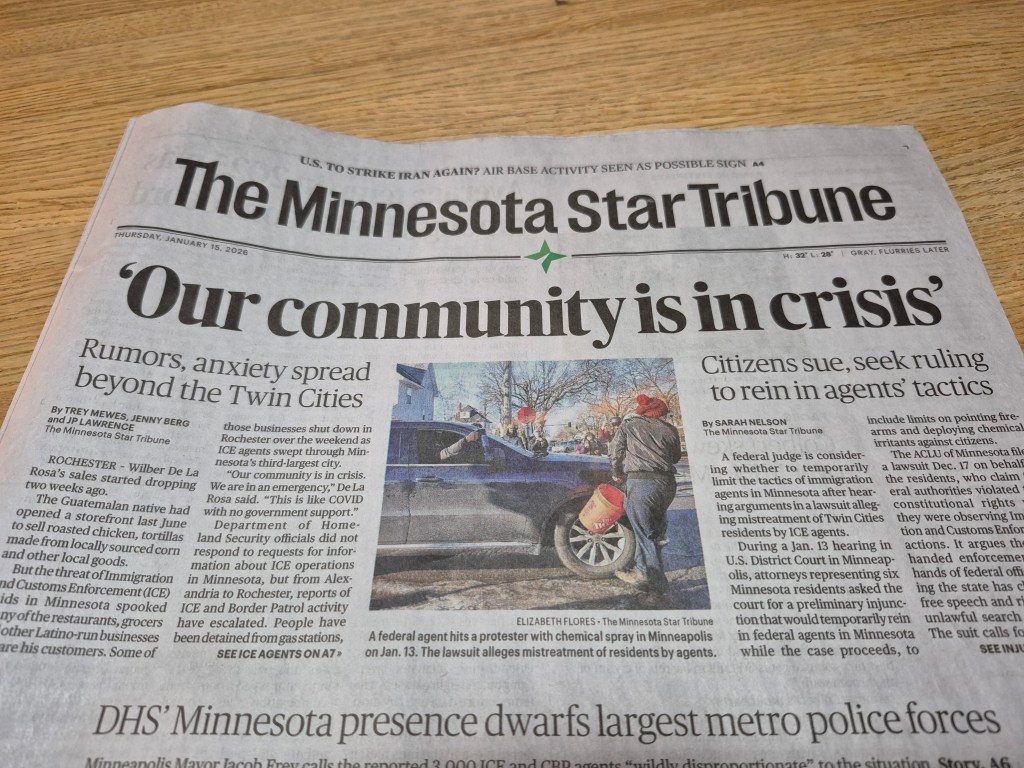
Our American government has created chaos and fear in Minneapolis and some parts of greater Minnesota. People living in the United States of America are disappearing.
My city is under seige from our own federal government. Our immigrants and people and children that aren’t white have gone into hiding. Last week students at one Minneapolis high school were pepper sprayed. Safety mandated our children not attend school, walk on the street or go to playgrounds. Many helpers are delivering food to families confined to their homes. Many helpers are also monitoring minority business and neighborhoods. doing what they can to keep everyone safe.
A city’s limit (From the New York Times) Minneapolis is on a knife’s edge. One week after a federal agent shot and killed Renee Good, aggressive arrests have enraged residents. The Trump administration has redoubled its effort to deport illegal immigrants, sending officers into residential neighborhoods and the parking lots of big-box stores in search of people to grab. They’ve also detained — and roughed up — several U.S. citizens, and social media is awash in viral videos of the confrontations.
Meanwhile, activists have sought to observe, document or impede the agents, Julie Bosman reports. On WhatsApp, neighbors watch out for immigration officers and run from their homes to shout at them. “It feels like our community is under siege by our own federal government,” State Representative Michael Howard, a Democrat, told The Times.
The encounters can be terrifying. My colleagues verified images circulating this week that show agents tackling a man at a gas station and shoving Elliott Payne, the president of the City Council. Payne told my colleagues that there were federal agents equipped with assault rifles and combat gear patrolling the streets, repeatedly unholstering their handguns. “It feels like a military occupation,” he said. Some of the stops go beyond ordinary law enforcement. In a few of the run-ins, you can feel the animosity building between federal officers and citizens they serve. One man The Times spoke to said he was glad that there were other people around to film his encounter with federal agents, which occurred after they rammed their car into his, forcing him to a stop.
He said he believed the presence of people with cameras had helped lead the agents to let him go. But as the crowd grew — the crowds always seem to grow now — and began to yell at the officers, he worried that the situation could tip over into something darker, something violent. “It makes them act different. NYT
Everyone needs to work to help our planet. So much leadership is needed!
A chance for other countries to lead. France, Germany, England, Italy, India?
U.S. leaves international climate agencies This week the United States announced it would be leaving 66 international organizations, agencies, and commissions which includes many related to climate change.
Among these is the UN Framework Convention on Climate Change (UNFCCC) which was adopted by all member nations in early 1990s and is considered the treaty which led to 2015’s Paris Agreement. The U.S. also previously announced its withdrawal from the Paris Agreement, which will officially take effect on January 20.
Also included are:
Intergovernmental Panel on Climate Change International Renewable Energy Association International Solar Alliance International Union for Conservation of Nature Intergovernmental Science-Policy Platform on Biodiversity and Ecosystem Services With these actions, the U.S. has further separated itself from other countries in the climate change space. Does its withdrawal give pause to the activities of other nations? Or will it motivate other countries to lead in this evolving space?
Start the day with hope. Spring will come! Collective positive energy can make things better.
All people matter!
Embrace a new year and each new day with hope!
The road is before us! It is a new day, a new beginning, And it is filled with hope.” Walt Whitman
Start each day with hope!
2025 has been a hard year. Wars are raging, too many die from gun violence, democracy is threatened, ICE is threatening communities, climate change brings storms, fires, drought and flooding. But we must move forward toward a new world. Our mental health is so much better if we start each day with hope and positive energy to make things better.
Below is from the NYT today:
While optimism is the belief that the future will be better, hope is the belief “that we have the power to make it so,” said Chan Hellman, the director of The Hope Research Center at the University of Oklahoma. It is “one of the strongest predictors of well-being,” he said. It helps improve the immune system and aids recovery from illness. More hopeful people may actually grow taller than less hopeful people.
To cultivate hope, people need three things. They first need to be able to envision a better future, either personally or collectively. Second, they need the willpower or motivation to move toward that future. And third, they must be able to chart “a path from where they are to where they want to be,” he added.
How to be more hopeful There are a few ways, experts say.
People can set specific goals and then “begin brainstorming the pathways or road maps” to achieve them, ideally by writing them down, Hellman said. That can start small. “It is much better to set and focus on short-term goals rather than long-term, abstract goals,” he added.
That can often mean speaking more positively about other people. People gossip three times as much about the selfish things others do than about the generous things they do. To address that, an expert suggested “positive observation.” Share one story of something positive that you observed or did that day. The research finds that when you know you’re going to have to share something, you pay a lot more attention to it.
Lift every voice and sing Till earth and Heaven ring Ring with the harmonies of Liberty; Let our rejoicing rise, High as The list’ning skies, let it resound loud as the Rolling sea
This is the coolest newsletter. I hope you will subscribe.
The Daily Difference Newsletter
Join the Daily Difference, a newsletter to help everyone around the world in taking action and making a significant positive impact. It’s not too late. The earth needs passionate people like you to spread the word and create meaningful change.
Taking action to heal the planet doesn’t need to be overwhelming. It doesn’t need to be perfect. It just needs to happen. Take a moment today and be a difference […]
The International Union for Conservation of Nature’s (IUCN) Red List of Threatened Species is a report on the health of the world’s biodiversity. It is a comprehensive source of information […]
Negative climate stories in the United States often make the headlines – cancelling wind farm construction, accelerating oil and gas drilling, rolling back regulations on greenhouse gas emissions and air […]
In Canada, and in many other countries around the world, it is often Indigenous people leading the way in sustainability and stewardship of nature. The Heiltsuk Nation, on British Columbia, […]
In the United Kingdom, companies who make packaging are now having to pay as the Extended Producer Responsibility (EPR) has started its enforcement stage. What is EPR? It is based […]
Mihir Rao, an 18-year-old from Alberta, Canada, is helping other young people to learn how to influence decision-makers. Rao, who is also a winner of the 2025 I-SEA Youth Climate […]
This is from the Story of Stuff. I hope you will give it some thought and make thoughtful purchases for the holidays and all year. “This time of year, the pressure to buy more — and waste more — is everywhere. Black Friday doorbusters, holiday flash sales, limited-time offers: overconsumption during the holidays isn’t an accident. It’s by design.
And the consequences are massive. Americans generate 25% more waste between Thanksgiving and New Year’s — an extra one million tons of trash every week. From impulse purchases tossed by January, to mountains of packaging, the holiday season has become a pipeline of extraction, production, shipping, and disposal.
What we rarely see are the impacts hidden upstream. Most of a product’s environmental footprint happens long before it reaches your door — through rapid mining of raw materials, energy-intensive manufacturing, and global shipping emissions that fuel the climate crisis.
Fast fashion hauls and holiday overbuying only accelerate the damage. Every second, a garbage truck’s worth of clothing is landfilled or burned. Electronics, toys, gadgets, and seasonal “stuff” flood into toxic e-waste dumps around the world.” Story of Stuff
Trying to be more climate friendly with gift giving this year? This holiday gifting guide will help you get in the spirit while saving you money and deepening the meaningfulness of your holiday season.






 Health4earth